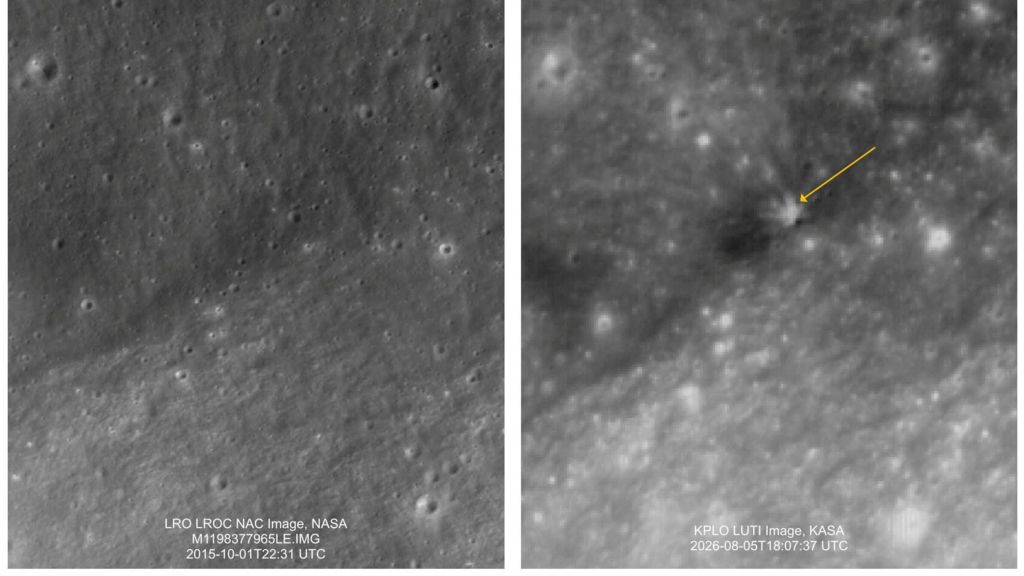
On Wednesday, a discarded upper stage of a SpaceX Falcon 9 rocket made an unplanned, high-speed crash into the lunar surface, and South Korea’s national space body has now released unprecedented imagery capturing the event. The Korean AeroSpace Administration (KASA) obtained new shots of the impact site from its Danuri lunar orbiter, pairing the post-crash photographs with earlier clear images of the same section of the Moon to document the collision’s effect. According to KASA’s official timing, the debris made contact with the Moon at approximately 06:35 GMT. SpaceX has publicly confirmed that the impact was never part of the mission’s original design.
This incident is the end of an 18-month uncontrolled drift for the 4,000-kilogram empty rocket stage, roughly the volume of a five-story building. The Falcon 9 launch that left the stage adrift took place from Cape Canaveral, Florida in January 2025, with the rocket’s core mission being to deliver two lunar landers toward their lunar trajectory. After completing the burn that sent the landers out of Earth’s orbit on their moon-bound path, the spent upper stage was left drifting in a wide looping orbit that crossed between Earth and the Moon. Over a year and a half, cumulative subtle gravitational pulls from the Earth, Moon, and Sun, combined with faint pressure from solar radiation, gradually altered the stage’s orbit. Astronomers tracking the debris calculated months ago that these small incremental shifts would eventually send the object crashing into the Moon at a projected speed of around 8,700 kilometers per hour (5,400 miles per hour), matching the final impact.
Even for dedicated amateur astronomers working with advanced professional-grade telescopes, the brief, faint flash generated by the collision was nearly impossible to detect, as the impact occurred during daylight hours for most populated regions of the globe. That has left large institutional observatories, including KASA’s orbiting lunar research platform, to collect and analyze the only usable data from the event. While the crash posed zero risk to human life or infrastructure on Earth, it has reignited longstanding concerns among astronomy and space experts about the growing crisis of uncontrolled space debris.
Matt Bothwell, an astronomer at the University of Cambridge, noted that near-Earth and cislunar space are growing increasingly crowded as commercial and government actors launch hundreds of new satellites and mission components every year. “It could feasibly be within a few decades that it’s actually quite hard to get past Earth’s orbit because space is so crowded,” Bothwell warned, highlighting the growing risk of catastrophic collisions that could render key orbital regions unusable for future missions.
Notably, the first-stage booster from the same January 2025 Falcon 9 mission is still in active, reusable service, and is scheduled to lift off on its 18th operational flight as early as August 10. The upcoming mission will carry 29 new Starlink internet satellites to low-Earth orbit, continuing SpaceX’s routine commercial launch cadence amid the debris discussion.