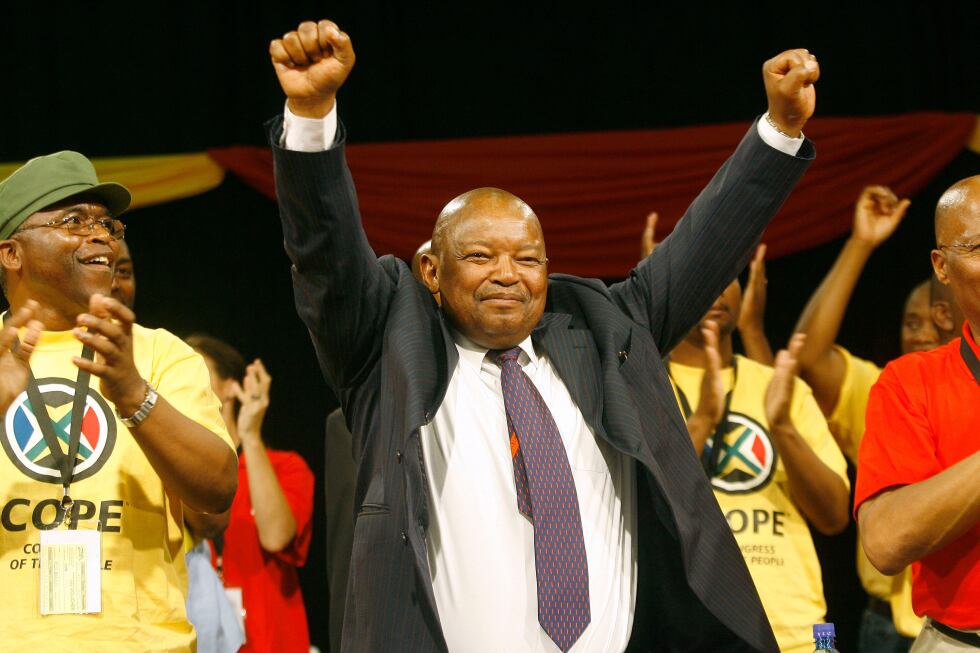
JOHANNESBURG — South Africa’s political landscape is in mourning following the passing of Mosiuoa “Terror” Lekota, the renowned anti-apartheid stalwart and former defense minister, who died at 77 after an extended illness. His political organization confirmed his demise on Wednesday, marking the end of an era for South African politics.
Lekota’s legacy as a formidable opponent of white minority rule was forged during his eight-year imprisonment on Robben Island (1974-1982), where he shared incarceration with Nelson Mandela and other legendary freedom fighters. His activism continued relentlessly even after his release, resulting in additional detentions for his unwavering opposition to apartheid.
Following South Africa’s historic democratic transition in 1994, Lekota ascended to significant leadership roles, serving as Defense Minister from 1999 to 2008 and occupying the national chairmanship of the ruling African National Congress. His political trajectory took a dramatic turn in 2008 when he severed ties with the ANC following the contentious removal of President Thabo Mbeki, who had previously lost the party presidency to Jacob Zuma.
In a bold political maneuver, Lekota established the breakaway Congress of the People (COPE) party, which achieved remarkable success in the 2009 elections by capturing over 7% of the national vote and securing 30 parliamentary seats. This schism substantially weakened the ANC’s electoral dominance, drawing away numerous disaffected members and officials.
Despite his monumental contributions to strengthening multiparty democracy, internal factionalism within COPE precipitated its gradual decline, culminating in the party’s failure to win any legislative representation in the 2024 elections. Lekota’s departure from active politics in 2025, prompted by health considerations, preceded the ANC’s own historic loss of parliamentary majority that same year.
Political leaders across the spectrum have paid tribute to Lekota’s enduring legacy. Bantu Holomisa, Defense Deputy Minister and opposition leader, praised Lekota for fundamentally transforming South Africa’s opposition landscape by establishing a credible alternative to ANC hegemony, noting that he and other ANC dissidents remained committed to the original principles of the liberation struggle.