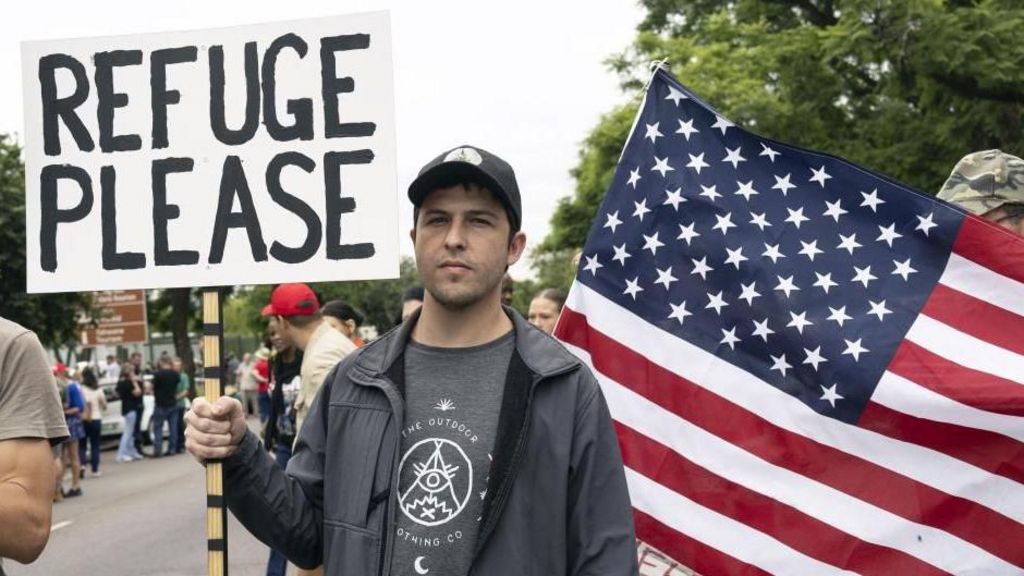
A significant diplomatic rift has emerged between the United States and South Africa following a contentious government raid on a refugee processing facility. The U.S. State Department issued a formal condemnation on Thursday, alleging that South African authorities had engaged in the harassment and intimidation of American officials during an operation targeting a center processing asylum applications for white South Africans.
The incident occurred on Tuesday when South African immigration officials conducted a raid that resulted in the expulsion of seven Kenyan nationals accused of working illegally within the country. The U.S. government subsequently accused South African authorities of publishing passport details of American diplomatic personnel, characterizing this action as ‘unacceptable’ and warning of potential ‘severe consequences’ for bilateral relations.
South Africa’s Department of Home Affairs has categorically denied these allegations, stating in an official response that no U.S. officials were arrested during the operation and emphasizing that the facility raided was not a diplomatic site. The department further asserted that South Africa ‘treats all matters of data security with the utmost seriousness’ and operates under ‘stringent legal and diplomatic protocols.’
This diplomatic confrontation occurs against the backdrop of the Trump administration’s controversial policy offering refugee status to members of South Africa’s Afrikaner community, whom the U.S. claims face persecution. While the administration has dramatically reduced overall refugee admissions from 125,000 to 7,500 annually, it has designated Afrikaners—descendants primarily of Dutch and French settlers—as a priority group.
South African authorities have expressed concern about apparent coordination between foreign officials and undocumented workers, noting that they have engaged both U.S. and Kenyan representatives to resolve the matter. The U.S. maintains that its refugee program operates within legal boundaries but has not directly addressed allegations regarding the Kenyan workers’ denied permit applications.
The tension reflects broader deterioration in U.S.-South African relations since President Trump took office. Earlier this year, Trump claimed—without substantiating evidence—that Afrikaners face ‘genocide’ in South Africa, despite statistics showing white farmers are not disproportionately targeted compared to black counterparts. The refugee program initiative followed South African President Cyril Ramaphosa’s signing of land reform legislation allowing, in limited circumstances, government land expropriation without compensation.
Approximately 50 Afrikaners have reportedly relocated to the U.S. via chartered flight, though total numbers remain unclear. The land reform issue remains particularly sensitive given that most privately owned farmland remains white-owned due to apartheid’s legacy, while the government faces pressure to redistribute land to black farmers.
Despite South Africa’s efforts to improve relations, including a high-profile delegation to the White House earlier this year, tensions escalated when Trump confronted Ramaphosa with allegedly misleading media depicting white persecution. Recent months have seen the U.S. boycott the G20 summit hosted by South Africa and exclude South African officials from meetings of the world’s largest economies.