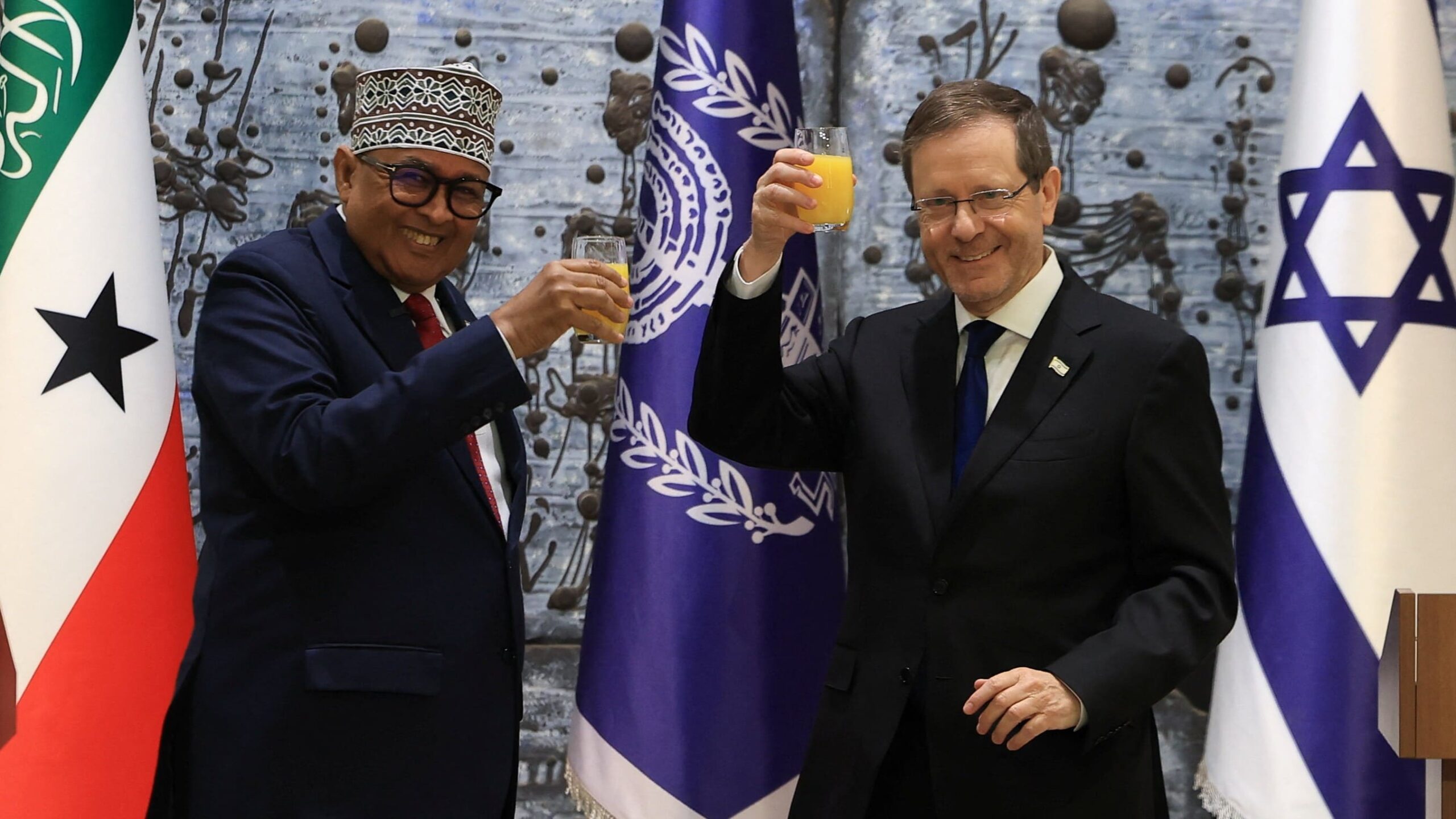
In a moment that marks a pivotal shift in regional geopolitics, Abdirahman Mohamed Abdullahi — popularly known by his nickname Cirro and serving as the president of the self-declared independent state of Somaliland — arrived in Israel on Sunday, making history as the first Somaliland head of state to conduct an official state visit to the Jewish nation. The trip comes roughly six months after Israel made a groundbreaking move to recognize Somaliland as an independent sovereign state, a step no other United Nations member state had previously taken.
Taking to the social platform X to share his first impressions after landing, Cirro expressed deep gratitude for the reception he received from Israeli President Isaac Herzog. He called the journey a once-in-a-generation milestone for the relationship between the breakaway East African territory and Tel Aviv. “For thirty-five years, the people of Somaliland have built a peaceful, democratic, and resilient nation. We asked the world: Do you see us? Israel answered first,” Cirro wrote in his public post, which was paired with an on-the-ground photo from his arrival. “Today, history is being written, and Somaliland stands ready to forge a shared future founded on friendship, cooperation, and mutual respect.”
According to reporting from Israeli daily newspaper Maariv, the two-day visit will see Cirro hold additional high-level meetings with Israeli Prime Minister Benjamin Netanyahu and Foreign Minister Gideon Saar, beyond his initial talks with Herzog. Israeli President Herzog struck a collaborative tone in his response to the visit, noting that both sides aim to expand joint work across multiple priority sectors. “We both seek security and stability in the region and in the Horn of Africa. We both see the importance of protecting maritime freedom,” Herzog stated.
To understand the full context of this historic encounter, it is necessary to outline Somaliland’s decades-long path to international recognition. The autonomous region in northern Somalia declared its separation from the rest of Somalia in 1991, following the collapse of the Siad Barre regime. To date, however, the United Nations, the African Union, and nearly every sovereign government across the globe still formally recognize the territory as an integral part of Somalia, leaving Somaliland’s independence bid isolated on the global stage.
That changed this past December, when Israel became the first UN member state to formally grant recognition to Somaliland as an independent country. Regional analysts have widely framed the move as a calculated step to advance Israeli geopolitical interests in the Horn of Africa and the Red Sea region. The territory sits just 30 kilometers south of the Bab el-Mandeb Strait, the critical narrow waterway that links the Gulf of Aden to the Red Sea — one of the world’s most vital shipping lanes for global trade.
A permanent Israeli foothold in Somaliland would place Israeli military and intelligence assets within very close proximity to Yemen’s Houthi movement, which has launched repeated attacks on commercial shipping in the Red Sea since late 2023. The Houthis have stated their attacks are a retaliation for Israel’s military campaign in Gaza against Hamas. For Israel, establishing a presence in Somaliland also advances a broader goal of countering the expanding influence of Iran and its regional allied network across the Red Sea and Horn of Africa, analysts add.
Israel’s alignment with Somaliland also deepens its existing close security and political partnership with the United Arab Emirates, which has long backed Somaliland’s bid for international standing. Back in 2017, the Somaliland government approved a UAE bid to construct a military base at the strategic Port of Berbera, a move Hargeisa hoped would bolster its case for global recognition. Since Israel granted recognition to Somaliland earlier this year, senior Somaliland officials have confirmed they have held discussions about hosting an Israeli military base on their territory — a reversal of earlier denials of any such plans from Hargeisa’s foreign ministry.
For Somaliland, the new partnership with Israel carries tangible potential benefits beyond the long-sought win of international recognition. In comments given to Reuters back in February, Cirro revealed that Somaliland expects to finalize a bilateral trade agreement with Israel in the near future, and has offered Israel exploration and extraction rights to its untapped mineral deposits as part of the broader deal. The breakaway region has also identified growing security cooperation with Israel as a key priority: after the United Nations partially lifted its long-standing arms embargo on Somalia in 2023, Somaliland has cited new growing security threats to its territory and has sought to strengthen its own military capabilities.