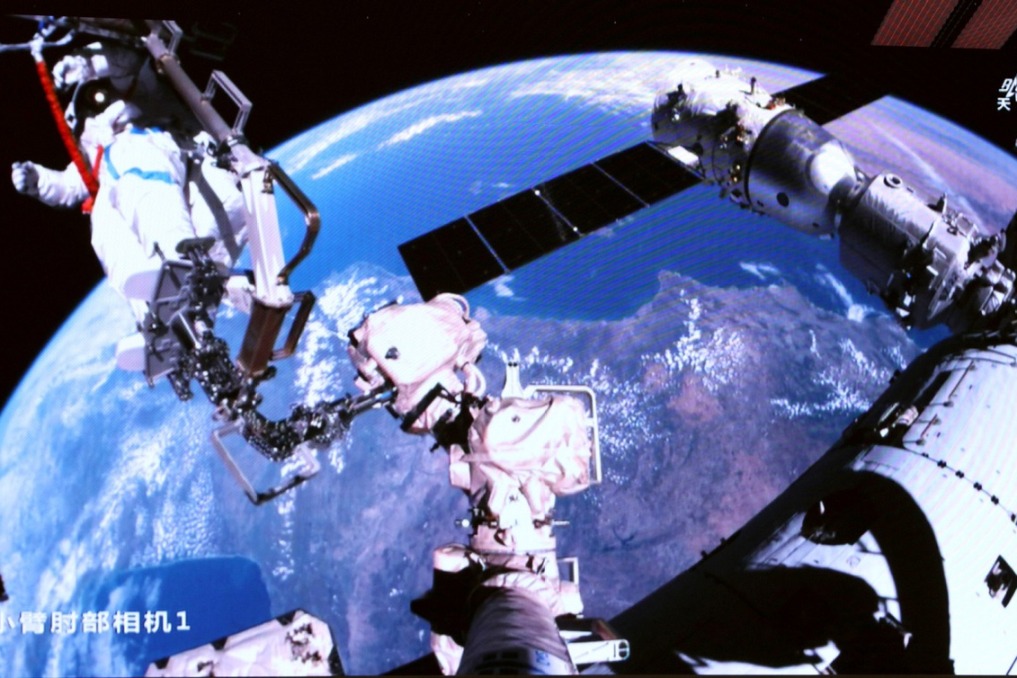
China’s ongoing human space exploration program reached a new milestone earlier this week, when the three-person Shenzhou XXI crew stationed at the nation’s Tiangong space station successfully wrapped up their third extravehicular activity, according to official announcements from the China Manned Space Agency.
The excursion, which concluded at 1:36 a.m. Beijing Time on Friday, saw mission commander Senior Colonel Zhang Lu and spaceflight engineer Major Wu Wu spend roughly five and a half hours operating outside the massive orbiting outpost before returning safely to the Wentian experimental module. The third member of the crew, payload specialist Zhang Hongzhang — a researcher from the Chinese Academy of Sciences — remained inside the space station throughout the spacewalk to coordinate operations and provide critical in-orbit support.
Working in tandem with ground control teams and leveraging the station’s robotic arm for assistance, the astronauts checked off every scheduled task on their itinerary, including the installation of protective shields designed to mitigate damage from orbital space debris and comprehensive inspections of extravehicular hardware.
This spacewalk carries special historical significance for China’s human space program: it marks the 27th extravehicular activity conducted by Chinese taikonauts overall, and it is the seventh spacewalk for commander Zhang Lu. With this milestone, the 49-year-old Hunan-born astronaut has become the new record holder for the most spacewalks completed by any Chinese astronaut. Zhang previously completed four spacewalks during his first mission, the six-month Shenzhou XV expedition that launched in November 2022.
The Shenzhou XXI mission is China’s 16th crewed spaceflight, and the trio has served as the 10th long-term resident crew aboard Tiangong, currently the only operational space station fully developed and operated independently by a single nation. The crew has now lived and worked in low-Earth orbit for more than five months, having arrived at the station on November 1, 2025.
Over the course of their stay, Zhang Lu and his crewmates have carried out a wide range of work, from cutting-edge scientific experiments in space life science, human physiology and microgravity physics to routine maintenance and operations. These routine tasks include in-orbit environmental monitoring, regular equipment checks and upkeep, and organization of cargo delivered to the station. The team has also completed required emergency preparedness training, including a full-system pressure emergency response drill and on-orbit emergency survival training, alongside all pre-deployment preparations for extravehicular activities.
In a surprise announcement included in the agency’s news release, officials confirmed that after comprehensive technical analysis and risk assessment, the Shenzhou XXI mission will be extended by approximately one additional month. The adjustment is designed to further test and validate key technologies required for long-duration human spaceflight, and to allow the crew to make full use of additional mission supplies and materials transported to the station by the uncrewed Shenzhou XXII spacecraft.
Shenzhou XXII launched in late November 2025 on an uncrewed resupply mission to Tiangong, dispatched after a window damage incident affected the return capsule of the earlier Shenzhou XX mission during its reentry. In addition to delivering critical replacement hardware, the spacecraft carried a large volume of additional mission supplies to support extended operations aboard the station.
Looking ahead, the CMSA confirmed that the Shenzhou XXI crew will continue carrying out their ongoing scientific research and technical tasks for the duration of their extended stay, advancing China’s growing body of knowledge about long-duration human spaceflight and orbital operations.