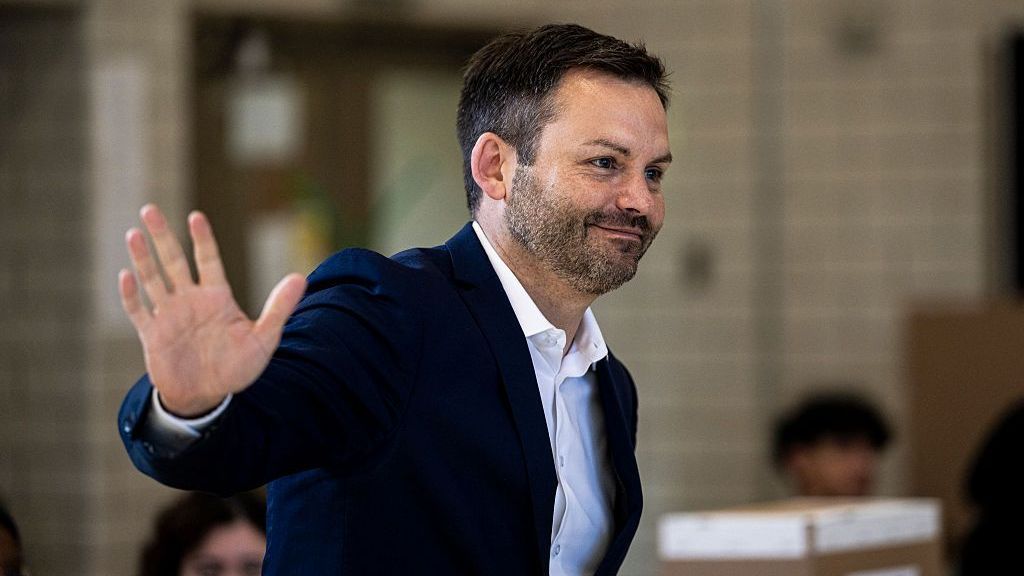
After a landmark provincial election in the French-speaking Canadian province of Quebec, the sovereigntist Parti Québécois (PQ) has claimed a narrow minority victory, catapulting party leader Paul St-Pierre Plamondon into the role of incoming premier. The win marks the PQ’s return to provincial power for the first time in more than a decade, ending the eight-year rule of the former Coalition Avenir Québec government and setting the stage for a new period of political friction between Quebec City and Canada’s federal government in Ottawa.
The outcome of Monday’s vote is already being framed as a major early test for sitting Canadian Prime Minister Mark Carney, who will now have to navigate rising tensions over divisive priorities that Plamondon’s party has laid out in its campaign platform. Most notably, the PQ has pledged to hold a third provincial referendum on Quebec’s full independence from Canada, following unsuccessful votes on separation in 1980 and 1995. Plamondon has confirmed that the vote will not be scheduled until U.S. President Donald Trump leaves office, which is currently set for 2027, putting the potential plebiscite on track to take place between 2029 and 2030. Public opinion polling shows only around 30 percent of Quebec voters currently support full sovereignty, but the pledge remains the PQ’s core ideological commitment.
The prospect of an independence vote in Quebec comes as a second separatist vote is set to be held in the province of Alberta later this month, meaning Carney could soon face simultaneous national unity crises in two separate regions of the country. Beyond the sovereignty question, Plamondon has made clear he is prepared to confront the federal government on a wide range of policy issues where he believes Ottawa has overstepped Quebec’s provincial jurisdiction. A key flashpoint is immigration: during the election campaign, Plamondon vowed to aggressively push back against any federally mandated increases to Quebec’s immigration intake.
One of the most controversial policy pledges from the incoming PQ government is its plan to remove the British monarchy from Quebec’s provincial governance structure. Plamondon has committed to cutting public funding for the office of Quebec’s lieutenant-governor, the position that formally represents King Charles III in the province, and redirecting the funds to social programs — primarily to expand services to address chronic homelessness in the province. “We are going to do what we have to do to get the monarchy out of Quebec, repatriate those funds, and send them to social causes,” Plamondon told reporters in late September.
This plan is not without its steep legal and political barriers. Under Canada’s constitution, the monarchy holds a formal role in national and provincial governance, and the lieutenant-governor’s core responsibility is to grant royal assent to any new legislation passed by the Quebec National Assembly to bring it into force. Removing funding for the office could throw the legitimacy of future Quebec laws into legal doubt, and Plamondon’s proposal is almost certain to face major court challenges. When pressed on these obstacles during the campaign, the incoming premier reaffirmed he is fully prepared to wage a protracted legal battle against the federal government to advance the policy. The plan builds on prior action Plamondon took in 2022, when he was among a group of Quebec lawmakers who refused to take the required oath of allegiance to King Charles, a stand that ultimately led to provincial legislation making the oath optional for elected representatives.
Political analysts attribute the PQ’s election win in large part to widespread public fatigue with the outgoing Coalition Avenir Québec (CAQ) government. The CAQ, which made protecting Quebec’s unique cultural identity and French language the centerpiece of its two terms in office, saw its support collapse under its long-time leader François Legault. An 11th-hour effort to revitalize the party by replacing Legault with new leader Christine Fréchette, the outgoing premier, failed to reverse its fortunes. Fréchette even conceded her own race for a seat in the riding of Trois-Rivières shortly before 10 p.m. local time on election night. In a concession speech, she pledged to cooperate with Plamondon on a smooth transition of power, saying, “Governing Quebec is the greatest honour I have ever had. I have Quebec tattooed on my heart.”
In the final seat count, the Quebec Liberal Party took the second-largest number of seats in the National Assembly, while the Quebec Conservative Party made modest gains in representation. Carney, who leads the federal Liberal Party, has retained broad popularity across Quebec in recent years, though his support has slipped in recent months after U.S. President Donald Trump imposed new tariffs on Canadian goods in August, following a breakdown in bilateral trade negotiations. Quebec is one of the Canadian provinces hardest hit by the new tariffs, with economic analysts from Oxford Economics projecting the province will suffer a C$2 billion hit to its economy from the trade measures.
Late Monday night, Carney issued a formal statement congratulating Plamondon on his election victory and pledged to work collaboratively with the incoming PQ government. “Building a stronger Québec is core to our mission of building a stronger Canada,” Carney wrote in a social media post. “I look forward to working with you to support Québec’s businesses and workers impacted by tariffs, create more good jobs, work to end homelessness, and get more homes built across Québec.”