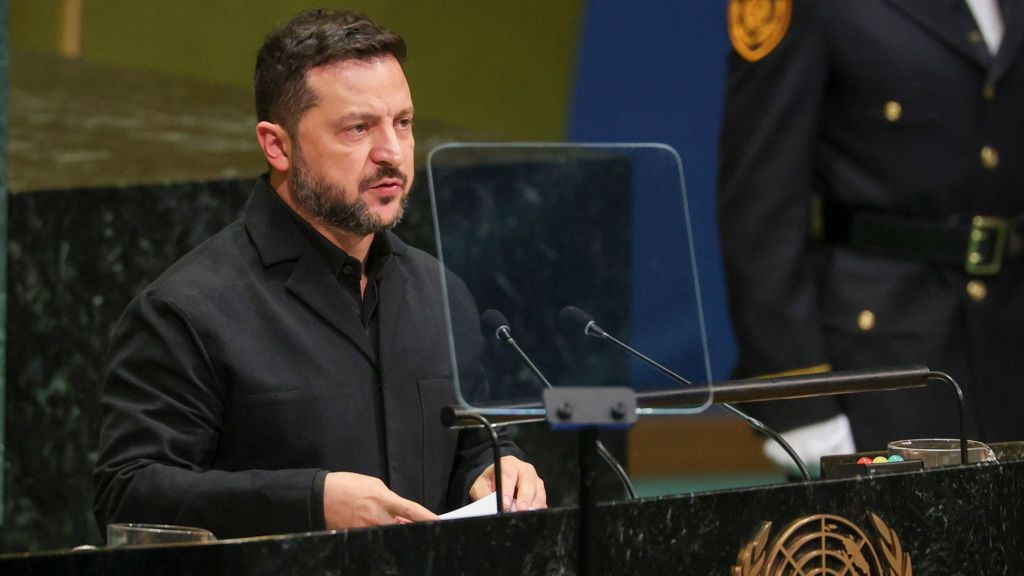
A major diplomatic rift has opened between Seoul and Kyiv after Ukrainian President Volodymyr Zelensky publicly disclosed the transfer of two captured North Korean soldiers to South Korea during his address to the UN General Assembly, breaking what South Korean officials say was a agreed confidentiality arrangement.
The two captured service members were part of a contingent of thousands of North Korean troops deployed to support Russia’s military operation in Ukraine starting in 2024. Ukrainian forces seized the pair in Russia’s Kursk Oblast in early 2025, and after more than 12 months of quiet negotiations between the two governments, the soldiers were transferred to Seoul last week. The soldiers had previously stated to media that they wished to resettle in South Korea.
In response to Zelensky’s public announcement, South Korea summoned Ukraine’s acting ambassador Andrii Vieshkin, where Vice Foreign Minister Park Yoon-joo issued a formal complaint and registered “strong regret” over the unapproved disclosure. South Korean President Lee Jae Myung called the revelation “greatly disappointing”, noting that the transfer of the soldiers was a highly sensitive matter that directly impacts the country’s national security.
A statement from President Lee’s office clarified multiple reasons for the required secrecy: first, the confidentiality was intended to protect the family members of the two North Korean soldiers still residing in North Korea; second, Ukraine had also shared an interest in keeping the transfer quiet, to avoid domestic criticism that it had forfeited a chance to swap the prisoners for Ukrainian captives held by Russia. The statement further added that while Seoul was aware Zelensky would reference the soldiers in his UN speech, the two sides had agreed he would not confirm the transfer had already been completed.
The disagreement quickly escalated after Zelensky’s office issued a counterstatement denying any formal non-disclosure agreement had ever been reached between the two states. This prompted Seoul to demand an immediate apology from Kyiv for spreading what it calls a false claim, warning that the unilateral action has caused severe and lasting damage to bilateral trust between the two nations.
The public disclosure has also created significant domestic political fallout for President Lee, who has faced intense criticism from South Korea’s opposition parties, which accuse him of attempting to cover up the transfer in a bid to appease the Pyongyang regime. Lee’s ruling party has long pursued a conciliatory policy toward North Korea, and his administration has made repeated efforts to restart inter-Korean peace talks, though those efforts have yet to yield any tangible progress.
The diplomatic clash unfolds against a complex backdrop of competing regional and global security priorities for both nations. Since Russia launched its full-scale invasion of Ukraine, South Korea has maintained a position of public sympathy for Kyiv, but has stuck to its long-standing national policy of refusing to supply lethal weapons to countries involved in active conflict. That position has come under growing pressure from Ukraine after North Korea deployed troops to support Russia in 2024.
Kyiv has repeatedly pushed Seoul to provide advanced anti-air missile systems to help defend critical Ukrainian energy infrastructure from relentless Russian drone and missile strikes. Mykhailo Podolyak, a senior advisor to President Zelensky, argued in comments that South Korea can no longer afford to stand on the sidelines now that North Korea is actively participating in a European conflict. “The transfer of defence technologies and capabilities from Seoul to Kyiv is not just about helping Ukraine; it is about South Korea protecting its own long-term security interests by containing the expansion of an aggressive totalitarian axis,” Podolyak said.
In July of this year, Seoul announced a new $100 million aid package for Ukraine, which Lee’s office confirmed would expand previous non-lethal assistance shipments that have included helmets, body armor, and medical equipment. Russia, for its part, has issued explicit warnings to South Korea that if it agrees to supply lethal arms to Kyiv, Moscow will have “no choice but to retaliate”, though it has not yet specified what form that retaliation could take.
South Korea has long worked to maintain constructive diplomatic and trade ties with major powers that oppose the United States, including Russia and China. Russia shares a border with North Korea, and Seoul has long viewed both Moscow and Beijing as critical partners in efforts to moderate Pyongyang’s behavior and advance regional stability. Ukraine’s foreign ministry has so far declined to issue any public comment on the dispute when approached by the BBC.