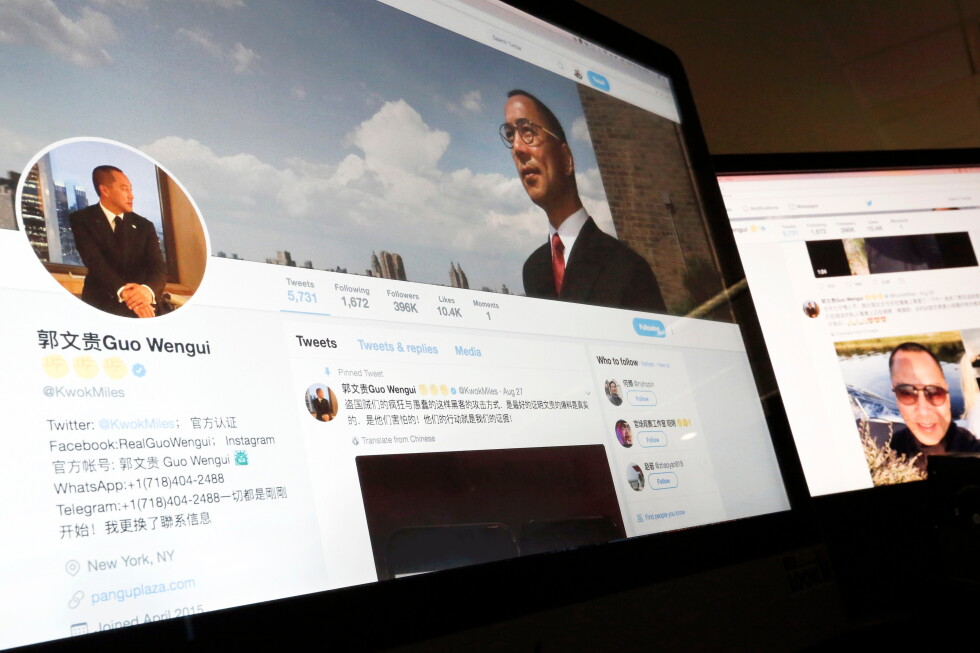
On a Monday ruling in a Manhattan federal courtroom, disgraced exiled Chinese billionaire Guo Wengui — who rebranded himself as a high-profile anti-China critic after fleeing his home country a decade ago — received a 30-year prison sentence for orchestrating one of the largest financial fraud schemes prosecuted in recent U.S. history. U.S. District Judge Analisa Torres handed down the sentence, following a conviction on nine out of 12 criminal charges stemming from a five-year conspiracy that defrauded thousands of investors out of more than $1 billion.
Before the sentence was announced, Guo was given the opportunity to address the court, where he used the time to complain about his treatment in detention, claiming he had fainted early that morning, been forcibly returned to jail from a hospital against medical advice, and suffered repeated illness during transport. Through a court interpreter, he repeated his long-held stance that his core goal after moving to the United States was to oppose the Chinese Communist Party.
A self-styled dissident, Guo embedded himself in far-right U.S. political circles after arriving in New York in 2017. He developed a close public alliance with former Trump advisor Steve Bannon, with the pair announcing a joint initiative to overthrow the Chinese government in 2020. Guo lived a life of extreme luxury in a Central Park-view Manhattan penthouse, gained membership at former President Donald Trump’s Mar-a-Lago golf resort, and maintained his lavish lifestyle until his 2021 arrest, after which he has been held without bail.
Prosecutors had pushed for the 30-year sentence requested, arguing that Guo’s deception, which ran from 2018 to 2023, destroyed the financial and emotional well-being of hundreds of lives. During the sentencing, Judge Torres read excerpts of victim impact letters from investors who lost their entire life savings to Guo’s scheme, with many reporting crippling anxiety, broken family relationships, and long-term psychological harm. The judge noted that Guo specifically targeted people who shared his stated opposition to the Chinese government, preying on their shared political beliefs to gain their trust before scamming them. Torres emphasized that to date, Guo has refused to accept any accountability for his crimes, falsely claiming his actions caused no harm to anyone, and has incited his supporters to harass and intimidate witnesses who spoke out against him.
Prosecutors detailed in court filings that the more than $1 billion Guo raised through fraudulent investments funded his over-the-top luxury lifestyle, including multiple mansions, private yachts, high-end race cars, designer clothing, and luxury home goods. The scheme centered on three sham entities controlled by Guo: his media venture GTV Media Group Inc., the Himalaya Farm Alliance, and the Himalaya Exchange, which he pitched to thousands of followers as exclusive high-return investment opportunities.
Guo’s legal team mounted an unconventional defense ahead of sentencing, arguing their client was the target of a global conspiracy orchestrated by the Chinese Communist Party, which they claimed recruited U.S. elites across business, entertainment, and politics to frame him. They contended that a 30-year sentence would validate what they called a Chinese smear campaign and embolden efforts to target Chinese dissidents living abroad, noting that defendants in similar financial fraud cases typically receive sentences between two and four years. The defense also cited past physical injuries Guo claims he sustained from torture in China, which required multiple surgeries between 1993 and 2022, as a factor warranting a reduced sentence.
The U.S. Probation Department had recommended a 25-year sentence, acknowledging the more than $1 billion in total losses suffered by investors, a figure prosecutors described as “astronomical.” According to prosecution filings, Guo remains entirely unrepentant for his crimes, having taken advantage of U.S. asylum laws to build his operation in the country. “He does not even offer the lip service of remorse or acceptance of any responsibility for the harms he caused so many individuals and their loved ones, some of whom have been pushed to consider suicide as a result of his crimes,” prosecutors wrote, adding that multiple victims testified at trial that Guo brainwashed, cheated, and irreparably harmed them.
Guo’s long-standing narrative, repeated by his defense, holds that he amassed his initial wealth as his family became the largest shareholder in China’s largest publicly traded securities firm, then became a target of Chinese government officials after he exposed their corruption. Chinese authorities have previously charged Guo with crimes including rape, kidnapping, and bribery, charges Guo has always claimed are fabricated to punish him for criticizing senior Communist Party leaders.