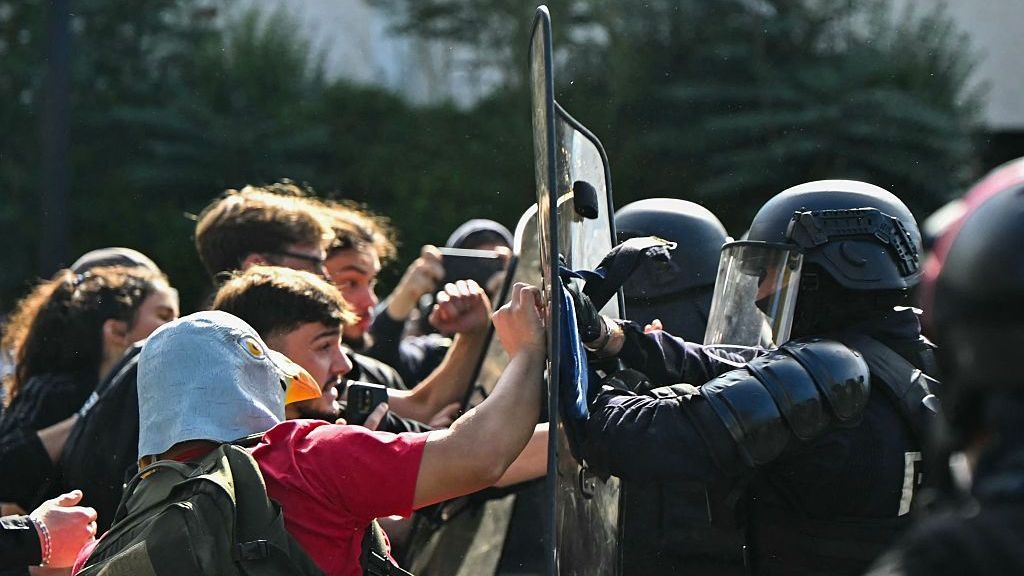
For more than five decades, every French administration has carried a hard-earned lesson etched into policy by the 1968 May student uprisings: mass youth mobilization on the streets poses an existential threat to sitting governments. Then-President Charles de Gaulle infamously dismissed the chaotic movement as chienlit – a crude term for unbridled disorder – and ever since, leaders have approached youth protests with extreme caution. Today, that long-held wariness has curdled into open anxiety for President Emmanuel Macron’s government, as a new youth-led protest movement that erupted just two weeks ago has swept across the nation, leaving widespread disruption, property damage, and political uncertainty in its wake.
The unrest first ignited in Seine-Saint-Denis, a low-income, diverse northern suburb of Paris long marked by systemic underinvestment. What began as a local outcry over underfunded education has rapidly expanded, reaching every corner of France in less than a fortnight. At the peak of mobilization last Thursday, hundreds of lycées – France’s secondary schools for 15 to 18-year-old students – were blocked by protesters. By Friday, roughly 400 lycées remained shuttered, closed by administrative order to protect staff and learners, and university student unions have begun joining the movement, amplifying its scale.
The protests have not remained peaceful. On Thursday, arson destroyed the main assembly hall of a Nantes lycée, and hundreds of small blazes were set at school entrances across the country, with total damage estimated in the millions of euros. According to Education Minister Édouard Geffray, 65 education staff, including 40 school principals, have sustained injuries, with most injured employees reporting that their attackers were not their own students. Government data also shows 300 police officers and firefighters have required medical treatment for injuries, and roughly 2,000 people, the vast majority of whom are minors, have been taken into police custody. Protesters and student groups push back on this official narrative, compiling their own list of injuries at the hands of police, including two teenagers who suffered severe permanent eye damage and another who lost multiple teeth.
Beyond the immediate chaos of street protests and blockades, the movement presents a uniquely thorny challenge for Macron’s government, rooted in both social and political context. While the core demands of protesters remain loosely defined, they center on a single, broadly resonant grievance: chronic underfunding of France’s public education system. Protesters are calling for increased education spending, more teaching staff, smaller class sizes, and critical infrastructure upgrades to crumbling school buildings. This grievance has broad public sympathy: most French observers acknowledge that education conditions have deteriorated steadily as public budgets have tightened, and mass protest to demand government investment is a long-accepted norm in French political culture.
Yet the timing of the unrest could not be more politically charged, coming just months ahead of France’s 2026 presidential election. Last week, Prime Minister Sébastien Lecornu unveiled his 2027 draft national budget, anchored by a pledge to cut €54 billion in public spending to reduce France’s chronic deficit. For Macron’s government, the era of large-scale public spending to defuse social unrest is effectively over, meaning any major concessions to student demands are all but off the table. That leaves the administration with few tools to de-escalate the crisis.
The far greater political fear, however, is that the protests are being intentionally stoked by the hard-left France Unbowed (LFI) party and its presidential candidate, veteran leftist leader Jean-Luc Mélenchon, as part of an election strategy to mobilize young voters ahead of the May vote. Centrist and right-wing political observers, as well as a leaked internal Paris police intelligence report, point to evidence of far-left coordination: the presence of non-student protesters at blockades, the loose framing of demands, the display of Palestinian and Algerian flags at rallies, and the use of radical-left protest tactics such as organizing secondary demonstrations outside police stations. The police report concludes the unrest could be part of a deliberate “flame-kindling strategy” to advance LFI’s political agenda ahead of the elections.
LFI has repeatedly denied manipulating the movement, saying it is merely offering principled support to a legitimate grassroots protest of young people. Mélenchon himself has publicly called on students to avoid violence, arguing that unrest only plays into the hands of political opponents. Even so, his political rivals are convinced the 75-year-old candidate is deliberately leveraging the protests to shore up his already strong base among young French voters. Polling bears out the scope of his support: Mélenchon captures roughly 40% of the vote among 18 to 24-year-olds, and his messaging around a “new France” and “creolization” – a framework that celebrates France’s diverse, changing population and linguistic landscape – resonates deeply in the working-class, high-immigration suburbs that are the epicenter of the current unrest.
A key challenge for Mélenchon, however, is that young people are the demographic with the lowest voter turnout in French elections. Political analysts broadly see the current unrest as a way for LFI to energize this disengaged base, reminding young voters that the party aligns with their grievances and that their votes can shift the outcome of the election. Even so, polling consistently shows that Mélenchon would lose heavily to hard-right candidate Marine Le Pen in a head-to-head runoff election – a result that would plunge France into unprecedented political instability. For Macron’s government and centrist voters across the country, the current wave of youth protests is not just a temporary public disruption: it is seen as a potential early warning sign of the deepening polarization and instability that could follow next spring’s election.