For more than four and a half years, Russia’s full-scale conflict in Ukraine has shaped every corner of domestic life in the country, bringing heavy military casualties, widespread economic strain, and repeated infrastructure disruptions from Ukrainian drone strikes, including recent attacks that have triggered widespread petrol shortages across multiple regions. Against this turbulent backdrop, Russia’s latest parliamentary election has delivered the outcome that political observers nearly universally predicted: a sweeping victory for the Kremlin-aligned ruling party United Russia, with no unexpected shifts in the makeup of the State Duma.
Under Russia’s tightly centralized political system, controlled firmly by the Kremlin, United Russia was always projected to hold onto its power in the lower house of parliament. Preliminary vote counts confirm the party will retain its constitutional supermajority, enough to pass any constitutional amendment without opposition support. Even more notable is the fact that every party that has cleared the 5% vote threshold to enter the new Duma is the exact same cohort of parties that held seats in the outgoing legislature — a body that uniformly backed the Kremlin’s agenda and the so-called “special military operation” in Ukraine, with zero consistent opposition to the war effort.
The only anti-war party cleared to appear on the national ballot this cycle, Yabloko, was removed from the party list just 12 days after official registration, in a ruling by Russia’s Supreme Court. The abrupt removal came amid signs the party’s pro-peace messaging was resonating with a growing segment of the Russian public, a development that triggered concern from the Kremlin. Even after being struck from the national party list, roughly 100 Yabloko candidates still ran in individual constituency races, but the party faced relentless official pressure throughout the campaign.
Yabloko chairman Nikolai Rybakov says the expected pro-Kremlin makeup of the new Duma comes as no surprise to his party. “What other result can there be if there were 10 parties on the ballot and they all support the policies of President Putin?” Rybakov told reporters. “I don’t think the Duma will change. They’ll vote 100% for the policies of Putin just like they did.” Rybakov also outlined widespread barriers to Yabloko’s participation: “Some of our candidates, who should have been running, are in jail, many were barred from running and some of our election observers weren’t registered and were unable to keep an eye on the voting.”
On the final day of the three-day voting period, Ukraine launched a large-scale drone strike that targeted infrastructure in the Moscow region, hitting a major city oil refinery. Speaking to reporters at a polling station near the damaged facility, local voters displayed little shock at the attack. After more than four and a half years of war, periodic strikes on Russian territory have become a routine part of life, and Muscovites responded with quiet resignation rather than outrage. “People in the Donbas, as well as in Bryansk, and Belgorod near the Ukrainian border, hear this kind of thing every day,” said Viktor, a voter who had just cast his ballot. “They just get on with their lives.”
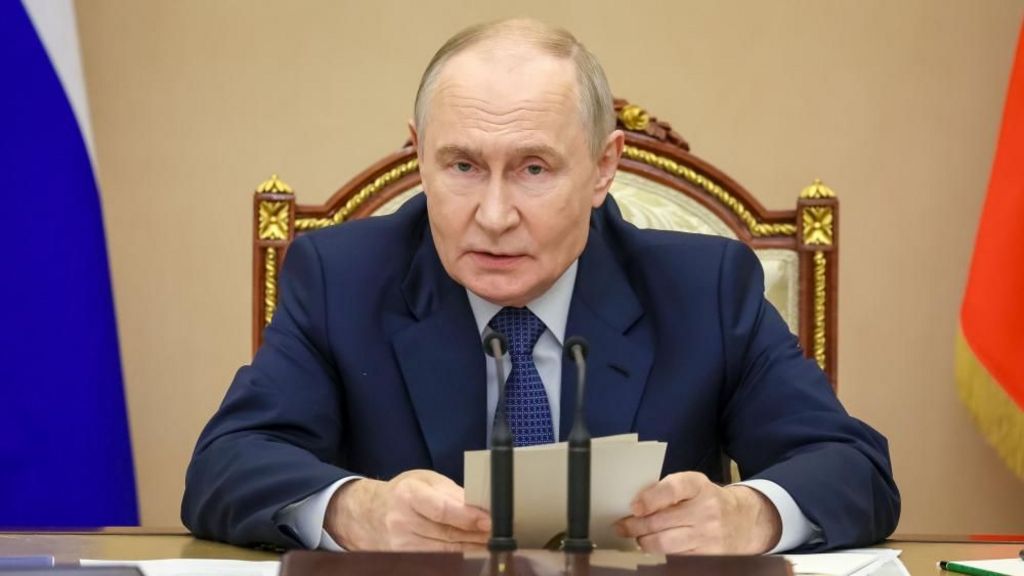
While the election outcome was entirely predictable, what comes next for Russia’s war policy remains uncertain. The Kremlin is widely expected to frame the lopsided result as evidence that the Russian public has united behind President Vladimir Putin and the war effort, using the outcome to justify future policy and military decisions. Just days before the vote, Putin publicly ruled out the possibility of a new wave of national mobilization, stating “There is no scenario today that would require it.” But despite that official reassurance, widespread anxiety over a future mobilization persists across Russian society, with many residents questioning whether the policy will remain off the table in the months ahead. Analysts widely agree that the Kremlin will at minimum treat the lopsided election result as a public mandate to continue its military campaign in Ukraine.