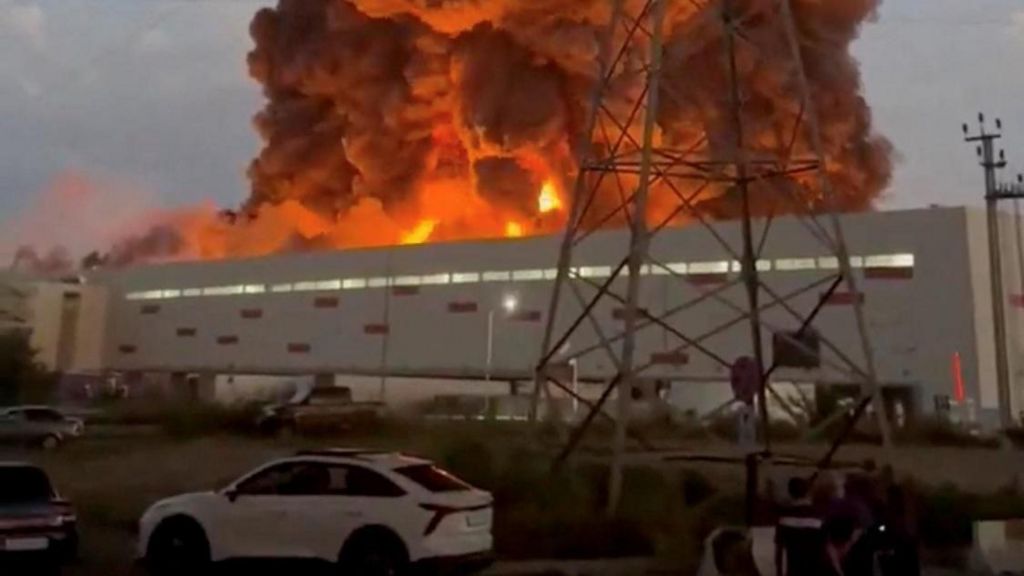
Nearly four and a half years into Russia’s full-scale invasion of Ukraine, Kyiv has expanded its long-range drone campaign to target critical domestic logistics infrastructure inside Russia, shifting focus from energy facilities to warehouses operated by Wildberries, Russia’s largest online retail marketplace. Over a four-day span, four separate Wildberries distribution hubs have been hit by drone attacks, leaving eight workers dead, dozens injured, and an estimated $1 billion worth of stored inventory reduced to ash.
The first wave of attacks struck over the weekend, targeting facilities in Elektrostal, just east of Moscow, and Kotovsk in the Tambov region, roughly 250 miles from the Ukrainian border. Seven night-shift employees were killed in the Kotovsk strike, with one additional fatality recorded at Elektrostal. Follow-up attacks overnight Wednesday hit two more hubs in Krasnodar and Nevinnomyssk in Russia’s Stavropol region, with Wildberries owner Tatiana Kim confirming additional unspecified casualties.
Ukrainian officials have framed the strikes as a deliberate strategic move targeting infrastructure that supports Russia’s military effort. Ukrainian President Volodymyr Zelenskyy affirmed the shift in targeting, stating “We are, quite justly, bringing the war back home – to Russia.” Kyiv claims the targeted warehouses stored sanctioned electronic components used for Russian drone manufacturing and military navigation equipment. Pro-Kremlin military bloggers have also acknowledged that Russian volunteers and military suppliers regularly use major online marketplaces including Wildberries to source tactical gear and dual-use components for frontline forces.
Independent verification of military stockpiles at the targeted sites has not been obtained, and the Kremlin has denied that domestic online platforms are used to supply the Russian army. Regardless of the military intent, the strikes have imposed devastating costs on thousands of independent Russian small and medium-sized sellers who rely entirely on Wildberries to store, distribute, and sell their goods to consumers across the country.
Unlike Western marketplace giant Amazon, which operates both a first-party retail business and third-party seller platform, Wildberries and its primary competitor Ozon function almost exclusively as intermediary marketplaces. More than 85% of Russia’s economically active population uses the two platforms, and in many remote, underserved regions of the country, they are the only reliable source of everyday goods from clothing to household appliances. This business model means nearly all losses from the attacks fall to independent sellers, not the company itself.
Hundreds of sellers have reported losing their entire stockpiles in the strikes, with many sharing devastating accounts of financial ruin on Russian social media. One seller, a mother of a disabled child who built her small business from scratch, wrote in a viral expletive-laden post that she had lost 1 million rubles ($12,700) in inventory, writing “We’re already getting screwed over from every direction as it is.”
A stationery seller who delivered her full back-to-school inventory to the Elektrostal warehouse just one day before the attack lost all of her stock just weeks before the critical autumn shopping season. A teenage clothing retailer reported 1.4 million rubles ($13,300) in lost inventory and has paused new shipments, noting “The outlook for working with Wildberries is very murky. Right now I have enough of a safety cushion to survive the current losses, but if there are more strikes, I probably won’t manage.”
Most sellers do not expect any meaningful compensation for their losses. Less than two weeks before the first strike, Wildberries updated its seller contracts to add drone attacks to its list of force majeure events, exempting the company from liability for inventory destroyed in attacks. While Kim has promised not to abandon affected sellers, offering temporary fee waivers and discounted shipping rates, these measures have done little to ease widespread anxiety among the platform’s seller base.
The strikes come as Russia’s civilian small business sector already faces mounting pressure under the weight of wartime economic policies. Despite Russian President Vladimir Putin repeatedly naming support for small and medium-sized enterprises a top priority even during the war, the sector has faced a cascade of new challenges in 2026. In January, the national value-added tax was increased from 20% to 22% to fund additional defense spending, and targeted tax breaks for small businesses were eliminated. Data from business intelligence platform Kontur.Fokus shows more than 209,000 small and medium-sized companies closed in the first quarter of 2026, a 9% increase from the same period in 2025.
Additional pressures include widespread internet restrictions, a crackdown on independent messaging apps that disrupted business operations, and a national fuel crisis triggered by earlier Ukrainian drone strikes on Russian oil depots and refineries. Analysts note the Wildberries strikes represent another major blow to a sector already reeling from cumulative strain.
“There are already a lot of nails, and they keep hammering them in. Is [the attack on Wildberries warehouses] another nail in the coffin? Well, yes, of course,” said Ruben Eniklopov, a professor at Barcelona’s Pompeu Fabra University. While Russian small businesses have demonstrated surprising resilience through the first years of the war, high inflation, widening budget deficits, and a 23% drop in oil and gas revenues compared to the first half of 2025 have left the civilian economy increasingly fragile. Russia’s large peacetime financial reserves are increasingly being diverted to fund the war effort, crowding out support for civilian economic growth.
The Wildberries strikes mirror a recent pattern of reciprocal targeting of civilian logistics infrastructure by both sides. In recent weeks, Russia has launched drone and missile strikes on sorting terminals and warehouses belonging to Ukraine’s largest private postal operator Nova Poshta, major retail chain ATB, and confectionery group Roshen. With frontline combat largely stalled in a stalemate, both sides have expanded long-range strike campaigns to disrupt supply chains and put increasing pressure on the opposing side’s domestic population.