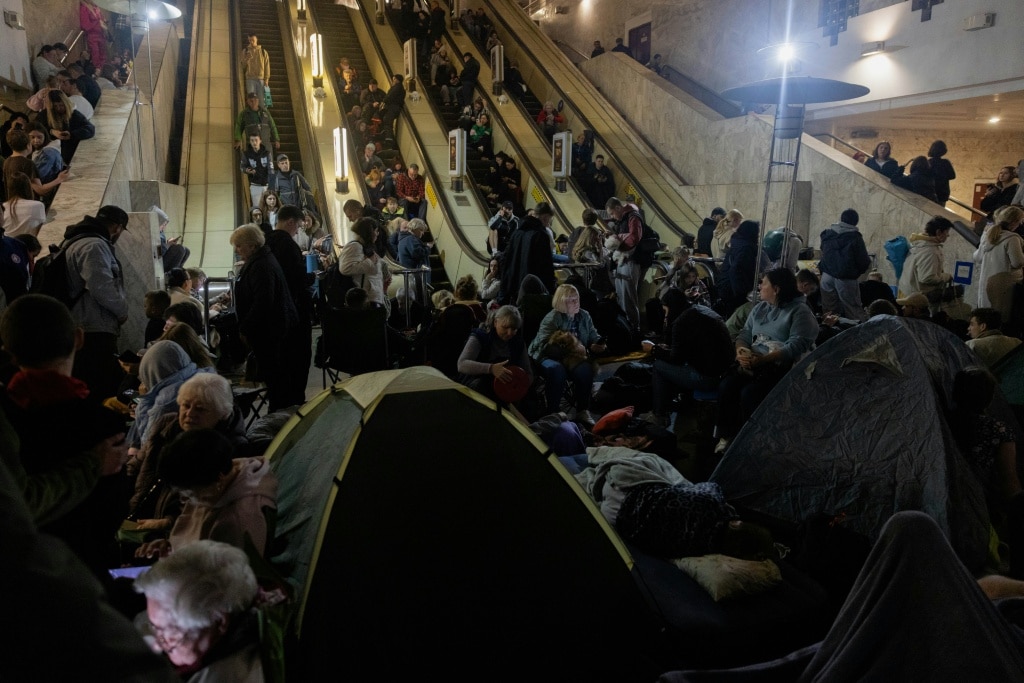
Just five days after Ukrainian President Volodymyr Zelenskyy publicly warned that Moscow was gearing up for a large-scale new offensive across the country, a coordinated wave of Russian missile and drone attacks killed at least nine civilians and injured dozens more across Ukraine on Tuesday, local authorities confirmed. The assault marks the latest escalation in a grinding, two-year-plus full-scale invasion that has become Europe’s deadliest conflict since World War II, with diplomatic efforts to reach a ceasefire remaining completely stalled as of this report.
Agence France-Presse reporters on the ground in Kyiv, Ukraine’s capital, reported hearing multiple loud explosions rip through the city early in the attack. Local officials confirmed Russia used advanced ballistic missiles for the strikes, which ignited large structural fires and knocked out electrical power for residents in multiple central and residential districts.
Kyiv Mayor Vitali Klitschko confirmed that four residents were killed in the capital’s assault, and at least 58 more people — including two young children — were wounded. “Explosions in the city. Air defence forces are working! Stay in shelters!” Klitschko had posted in an urgent public alert minutes after the first strike. AFP journalists observed panicked residents rushing to underground bomb shelters, many carrying only small bags of belongings and blankets, while a thick column of black smoke billowed over central Kyiv.
Tymur Tkachenko, head of Kyiv’s City Military Administration, confirmed that all of the capital’s strikes were carried out with ballistic missiles, a weapon type that is far harder for Ukrainian air defenses to intercept than slower drones.
The deadly assault was not limited to the capital. In the central Ukrainian city of Dnipro, local regional governor Oleksandr Ganzha confirmed a separate Russian attack killed five additional people and wounded 25 others, three of whom remain in critical condition as of Tuesday evening. In Ukraine’s second-largest city Kharkiv, located just miles from the Russian border, Mayor Igor Terekhov reported 10 wounded people, including one child, from the coordinated strikes.
In what has become a standard pattern of retaliation amid the ongoing conflict, Ukrainian drone strikes hit targets inside Russian territory hours after the Russian barrage. Alexander Khinshtein, governor of Russia’s western Kursk region which borders Ukraine, confirmed one person was killed in a Ukrainian drone strike there. Separately, a second drone sparked a large fire at an oil refinery in Krasnodar, a major southwestern Russian city, according to the facility’s operational management team via Telegram.
The timing of Tuesday’s Russian offensive lines up exactly with warnings Zelenskyy issued last Friday. The Ukrainian leader stated at the time that Kyiv had received credible intelligence confirming Russia was preparing a new massive strike, and urged all citizens to take air raid alerts seriously. “Please pay attention to air alerts, protect your lives. Our services are working efficiently and are prepared; the Air Force and other defenders of our skies will be on duty 24/7, as always,” Zelenskyy said in his address.
Zelenskyy has repeatedly pushed Western allies to approve and fund additional supplies of Patriot air defense systems, the only weapon Ukraine currently operates capable of reliably intercepting Russian ballistic missiles. Last week, he sent formal requests to U.S. President Donald Trump and the U.S. Congress specifically asking for additional Patriot batteries to counter the growing intensity of Russian air attacks.
In response to near-daily Russian bombardments across Ukrainian territory, Kyiv has significantly stepped up its own drone and missile strikes on Russian-occupied Ukrainian territories and targets inside mainland Russia. An Agence France-Presse analysis of official Ukrainian Air Force data found that Russia launched a record 8,150 long-range attack drones against Ukraine in May alone, a 24% increase from the total number launched in April. Ukrainian air force data indicates the country’s air defenses managed to intercept roughly 90% of all incoming Russian missiles and drones last month.