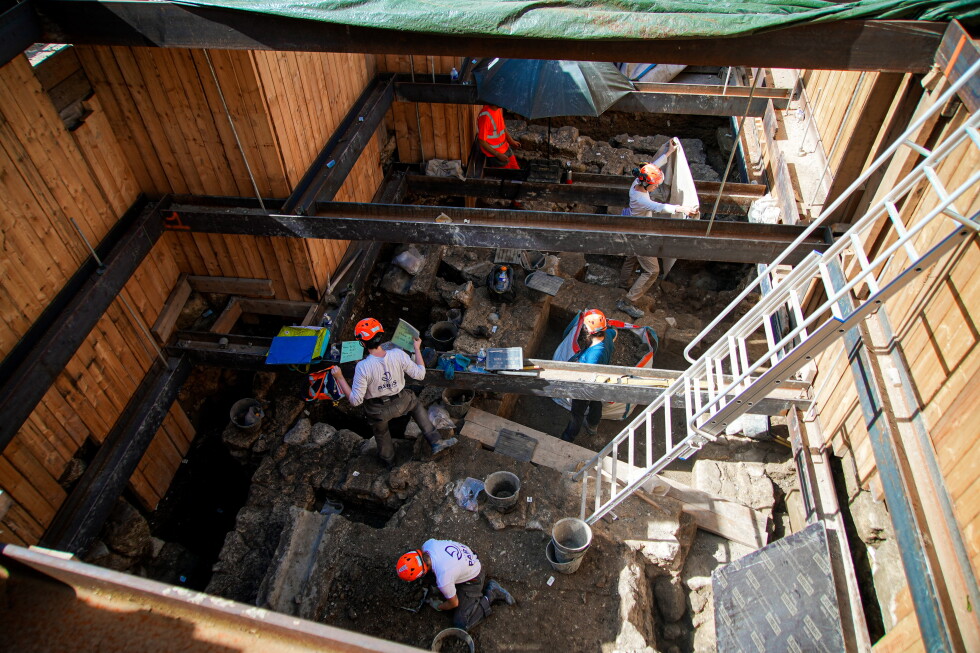
Beneath the baking summer sun where crowds of tourists queue to climb the iconic Notre Dame cathedral and glimpse its famous gargoyles, an unprecedented archaeological excavation is unfolding 13 feet underground. This dig is not just a side project to post-fire reconstruction: it is a journey back through millennia, pulling back the curtain on the layered origins of Paris, from its Roman beginnings to the medieval era and beyond.
Five years after a devastating 2019 fire collapsed Notre Dame’s spire in an event watched by the world, the historic cathedral completed its extensive reconstruction and reopened to the public in late 2024. As part of post-reopening improvements, city officials planned to transform the harsh, sunbaked public square in front of the cathedral into a greener, shaded space to accommodate visitors and combat rising temperatures linked to climate change. Under French archaeological protection rules, however, any ground disturbance for construction must be preceded by full excavation to protect undiscovered historical artifacts. What began as a pre-construction survey quickly grew into what local French media has dubbed the “dig of the century.”
“It’s a rare opportunity for us to work on something that’s tangibly going to make a difference to the history of Paris,” explained Lucie Altenburg, a conservator with Paris’ municipal archaeology unit, in an interview with the Associated Press. Already, the small excavation team has uncovered hundreds of significant objects, ranging from a well-preserved 4th-century Roman coin bearing the portrait of Emperor Constantine to fragments of medieval pottery marked with undeciphered symbols that have left experts baffled — a puzzle many on site compare to a real-life ancient Da Vinci Code.
For tourists visiting the newly reopened landmark, the active dig has added an unexpected layer of magic to their trip. “It makes Notre Dame feel alive again,” shared Emily Carter, a 34-year-old visitor from Manchester who was waiting in the tourist line with her two children. “You come to see the cathedral, then realize there’s another city under your feet. That’s almost more moving.” Just 20 inches below the surface, the first traces of earlier settlements emerge, and the team has continued to recover new artifacts all the way down to the 13-foot depth. On busy dig days, the team fills up to 15 crates of finds from ground that has remained undisturbed for hundreds of years.
This type of layered urban archaeology is not unique to Paris, but it offers one of the clearest glimpses into how ancient cities evolve. As the old adage goes: in historic global cities, the past is not kept in a distant museum — it lies directly beneath the modern streetscape. Every successive civilization builds its new structures atop the rubble of the one that came before it, pushing the ground level higher over centuries. For context, ground level in central Rome has risen roughly 30 feet since the fall of the Western Roman Empire in the 5th century, and the large-scale Athens metro construction ahead of the 2004 Olympics triggered the largest archaeological excavation in Greek modern history, unearthing tens of thousands of artifacts that are now displayed directly in the city’s metro stations. Paris is no exception to this rule.
All of Paris traces its origins to the small Ile de la Cite, the island in the Seine River where Notre Dame now stands. When construction first began on the cathedral in 1163, the entire forecourt area was tightly packed with medieval homes, divided only by a single narrow street, according to Camille Colonna, the lead archaeologist heading the excavation. Colonna’s team has already excavated down to the cellars of these long-gone medieval homes, placing them firmly in their historical context. Deeper still beneath these cellars lie grain pits dating to the Merovingian and Carolingian eras, between the 6th and 10th centuries. Further down, researchers have uncovered a dense residential quarter from Roman Lutetia, dating to the 4th and 5th centuries. In total, 20 centuries of human settlement are compressed into just 4 meters of earth — roughly the height of two and a half Napoleon Bonapartes stacked atop one another.
“Here you can see the layers — medieval Paris, Roman Paris, maybe even before that,” said Yasmine Benali, a 22-year-old archaeology student observing the dig from behind public barriers. “It makes the city feel less like a postcard and more like something still being discovered.”
Some of the most well-preserved finds have come from an unexpected source: the deep medieval latrine pits that doubled as community trash dumps centuries ago. The anaerobic, soft waste environment cushioned fragile ceramic objects, leaving many fully intact even after hundreds of years. The team has pulled whole jugs, cups, and drinking vessels out of these pits, alongside broken pottery fragments and animal bones. “It’s rare to find complete ceramics,” noted Valentine Breloux, an archaeologist with the Paris unit, adding that the intact pottery recovered at the site is nothing short of miraculous.
The most puzzling discovery so far is a series of faint red markings painted on the inner surface of multiple medieval pottery shards. No expert has yet been able to decode the meaning of the repeated symbols, which Breloux describes as the most “astonishing” find from the dig to date.
Coins recovered from the dig also play a critical scientific role beyond their historical value. After cleaning and X-ray analysis, one heavily corroded black disc was confirmed to be a 4th-century coin bearing the face of Emperor Constantine, who ruled Rome in the early 300s AD. Dated objects like these coins allow archaeologists to accurately assign timelines to each stratigraphic layer of the excavation, Altenburg explained.
For the research team, the Roman-era finds are the most valuable, as they fill major gaps in historical knowledge. Researchers have long known that the center of Roman Lutetia was originally located on the Seine’s Left Bank, and as the Roman Empire collapsed in Western Europe, the local population retreated to the defensible Ile de la Cite, reusing stone from older Roman structures to build new fortifications. The Notre Dame dig has already turned up physical proof of this practice: a large Roman doorstep, taken from a much grander public building, flipped upside down, and repurposed as paving stone for a medieval road.
All artifacts recovered from the excavation are transported to Paris’ central regional archaeology center, a large, secure storage facility Colonna describes as “a huge archaeological store” and a hidden treasure house of Parisian history.
For archaeological teams across Europe, large open urban digs like this only happen when major construction is scheduled, a dynamic Altenburg compares to industrial quarry workers stumbling on dinosaur fossils. “This only happens because the city of Paris decided it wanted to beautify the area,” she said.
The redevelopment of Notre Dame’s forecourt is scheduled for completion by 2028. The new public space will be designed as a shaded woodland clearing, planted with 160 new trees and fitted with a shallow cooling water feature to combat the extreme summer heat waves that have become more frequent due to climate change. Tourists who currently wait in direct sun to enter the cathedral will eventually queue in cool shade, and the existing underground parking lot will be redeveloped into a new public visitor center overlooking the Seine.
Until construction begins, however, the excavation team plans to continue digging deeper, pushing past the Roman layers to search for traces of the Gaulish settlement that gave Paris its original name. “The hope is that we are able to go back in time even further than we’ve ever been before,” Altenburg said.