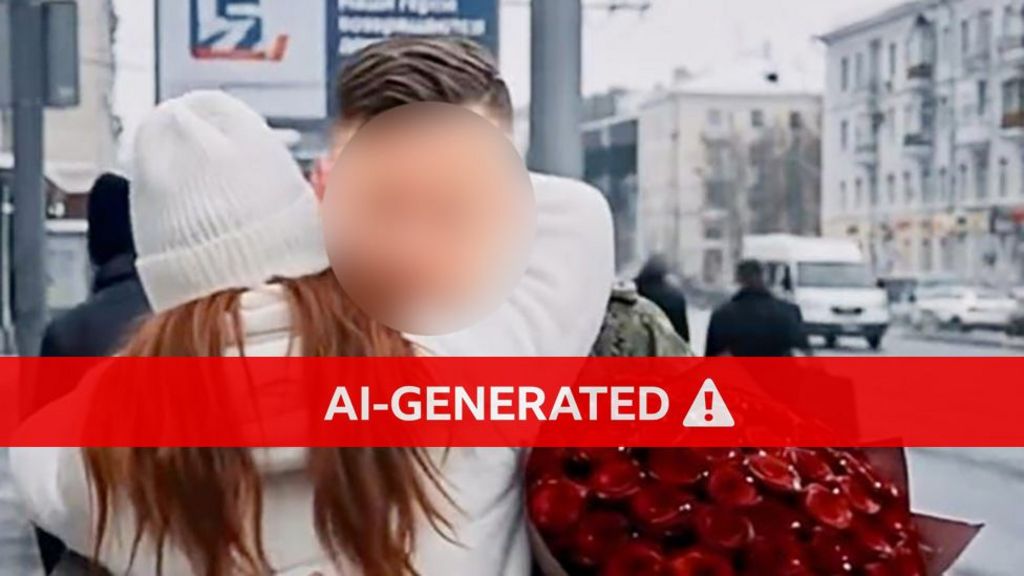
Since mid-2025, a new, deeply divisive trend has taken root on Russian social media: AI-generated videos that depict Russian soldiers serving in Ukraine returning home to their families, or appearing as peaceful spiritual figures after their deaths. For grieving relatives, these clips can offer a fragile, longed-for sense of closure. But critics denounce the practice as unethical, exploitative, and a dangerous distortion of the reality of Russia’s full-scale invasion of Ukraine.
The trend gained widespread attention after a 15-second AI-generated clip posted by popular blogger Katya Jin went viral. Set against a backdrop of snowy Moscow streets, the video features billboards bearing the message: “The Special Military Operation is over. Our heroes are coming home” – language that mirrors the Kremlin’s official framing of its war on Ukraine. At the center of the clip is a reunion: an airbrushed woman pushing a stroller hugs a man in military uniform, tears in her eyes. The fictional couple is modeled on Jin and her own husband, who, like tens of thousands of Russian troops, went missing on the front line, his fate still unconfirmed.
Jin was not the only creator behind this content. Until recently, she shared regular AI videos with her 10 million TikTok followers and 50,000 Instagram followers, even offering step-by-step tutorials for making similar clips. She also turned her personal grief into a commercial service: customers could submit photos of their own missing or deceased loved ones, and Jin would generate custom AI videos for a fee. Dozens of relatives placed orders, hoping to see a final embrace or peaceful final moment with the soldiers they lost. After BBC Russian reached out to Jin for comment, she removed all of her AI-generated content from her social media accounts and did not respond to questions.
Across Russia, other creators have built similar businesses around the trend. Anna Korableva, based in the Ural Mountain town of Kamensk-Uralsky, launched her “Farewell Video” project alongside her sister in May 2025. Korableva says her goal is to help families process “unfinished farewells,” giving them the chance to “embrace” husbands, fathers, and children one more time. “In the first months of working on these videos, I cried almost every day,” she told the BBC. “Over time, I learned to separate my emotions from work. I try to focus on the technical side, to make sure the video turns out beautiful and worthy of someone’s memory.” Most of Korableva’s requests come from families of soldiers killed in Ukraine since Russia’s 2022 full-scale invasion.
As of 2026, a joint investigation by the BBC, Russian independent outlet Mediazona, and volunteer researchers has verified the deaths of at least 225,000 Russian soldiers in the war, with the true death toll widely believed to be far higher. Russian state officials have never released full, reliable casualty figures, and generally avoid public discussion of mass military deaths.
Most AI-generated clips follow a predictable, sentimental narrative. For killed soldiers, common tropes show the uniformed man embracing his family, then walking slowly up a staircase into a bright blue sky, often flanked by angels, or appearing as a gentle “ghost” embracing his family from heaven. Videos for soldiers still serving on the front sometimes add symbolic angel wings to shield the man from harm. In nearly all clips, the reality of the war in Ukraine – the Russian invasion, widespread destruction, and Ukrainian civilian and military casualties – is entirely erased, with Russian soldiers uniformly framed as heroic defenders of their homeland and families.
This whitewashing has sparked fierce outrage among Ukrainians who encounter the clips online. “You should be ashamed to show your ‘heroes’ who went to earn blood money by killing our children,” one Ukrainian commenter wrote.
International generative AI tools have been largely blocked or restricted for users in Russia, pushing customers to turn to local independent creators like Jin and Korableva. Prices for custom AI content range from just 200 roubles (£2) to 10,000 roubles (£100), and quality varies widely: some low-budget clips produce distorted figures with missing limbs or grotesquely altered faces. Even so, low production costs allow popular creators to turn a significant profit. Ulyana Lebed, a creator whose husband is also a Russian serviceman, told the BBC she earns between 150,000 and 200,000 roubles (£1,500 to £2,000) per month – roughly double the average Russian monthly wage. This commercialization has drawn criticism from online users who accuse creators of cashing in on mass grief: “Be careful that loss doesn’t come knocking at your door. Some subjects should not be touched — but you just wanted to make money,” one commenter wrote under a AI clip of a dead soldier.
Academics studying the trend say it fits into a growing global “digital afterlife” industry that uses AI to create posthumous avatars and content for deceased people, already seen in museums, courtrooms, and political campaigns. It is no surprise, experts say, that this trend has flourished amid a brutal war where mass death and grief are pervasive. But the ethical and psychological impacts remain deeply understudied and hotly contested.
“Creating ‘deadbots’ of Russian soldiers or deepfakes of fallen Russian soldiers returning from Ukraine is extremely complex and ethically difficult to assess in a clear-cut way,” explained Katarzyna Nowaczyk-Basińska, a researcher at the University of Cambridge’s Leverhulme Centre for the Future of Intelligence. Ethically, she notes, the political context of the war makes these videos deeply problematic. Psychologically, it remains unclear whether AI-generated depictions help grieving families process loss or trap them in unhealthy denial that deepens their pain. “In a sense, we are all in the midst of a technological and cultural experiment,” she said.
Reactions from people who have commissioned these AI works are similarly divided. Some say the clips provide no meaningful comfort, calling them what they are: an illusion. “Could technology help me accept that I will never hug my son again? No. It’s an illusion,” one grieving mother told the BBC. Another woman, who bought an AI-generated photo of her late husband for his headstone, said, “Psychologically, no, of course it didn’t help – how could it?” even as she hung two other AI prints of him in her bedroom. For others, however, the virtual connection offers a small, valuable sense of peace, even if it exists only in a digital fantasy. “Thank you, AI, for this opportunity to be with my loved one,” one Russian woman wrote beneath a farewell video of her husband, who has been dead for nearly two years.