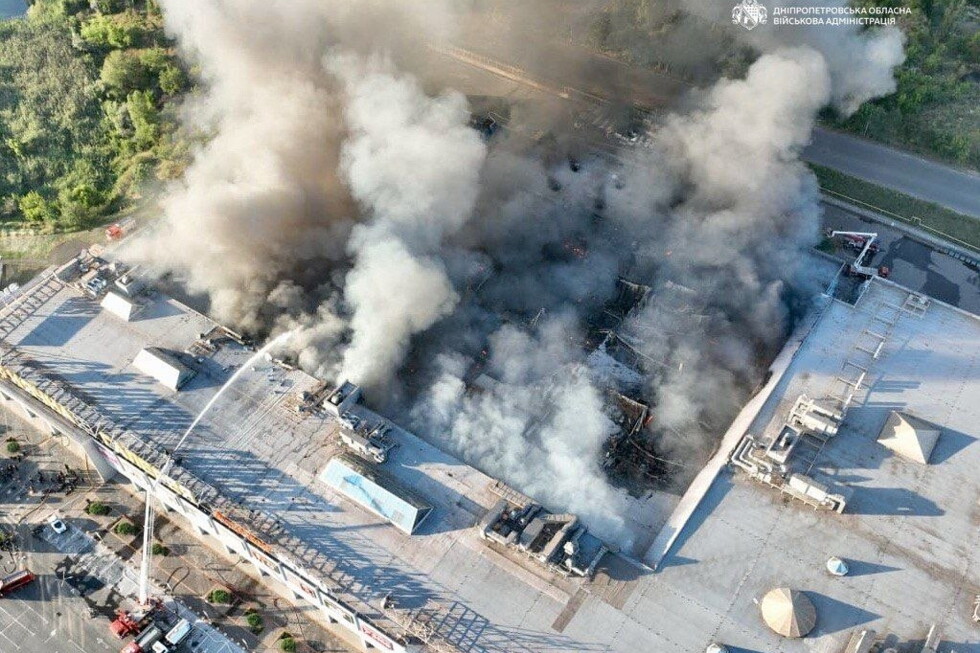
The ongoing full-scale Russian invasion of Ukraine has seen another deadly spike in targeted strikes against civilian and infrastructure targets across Ukrainian territory, with two additional civilians confirmed killed in a wave of overnight attacks launched by Moscow, just 24 hours after a devastating assault on a crowded central Ukrainian shopping center left 16 dead.
Ukrainian President Volodymyr Zelenskyy confirmed in a Saturday statement that one civilian was killed and a second injured after Russian ballistic missiles struck critical railway infrastructure in Kyiv, Ukraine’s capital. In a contrasting official statement, Russia’s Ministry of Defense claimed its military forces had successfully targeted a military-use locomotive depot in the strike.
In recent weeks, Russian forces have deliberately ramped up ballistic missile attacks against Kyiv, taking advantage of a critical shortage of U.S.-manufactured Patriot air defense interceptors in Ukraine’s arsenal. These interceptors are the only system Ukrainian air defenses currently operate that is capable of reliably intercepting and destroying Russian ballistic missiles.
Beyond the Kyiv strike, local Zaporizhzhia regional officials confirmed Saturday that one additional civilian was killed in an overnight Russian drone attack on a village in the southern region. Zelenskyy added that three more people were wounded in a separate drone assault on a civilian minibus in Zaporizhzhia, the region’s administrative capital.
The new round of Russian attacks came one day after Russian strike drones hit a busy shopping center in Kryvyi Rih, a major city in central Ukraine that is Zelenskyy’s hometown. Oleksandr Hanzha, head of the Dnipropetrovsk regional military administration, updated the casualty toll in the early hours of Saturday: the death toll had risen to 16, 130 additional people were wounded, and nine people remained unaccounted for as of Saturday morning.
Zelenskyy condemned the attack as a deliberate “double-tap” strike, a tactic where an initial wave of attacks hits the target, followed by a second strike timed to arrive when first responders and rescue workers have arrived on scene to treat casualties and clear debris. The Ukrainian leader added that a large fire that spread across 9,000 square meters of the shopping center had been fully extinguished, and search and rescue operations were continuing to recover missing victims.
Kryvyi Rih has been repeatedly targeted throughout more than four years of full-scale war, with one of the deadliest previous attacks recorded in April 2025, when 20 people — including nine children — were killed in a Russian strike.
Large, coordinated Russian strikes across Ukraine have become a near-weekly occurrence throughout this summer. Friday’s shopping center attack came just 24 hours after Russia launched a massive nighttime assault against Kyiv using dozens of missiles and drones, which also killed 16 civilians. The capital has faced near-constant bombardment in recent weeks: 17 civilians were killed in a strike on Kyiv and its surrounding suburbs just over two weeks ago, and another nine died in a separate attack on the city two days prior to that. A recent update from the United Nations released last week listed Kyiv as one of the hardest-hit Ukrainian cities in July, with at least 54 civilian fatalities and 202 injured recorded across the capital and its surrounding areas.
In a shift that has moved active hostilities back onto Russian sovereign territory, Ukraine has recently ramped up its own long-range drone strikes against Russian energy and commercial targets, creating widespread fuel shortages across Russia and sowing unease among the Russian general public. Beyond targeting key oil processing and storage facilities, Ukrainian drones have recently struck warehouse facilities owned by Wildberries, Russia’s largest domestic e-commerce retailer.
On Saturday, Russian independent online news outlet Astra reported that a Ukrainian drone strike sparked a large fire at an oil refinery in Russia’s Samara Oblast. Local Russian regional officials confirmed that damage had been recorded at an unspecified “industrial site” in the region, as well as at a logistics center owned by Ozon, Wildberries’ largest domestic competitor in the Russian e-commerce market.