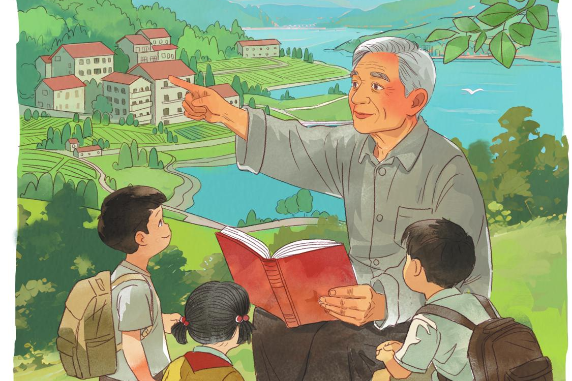
For 95-year-old New Fourth Army veteran Zhang Kexia, the scattered memorial halls and historic battlefields across China’s inland mountain regions are far more than static relics of history. Enlisted at just 13 years old, Zhang sees these sites hold profound meaning as living, foundational pillars of Chinese identity. “They are not cold stones and abandoned old buildings,” she explained. “They are the shared root of all Chinese people.”
For decades, however, these iconic old revolutionary base areas – the rural strongholds that nurtured China’s national liberation movement between 1927 and 1949 – faced a stubborn contradiction. Though they carry unmatched historical significance, their remote geographic locations and rugged terrain left them struggling to keep pace with China’s sweeping national economic growth over the past decades.
Today, a profound, nationwide transformation is unfolding across these regions, driven by a landmark strategic commitment from the Chinese central government. In March 2026, the general offices of the Communist Party of China Central Committee and the State Council released official guidelines to accelerate the comprehensive revitalization of old revolutionary base areas, formalizing this national priority.
The new policy framework lays out a clear development roadmap extending to 2035, with the core goal of aligning these regions’ modernization progress with the country’s broader national development targets by fostering self-sustaining, long-term economic growth. Moving away from the heavy reliance on direct government subsidies that characterized past support models, the new strategy taps into the unique local assets these regions hold – most notably their deep, rich Red cultural heritage – and integrates this legacy with modern industrial development, ecological conservation, and national rural vitalization initiatives.
This integrated development model is already being put into practice in Shanxi province, a region home to some of China’s most pivotal old revolutionary base areas, including the key strongholds of the Eighth Route Army, the CPC-led main fighting force during the Chinese People’s War of Resistance Against Japanese Aggression from 1931 to 1945. Tian Yuehui, deputy curator of the Taihang Memorial Museum of the Eighth Route Army in Wuxiang County, Changzhi, has watched this transformation unfold over her 26-year career at the site.
Since opening to the public in 1988, the museum has evolved from a static memorial into a vibrant, engaging cultural tourism destination, according to Tian. In 2025 alone, the site welcomed more than 1.03 million visitors and hosted over 500 cultural and educational activities designed specifically for diverse audience groups.
Beyond the museum itself, Tian noted that local authorities have developed an extensive cluster of cultural industry projects, including a purpose-built Red cultural park and a public peace square, to further amplify and preserve the Eighth Route Army’s cultural legacy. These initiatives, she explained, are injecting new, dynamic vitality into the high-quality development of the local old revolutionary base area.
“Empowering the local cultural and tourism sector with our unique Red heritage is not only a core cultural mission for this region, it is also the only viable path to achieve robust, sustained development here,” Tian said. Backing this growth momentum, local officials have set an ambitious target to generate 3 billion yuan ($435.9 million) in annual direct tourism revenue by 2035.
This localized development approach aligns perfectly with the priorities laid out in the national revitalization guidelines, which emphasize turning historical heritage into a dynamic, self-sustaining engine for modern shared prosperity.
The national policy document outlines a multifaceted strategy that supports the development of distinctive local industries, advances coordinated regional and urban-rural development, strengthens core infrastructure and public service systems, expands support for education, science, technology and talent cultivation, and preserves and promotes the iconic Red culture that defines these historic regions.
For residents and business owners who live and work in these areas, the true measure of the policy’s success lies in its tangible impact on local economies and everyday life. In Jiangxi province, the synergy between Red tourism expansion and rural entrepreneurship is already delivering visible, widespread prosperity.
Ruijin, the historic capital of the Chinese Soviet Republic founded by the CPC in 1931 in southern Jiangxi, is home to Zhufang Village, which once served as a critical logistics base for the provisional central government and hosts multiple historic sites from early revolutionary health care institutions. In recent years, Zhufing has leveraged its unique Red heritage to build a modern health and wellness economy, centered on the integrated development of cultural tourism, rural homestays, professional health services, sustainable agriculture and other connected industries.
“The most obvious transformation has been the massive upgrade to local infrastructure and supporting public facilities,” said Wang Xinwen, who operates a popular homestay in Zhufang. He pointed to improved paved roads, new public lighting and modernized sanitation systems as game-changing improvements. “These upgrades have directly lifted the overall visitor experience, which translates directly to higher revenue and more stable business for local operators like me,” he explained.
Wang recalled a recent group of travelers from the Inner Mongolia Autonomous Region who had only planned a short layover in the village. “They were genuinely surprised to find such a pleasant, well-maintained scenic spot here in Ruijin,” he said. “They enjoyed their stay so much that they extended their visit by an extra night after just one day exploring the area.”
Wang added that he has seen rapid growth in demand for integrated health, wellness and study-tour services in the region. “This development path has enormous growth potential, and it aligns perfectly with the national push to revitalize old revolutionary base areas. It not only promises solid growth for individual local businesses, it also lifts the entire local tourism sector as a whole,” he said.
Wang emphasized his appreciation for the government’s heavy investment in public infrastructure, which allows local business owners to focus their own resources on upgrading service quality and visitor experiences, rather than funding basic public works. “Working in partnership with the local government – with clear policy guidance and full support at every step of the process – we feel far more confident and secure building our businesses here,” he said.
The growing wave of revitalization has also attracted a new generation of young entrepreneurs back to their rural hometowns. Zhong Dan, a 30-something entrepreneur, moved back to Ruijin from Beijing to launch an e-commerce platform that sells local, sustainably grown agricultural products to national consumers. “My decision to come home was driven by two things: my belief in the quality of my hometown’s eco-friendly farm produce, and my desire to use my professional e-commerce experience to bring these local specialties to a much wider national audience,” she explained.
When Zhong and her husband first launched their farm operation, however, the village had underdeveloped roads, weak basic infrastructure, and the remote location made logistics and access extremely difficult. The local government stepped in with substantial targeted support, installing 10 new public street lamps for the farm at no cost. It also helped the village secure 900,000 yuan in collective village funds to upgrade general local infrastructure, and assisted Zhong in accessing an additional 300,000 yuan in funding to reinforce a local river embankment that protected the farm.
In recent years, the overall upgrading of village infrastructure and the booming growth of Ruijin’s Red tourism sector has directly boosted Zhong’s business. In 2025, the farm generated 2 million yuan in turnover, selling a diverse range of products including free-range chickens, ducks, soft-shelled turtles, grass carp, wild honey, lotus seeds, wild mushrooms, as well as newly introduced organic rice and high-quality camellia oil.
Zhong is deeply optimistic about the long-term development of Ruijin and other old revolutionary base areas. “We are committed to promoting Ruijin’s high-quality agricultural products and rich rural tourism resources, introducing our local specialties and beautiful natural landscapes to a much broader national audience,” she said.
She also voiced hope for continued government support for young e-commerce entrepreneurs building businesses in these regions.
“Expanded access to more resources would allow more local businesses like ours to help raise incomes for more local villagers,” she added. “By riding this wave of revitalization, we can grow our ventures through rural tourism, agricultural e-commerce and other innovative industries to build a better, more prosperous future for everyone in these historic regions.”