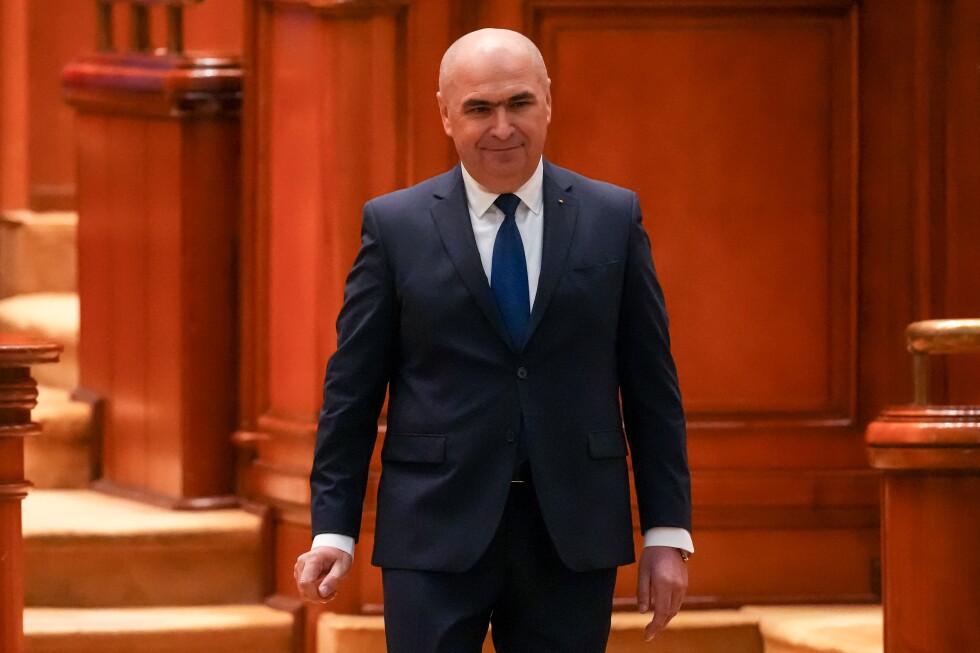
Romania’s pro-European center-right government, led by Prime Minister Ilie Bolojan of the National Liberal Party (PNL), faces a defining no-confidence motion on Tuesday that could oust the administration less than 12 months after it took office, bringing fresh political instability to the Eastern European EU member state.
The motion, submitted to Romanian parliament last week, is a joint push by two unlikely allies: the leftist Social Democratic Party (PSD), a former coalition partner that exited the governing bloc in late April, and the hard-right opposition Alliance for the Unity of Romanians (AUR). To succeed, the vote requires a minimum of 233 votes in favor from sitting lawmakers, and both opposition parties have already claimed they have secured enough backing to pass the measure.
Romania has been mired in persistent political uncertainty since the December 2024 annulment of its presidential election. Beyond the political turbulence, the country is also grappling with severe economic headwinds: it holds one of the largest budget deficits across the European Union, faces soaring inflation, and is currently stuck in a technical recession. When the ruling coalition was inaugurated last June, its top policy pledge was to cut the ballooning national deficit. But tensions over the austerity reforms implemented to hit that target ultimately split the coalition: the measures include tax increases, freezes on public sector wages and pensions, public spending cuts, and reductions to civil service roles, and PSD has repeatedly clashed with Bolojan over these policies.
Addressing parliament on Tuesday ahead of the vote, Bolojan slammed the no-confidence motion as “cynical and artificial”, arguing it was drafted by actors unfamiliar with the daily work of governing. “It is cynical, because it does not take into account the context in which we find ourselves,” he said. “I assumed the position of prime minister, being aware that it comes with enormous pressure and that I would not receive applause from the citizens. But I chose to do what was urgent and necessary for our country.”
Bolojan added that the tough but necessary fiscal policies his government implemented had already “regained the trust of the markets in the Romanian government”. For its part, PSD argues the prime minister has “failed to implement any genuine reform” over his 10 months in office, and claims the country needs a leader “capable of collaboration”.
AUR leader George Simion struck a populist tone in his parliamentary address, arguing that voters “supported and wanted water, food, energy, but had received taxes, war and poverty.” “We assume the future of this country, a future government and restore the hope of the Romanians,” Simion said. “Romania must go back to the vote of the Romanians.”
If the motion passes and Bolojan is removed from office, any new pro-European parliamentary majority will still require the participation of PSD. The party has repeatedly ruled out entering into a formal governing coalition with AUR, a stance backed by the presidency, which has confirmed it would never endorse an official PSD-AUR cabinet.
Cristian Andrei, a political consultant based in Bucharest, projected the crisis will most likely end in a prolonged political stalemate. “No one has a majority, or a coalition, and it will take the president weeks to find such a majority and name a new prime minister, prolonging the indecision,” Andrei explained.
He outlined two potential paths forward if Bolojan steps down, both of which carry significant hurdles: a reshuffled coalition made up of the same original partners but led by a new prime minister, or a minority cabinet led by PSD with informal support from populist groups including AUR and smaller parliamentary factions. A rotation of the prime ministerial post from PNL to PSD was already scheduled for 2027 as part of the original power-sharing agreement between the two former allies, with a general election set to take place in 2028.
This report was contributed by Stephen McGrath from Leamington Spa, England.