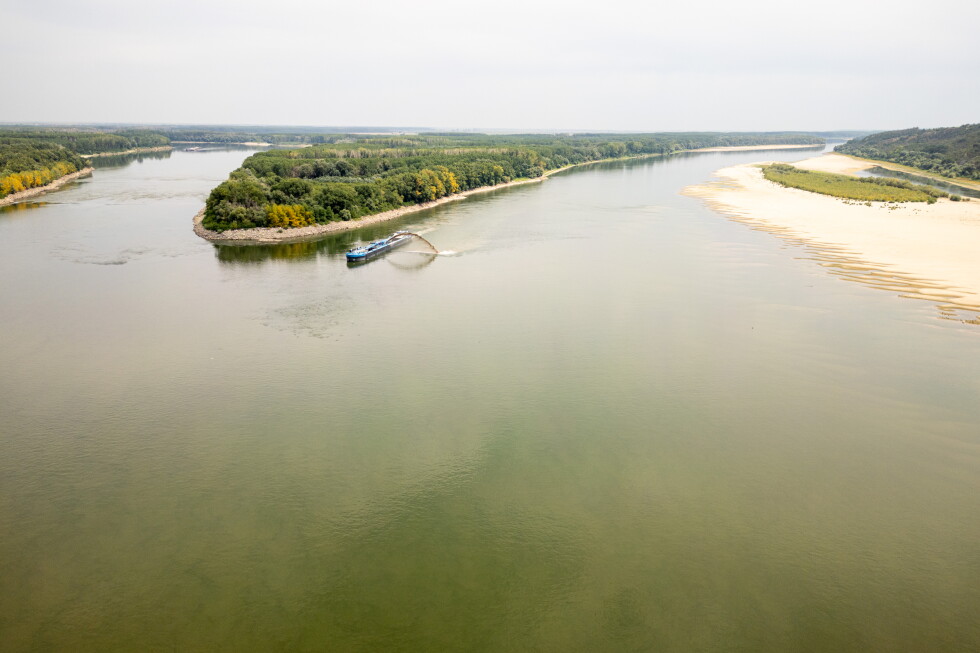
Amid a crippling regional drought that has pushed the Danube River to historic lows, Romania launched urgent emergency operations Thursday to sink four rock-laden barges in the waterway, in a last-ditch effort to redirect sufficient flow to the country’s critical Cernavoda nuclear power plant and prevent an immediate full shutdown of the facility.
Unprecedented heatwaves and drastically below-average rainfall across Eastern Europe have drained the Danube to record-low levels over the past seven days, forcing the plant to take its first reactor offline last week. When fully operational, the state-owned Cernavoda facility contributes roughly 20% of Romania’s total national electricity output, and relies directly on Danube water to cool its operating reactors.
The four barges were filled with rock extracted by the Romanian military from sections of the river near the Bala Canal earlier this week. Once fully submerged, the vessels will form a submerged barrier that shifts water flow back into the river’s main shipping and cooling channel, guiding it straight to the Cernavoda plant located downstream.
Romeo Urjan, director of the Cernavoda nuclear facility, told Romanian local news outlet Digi24 Thursday that the river’s water level had dropped an additional 2 centimeters (0.78 inches) between Wednesday and Thursday. Without the emergency barge barrier, Urjan confirmed the plant’s second and only remaining operational reactor would be forced to shut down within just five to six days. With the intervention, he projected the reactor could stay online for an extra four to five days, extending operations to nine to 10 days total from Thursday. Urjan also noted that it will take approximately 24 hours for the flow adjustment from the submerged barges to reach the plant, which sits 60 kilometers (37 miles) downstream from the worksite.
Since the first reactor was shut down, Romanian authorities have rolled out a series of emergency mitigation measures, including large-scale dredging of shallow sections of the river. This week, the Danube’s flow through Romanian territory dropped to 1,400 cubic meters per second — the lowest level recorded in decades, and less than one-third of the seasonal average for this time of year.
On July 31, acting Romanian Prime Minister Ilie Bolojan declared a nationwide state of alert for the country’s energy sector. Speaking to reporters Thursday, Bolojan reiterated an appeal to citizens and local governments to voluntarily cut back on electricity use during peak evening demand hours, and confirmed that the barge sinking operation would continue through Friday.
Following a special government meeting to address the crisis, Bolojan said all ongoing works are designed to maintain sufficient water flow even as forecasts predict Danube levels will remain at critically low levels. The core priority, he emphasized, is keeping enough water moving to the plant to allow the second reactor to continue operating “at maximum capacity.”
Bolojan also warned that a full shutdown of Cernavoda would leave Romania facing significant energy shortfalls. While the country could turn to energy imports from neighboring countries to cover peak evening demand, most neighboring states are also grappling with their own energy disruptions tied to the ongoing drought.
The drought-driven energy crisis is not isolated to Romania. In neighboring Hungary, record-low Danube levels have left the country’s only nuclear power plant at risk of a full shutdown — a scenario that has not occurred in decades. In Moldova, which relies heavily on imported electricity including from Romania, authorities have also issued public appeals for citizens to voluntarily cut electricity consumption during peak demand hours.