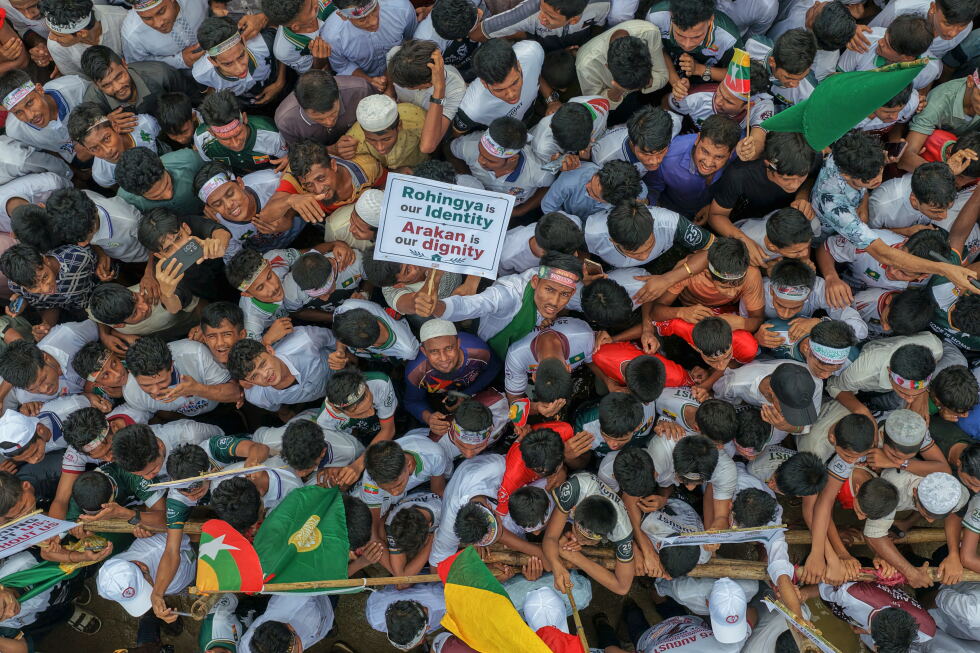
On Tuesday, marking nine years since they fled widespread violence in Myanmar’s Rakhine State, tens of thousands of Rohingya refugees gathered across dozens of sprawling camps in Bangladesh’s Cox’s Bazar to demand their safe, voluntary return to their homeland. The rally marked what Rohingya communities have named the “Ninth Anniversary of Rohingya Genocide Day”, with demonstrators calling on global powers to guarantee stable, secure conditions in Rakhine that would allow them to go home with dignity.
Today, more than 1 million Rohingya, an ethnic and religious minority from Myanmar, reside in the overcrowded refugee settlements that dot southeastern Bangladesh’s Cox’s Bazar district. The vast majority of this population fled across the border in a mass 2017 exodus, after Myanmar’s Buddhist-majority government launched a large-scale military crackdown in Rakhine. The operation was framed as a counterterrorism response to an attack by a Rohingya Muslim insurgent group, but it quickly escalated to mass violence that pushed hundreds of thousands of people to flee.
Bangladesh, a Muslim-majority nation, opened its borders to the fleeing populations, absorbing more than 700,000 new refugees in 2017. This influx added to a community of more than 300,000 Rohingya who had already been living in Bangladesh for decades after fleeing earlier rounds of violence perpetrated by Myanmar’s military. Two prior attempts by the Bangladeshi government to launch organized repatriation failed, as no refugees agreed to return, citing ongoing safety risks in Rakhine. Bangladesh has repeatedly reaffirmed it will not force any refugee to go back against their will.
The 2017 crackdown has drawn widespread international condemnation, with the United Nations and multiple global bodies labeling the campaign as ethnic cleansing and genocide. In January 2024, the International Court of Justice (ICJ) held three weeks of public hearings on a case accusing Myanmar of committing acts of genocide against the Rohingya people in 2017. During the proceedings, the court reviewed thousands of pages of documentary evidence, sworn expert testimony, and confidential statements from witnesses that documented mass killings, systematic sexual violence, and the deliberate destruction of hundreds of Rohingya villages. Myanmar’s legal team argued before the court that its military campaign was a legitimate counterterrorism operation and did not meet the legal definition of genocide.
In the years since 2017, security conditions in Rakhine State have only grown more unstable. The territory is currently the site of active conflict between Myanmar’s military government and the Arakan Army, an insurgent group that has seized control of large swathes of the state.
“Whether it is the Arakan Army or the Myanmar military, as long as they continue playing this double game, the situation in Arakan (the historical name for Rakhine) will not become safe. Does that mean we are expected to remain here for another 50 years?” said Sayed Ullah, a prominent Rohingya refugee leader, during Tuesday’s rally. “We cannot stay here for 50 years. Given the current situation in Arakan, we need to determine how an environment conducive to peace can be created,” he added.
Earlier this month, Myanmar’s military-backed government made a new overture, stating that more than 300,000 Rohingya refugees in Bangladesh’s camps are former Rakhine State residents and that it would accept their return once security improves. But Bangladesh has pushed back against the claim, disputing Myanmar’s population statistics and criticizing the government’s persistent refusal to recognize the group by the name “Rohingya” — referring to them instead as “Bengali”, a move Bangladeshi officials frame as a deliberate attempt to deny Rohingya’s distinct ethnic identity.