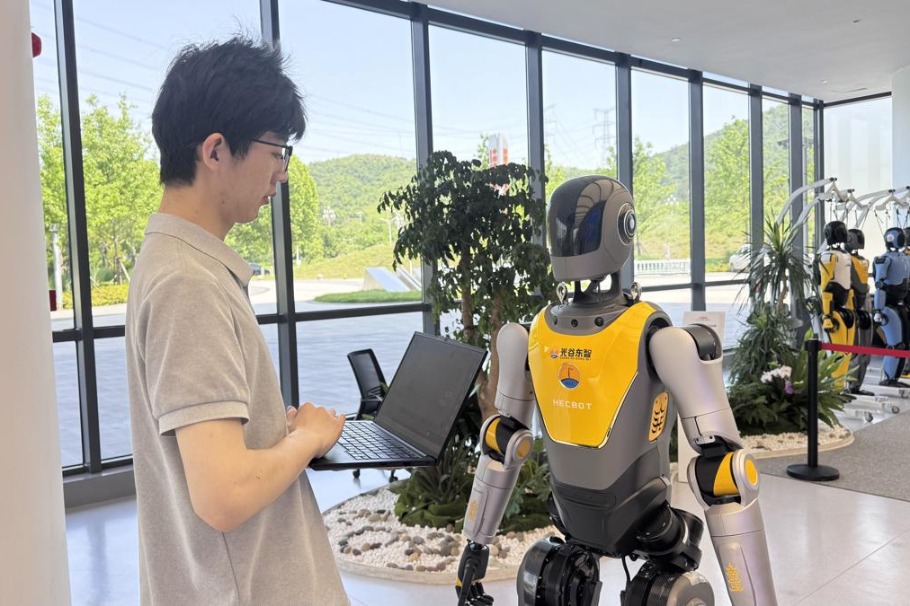
As China’s humanoid robot industry surges ahead to capture a dominant share of the global market, a pioneering new initiative in central China’s Hubei province is set to create the country’s first full-lifecycle digital identity system for humanoid robots, addressing critical gaps in industry standardization and safety oversight.
The program, led by the Hubei Humanoid Robotics Innovation Center based in Wuhan, will assign a unique 29-character alphanumeric ID to every registered humanoid robot, embedding core static information ranging from the robot’s brand origin, manufacturing enterprise, product model, and serial number to factory filing records, hardware specifications, and intelligence rating. Modeled after the national ID system used by Chinese citizens, every robot’s identification code is permanently unique, with 11 extra characters added to accommodate industry-specific tracking needs.
Unlike basic product labeling, the digital ID enables end-to-end traceability across the robot’s entire working life. Beyond static manufacturing details, the system logs dynamic information including routine maintenance histories and deployment application scenarios. A cloud-based management platform also allows authorized stakeholders to access real-time performance data at any time, including readings on joint wear and tear, battery health, and operational accuracy, according to Liu Chuanhou, the innovation center’s chief operating officer.
“In the event of a robot malfunction, we can pull its full operational logs and maintenance records via the unique ID to quickly locate the fault, confirm accountability, and complete efficient repairs,” Liu explained. The ID system also streamlines the secondary market for robots: when a robot is transferred to a new user, the new owner can verify full performance and service histories directly through the ID, eliminating the need for costly redundant testing and boosting reuse efficiency.
On May 11, the innovation center completed the first round of product filing applications and coding trials with China’s Ministry of Industry and Information Technology. The first batch of participating enterprises includes major players across Hubei’s entire humanoid robot industrial chain, including Optics Valley Dongzhi, GLRoad, Hubei Qirobotics, Jingchu Humanoid Robot, HandX, Guanggu Haribit, and Maxnova.
Liu Jieni, business director at Maxnova, confirmed that several of the firm’s flagship humanoid robots have already completed unified coding and official filing. Most of the company’s robots are deployed across industrial manufacturing, commercial services, and professional demonstration training, and Liu said joining the national initiative aligns perfectly with the industry’s growing push toward unified standards.
“Participating in this program not only helps us resolve existing compliance gaps and cut overall operation and maintenance costs, but it also clears the way for large-scale market expansion of our products,” Liu Jieni said. “At the same time, it lets us accumulate valuable data assets that further strengthen our core competitiveness and brand influence across the industry.”
Recent industry data underscores the urgency and importance of the new traceability system. A report published in March 2026 by Beijing CCID Publishing and Media and China Electronics News shows that global humanoid robot shipments hit approximately 17,000 units in 2025, with the total global market valued at 2.88 billion yuan (around $424 million). Thanks to strong advantages in supply chains, core technologies, and diverse application scenarios, China now leads the world in the humanoid robot industry, the report found.
China is home to more than 140 active humanoid robot manufacturers, with domestic shipments reaching 14,400 units in 2025 — accounting for 84.7% of total global supply. The country’s domestic humanoid robot market reached 1.55 billion yuan last year, representing 53.8% of the total global market value.
But despite this rapid growth, the industry still faces systemic challenges. Many enterprises operate with incompatible, disconnected technical standards, and there has been no unified regulatory framework for product traceability, safety supervision, and cross-enterprise data circulation to date, Liu Chuanhou noted. The new ID initiative is designed to address these gaps, drive industry-wide standardization, and build a solid institutional foundation for the large-scale, high-quality development of China’s humanoid robot sector.
As high-end intelligent equipment becomes increasingly integrated into industrial production and everyday public life, humanoid robots also carry underaddressed potential risks related to operational safety, data security, and ethical compliance. “In cases involving safety incidents or potential data hazards, the unique ID number supports rapid traceability and clear liability confirmation, helping prevent risks such as technology misuse and sensitive information leakage,” Liu Chuanhou added.