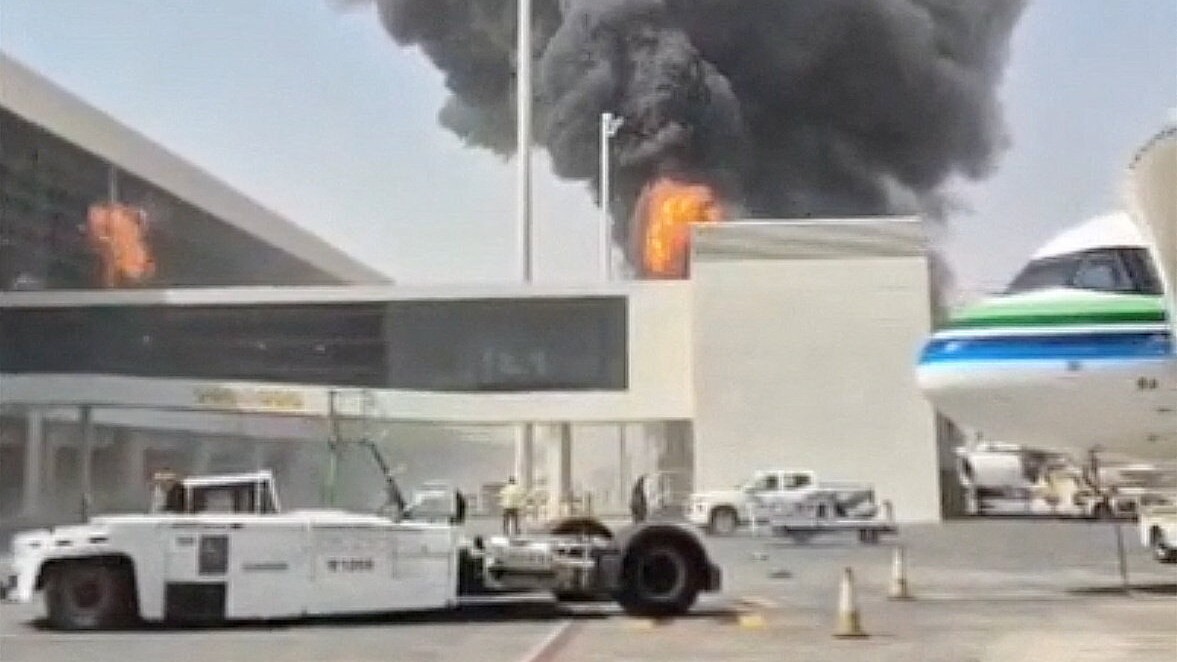
For decades, Saudi Arabia has carefully crafted a public image as a stable sanctuary amid the widespread chaos that has gripped much of the Middle East. That carefully constructed narrative has been violently torn apart, however, following a pair of deadly Houthi attacks on the kingdom’s capital that have left thousands of expatriate residents questioning their future in the country and thrown Riyadh’s ambitious economic and image-building plans into doubt.
The first and deadliest assault came Saturday, when Houthi forces launched a strike targeting King Khalid International Airport, Riyadh’s primary international air gateway and a key hub for religious travelers bound for the holy city of Mecca. The attack left at least 12 civilians dead and more than 300 others injured, with casualties ranging from a Bangladeshi cleric and a Syrian mother of four to a United States citizen. State broadcaster Al Ekhbariya aired shocking CCTV footage from the attack showing pilgrims clad in traditional white Umrah garments scrambling for cover as ceiling panels collapsed and thick dust engulfed the airport’s main lounge.
A second, follow-up strike the next day killed one additional person and wounded at least 11 more. Beyond the airport attack, the Houthi movement also fired cruise missiles toward key Saudi oil infrastructure and Dammam Airport in the kingdom’s eastern province. Houthi officials have framed the coordinated assaults as a direct retaliation for Riyadh’s ongoing military support for Yemeni government forces in the country’s long-running civil war, as well as a Saudi airstrike that targeted Sanaa Airport earlier this year.
The violence has sent shockwaves through Riyadh’s large expatriate community, many of whom have built long-term lives and careers in the kingdom. Bilal, a 39-year-old British expat who has lived in the Saudi capital for seven years, condemned the attack in an interview with Middle East Eye, noting that civilian spaces and religious travelers should never be targeted. “There’s no justifying attacks on ordinary people, and no way they can defend striking a civilian facility – whatever the Saudi-led coalition did in the war years ago,” he said. While Bilal noted he has no immediate plans to abandon his well-compensated position and comfortable life in Riyadh, he acknowledged he would not hesitate to send his family back to the UK if attacks become more frequent.
Similar concerns were echoed by Mohamed, another British national who has lived in Riyadh on and off for a decade. Mohamed told MEE he had long viewed the kingdom as a safe place to raise his children, but the failure of Saudi Arabia’s advanced missile defense systems to intercept the attack on one of the country’s most critical infrastructure sites left him deeply unsettled. “My children are also pretty scared by what’s happening,” he said. “I’ve reassured them that they will be safe, but with schools being cancelled and some foreigners openly expressing their plans to return to their home countries, it’s becoming much harder to explain Riyadh no longer feels safe.”
Beyond the immediate human cost, the strikes have struck a severe blow to the core of Crown Prince Mohammed bin Salman’s flagship modernization agenda. In recent years, the crown prince, who launched the Saudi-led military intervention in Yemen back in 2015, has worked tirelessly to rebrand the kingdom as an attractive destination for global business, tourism, and foreign direct investment. Just two weeks out from Riyadh’s high-profile Future Investment Initiative – the kingdom’s flagship investment conference that aims to draw billions in foreign pledges – a major energy conference scheduled for Sunday drew only a handful of international delegates, signaling early investor jitters over the new security risk.
The latest attacks mark a sharp dangerous escalation in the nearly decade-long confrontation between Saudi Arabia and the Houthi movement, which controls most of northern Yemen. The conflict had been locked in a lengthy stalemate for months until Saudi-led forces launched an airstrike on Sanaa Airport in July, aimed at preventing a plane carrying Houthi officials from Iran from landing in the rebel-held capital. In response, the Houthi movement threatened reciprocal action, vowing to target core Saudi interests in response to restrictions on their access to key airspace and transport routes. The group later declared an embargo on all Saudi shipping passing through the Red Sea – a route that has grown dramatically in importance for Saudi oil exports after tensions related to the Iran conflict disrupted shipments through the Strait of Hormuz, which normally carries roughly one-fifth of global oil and gas supplies.
The long-running conflict traces its roots back to 2014, when the Houthi movement capitalized on widespread public anger over crippling fuel subsidy cuts and the failure of a UN-backed national dialogue process to resolve Yemen’s deep-seated political and economic divides. After rejecting a proposed federal governing structure, the Iran-aligned movement advanced south and seized Sanaa, forcing the internationally recognized government of President Abd-Rabbu Mansour Hadi into exile. A Saudi-led military coalition intervened in March 2015 with the stated goal of restoring Hadi’s government to power. Backed by American-made munitions and British-built fighter jets, the coalition’s military campaign has killed hundreds of thousands of Yemenis, most of whom have died from preventable causes including hunger, disease, and the total collapse of essential public services.
Beyond its impact on Saudi Arabia’s domestic security and economic ambitions, the escalation has also laid bare growing strains between Gulf Arab states and their long-standing security partner, the United States. For more than 70 years, the six member states of the Gulf Cooperation Council – Bahrain, Kuwait, Saudi Arabia, the United Arab Emirates, Qatar, and Oman – have hosted U.S. military bases and infrastructure, and spent hundreds of billions of dollars on American weapons systems, in exchange for Washington acting as the region’s primary security guarantor. That long-standing arrangement is now under unprecedented strain, a senior Gulf analyst told Middle East Eye on condition of anonymity due to the sensitivity of the issue.
The analyst noted that Saudi leaders were already deeply concerned by former President Donald Trump’s decision to abandon diplomatic engagement with Iran in favor of a confrontational approach, which left regional allies to face the consequences of a conflict they did not choose. That frustration only deepened after the Riyadh attacks, when Trump publicly stated that Saudi Arabia was “able to defend” itself against Houthi attacks, signaling a historic retreat from long-standing U.S. security commitments. “The US has spent decades asking Gulf states to invest in American weapons and build their security around Washington. When the threat materialises, dismissing it as something Saudi Arabia can handle raises serious questions about what that partnership is actually worth,” the analyst said.
The growing uncertainty around U.S. security commitments has increased the strategic importance of the Mecca Joint Defence Agreement, a new collective defense pact signed by Saudi Arabia, Turkey, and Pakistan in August. The agreement is designed to strengthen regional deterrence against shared security threats, though questions remain over the timing and scale of any Turkish military deployment to the kingdom, as Ankara weighs its next strategic moves.