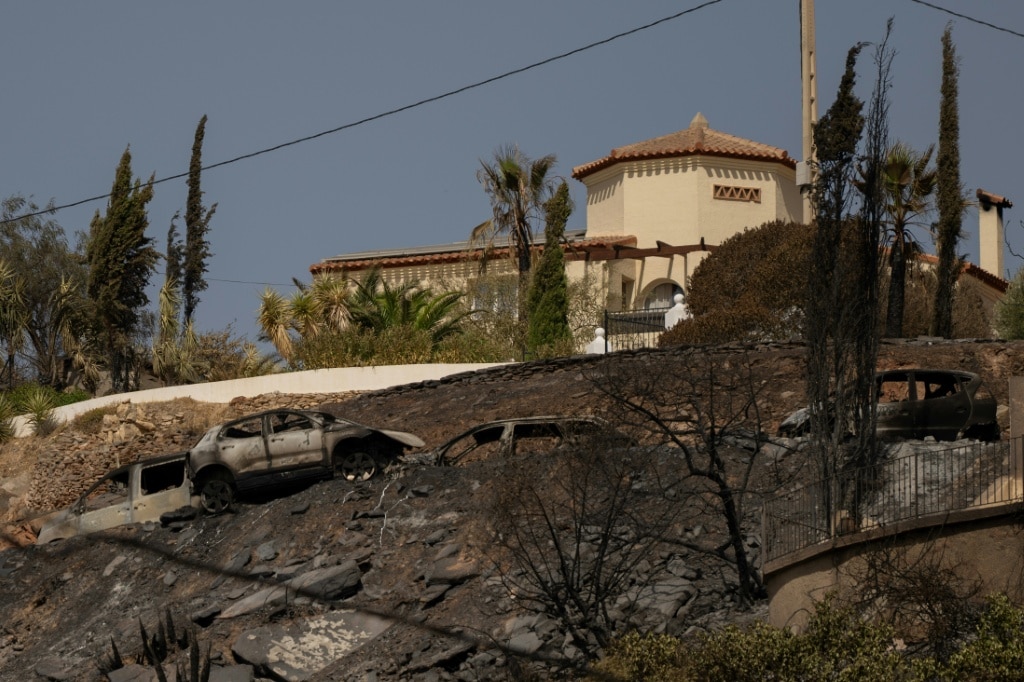
The arid hills of southeastern Spain’s Mediterranean coast, long a quiet haven for retirees and holidaymakers from across Europe, have been reduced to ash by a devastating fast-moving wildfire that has claimed 12 lives and scorched more than 6,000 hectares of land. Survivors of the blaze, which broke out last Thursday amid record-breaking extreme heat that turned dry vegetation into a tinderbox, have shared harrowing accounts of sudden escape and narrow survival as flames advanced faster than many could outrun.
When the fire’s edge began to encroach on the small village of Bedar, the epicenter of the disaster, 72-year-old local town councillor Manoli Ramos received an urgent, last-minute order from the mayor: race to the village church and ring its bells to sound the alarm for residents who had not yet received official evacuation alerts. “We rang the bells many times so people would know,” Ramos told AFP from her temporary refuge in nearby Los Gallardos, one of hundreds of displaced residents who fled their homes as the blaze moved through the region.
Official preliminary investigations point to a broken power line as the likely ignition source, with the extreme heat wave that has gripped southern Spain creating ideal conditions for the fire to spread rapidly. Most of the 12 victims killed were foreign residents, many of whom died trapped in their vehicles or while attempting to escape on foot. Officials have noted that many of the foreign residents in the area live in scattered, isolated properties outside the core of Bedar, drawn by the privacy and quiet of the rural hillside — a choice that left many with slower access to emergency warnings and fewer clear escape routes as the fire advanced.
“Foreigners live scattered outside Bedar,” Ramos explained. “They have beautiful homes and their belongings. They like living a little away from the centre.”
For 52-year-old Moroccan resident Hassan Oulghazzi, who has called Bedar home for 16 years, the first sign of danger was not visible flames, but an ominous dark cloud hanging over the hills that quickly turned into thick, choking black smoke. Before he could spot the fire advancing, local police were pounding on his front door, ordering him to leave immediately.
“How could you not be afraid?” Oulghazzi said. “When someone knocks on your door and tells you: ‘Get up, come on, leave here. This is real, you have to go.’” He fled with his wife and daughter with only the clothes they were wearing, leaving all their possessions behind. The family has since taken shelter at a municipal sports hall in the coastal town of Garrucha, where the Red Cross is providing food, medical care and support to hundreds of evacuees. For Oulghazzi, his own fear of displacement pales in comparison to the grief of losing neighbors and acquaintances in the blaze.
“Everyone was afraid, but I am really touched by the dead and those who were burned. I really am,” he said. “There are some people I know.”
Local officials have confirmed that some of the victims did not follow official orders to evacuate early or shelter in place once the flames reached their properties, a choice that proved fatal as the fire moved faster than many anticipated. For survivors who did escape, the scale of the destruction is still difficult to process, with many describing the scene as something out of a disaster film, not real life.
Eighty-seven-year-old British evacuee Austin Crilly, who has lived in the region for years and says he has weathered no shortage of crises, told reporters that Thursday’s blaze was unlike anything he had ever experienced. Crilly was watching television at home when he spotted what he thought was an unusual large dark cloud on the horizon. Minutes later, police arrived at his door with a direct order to evacuate immediately. “Take your money, take your cards and get out,” he recalled officers telling him. Like many other evacuees, Crilly has been staying at the Garrucha sports hall, waiting for updates on when it will be safe to return to assess his home.
British couple Martin and Elizabeth Smith, who were staying at a local campsite for a holiday, echoed that sense of surrealism. Martin Smith, 63, who has already had to cut his trip short and return to the United Kingdom, said the chaos of the escape was something he had only ever seen on screen. “It wasn’t good. Not good at all. I’d never seen anything like it. You see things like that in films, but never in real life,” he said. Despite the trauma of the disaster, Smith added that the fire has not dimmed his affection for Spain as a holiday destination. “It hasn’t put us off coming to Spain,” he said.