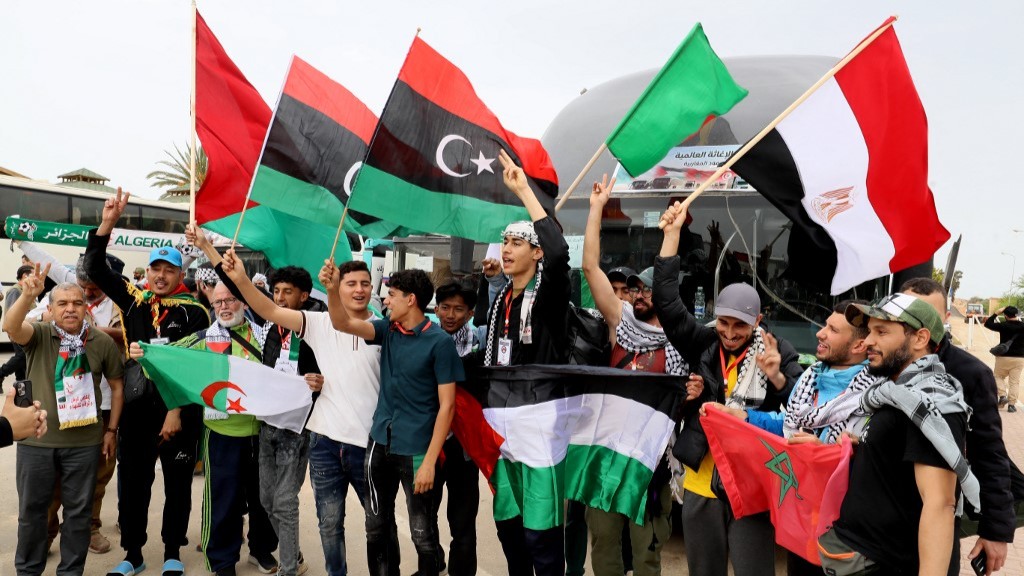
Nearly two months after 10 international pro-Palestinian activists were taken into custody by forces loyal to prominent Libyan military commander Khalifa Haftar in eastern Libya, global human rights organizations are escalating calls for their immediate and unconditional release. The activists, who hail from Spain, Poland, the United States, Argentina, Uruguay, Portugal, Tunisia and Italy, were arrested in late May while participating in the Global Sumud Convoy, a grassroots humanitarian initiative organized to deliver critical assistance to the blockaded population of the Gaza Strip.
Of the 200 activists that made up the cross-border convoy, all but 10 were forcibly deported from eastern Libyan territory following the operation by the Libyan Arab Armed Forces (LAAF), Haftar’s primary military wing. In protest of their arbitrary detention and repeated denial of access to legal counsel and family communications, the 10 detainees launched a hunger strike that ran from June 1 through at least June 4, according to public statements from rights monitors.
Amnesty International has confirmed that the activists are currently being held in pre-trial custody as investigators pursue charges of “unauthorized assembly.” If convicted on these counts, the campaigners could face up to six months of prison time and substantial financial fines. Mahmoud Shalaby, regional researcher for Amnesty International, issued a harsh rebuke of the detentions, describing the targeting of Gaza-focused humanitarian campaigners on what he called “bogus charges” as outright disgraceful.
“No one should be punished for undertaking peaceful humanitarian action and trying to stop human rights abuses,” Shalaby said in an official statement. He added that the LAAF must not only release the activists immediately and without preconditions, but also grant them prompt, regular access to family members, their respective consular representatives, legal teams and any necessary medical care while they remain in custody.
The detentions unfold against a backdrop of longstanding political division that has fractured Libya since the 2011 NATO-backed overthrow of longtime authoritarian ruler Muammar Gaddafi. Today, the country is split between two competing centers of power: a UN-backed unity government based in the capital Tripoli that controls western Libya, and Haftar’s self-governing administration in the east, which is backed by regional allies including the United Arab Emirates and Egypt.
The Global Sumud Convoy, a land-based initiative connected to the high-profile sea flotillas that have long challenged Israel’s blockade of Gaza, was first launched by North African activists before drawing international participants. The convoy carried a substantial cache of humanitarian supplies: seven ambulances, 20 mobile housing units, 10 aid trucks, and it included among its participants medical professionals, engineers, educators and independent legal observers.
After entering the 5+5 security zone near the contested coastal city of Sirte – a buffer zone established under the terms of Libya’s October 2020 national ceasefire agreement – the group was intercepted by LAAF forces. The activists had entered the zone in hopes of negotiating safe passage to continue their journey toward Gaza.
While many participants and observers have praised the convoy’s core mission of breaking the 17-year Israeli blockade on Gaza and highlighted the organizers’ unwavering commitment to the humanitarian cause, some veteran activists who have taken part in previous Gaza solidarity initiatives argue the mission suffered from critical planning oversights that led to the current crisis.
Felipe, a 29-year-old Chilean-Palestinian activist who has participated in multiple previous sea-based Gaza flotillas, told Middle East Eye that the convoy’s leadership bore partial responsibility for the detention outcome. During the group’s two-week stay in Tripoli prior to entering eastern Libya, Felipe said it became increasingly clear that organizers had made little to no contingency plans for the risk of detentions or armed confrontation with LAAF forces.
“If we were not able to go through east Libya, we should not have kept pressuring them because we were going to shift the narrative from Israel to Libya,” Felipe explained. “We were waiting in the desert for nine days doing nothing.”