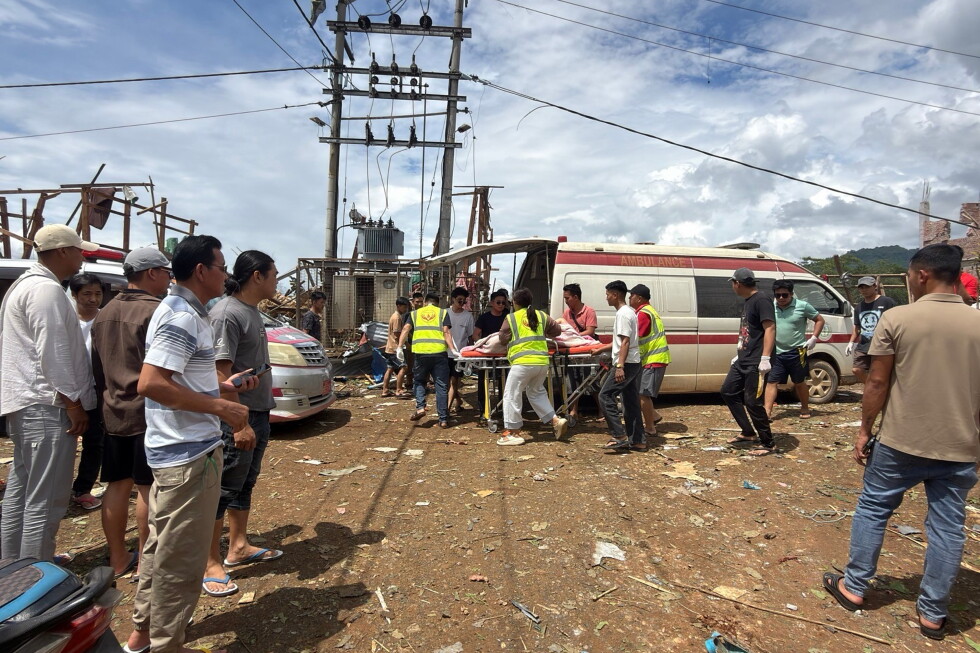
On a midday Sunday in Shan State, northeastern Myanmar, just kilometers from the Chinese border, a catastrophic detonation of improperly stored mining explosives ripped through Kaungtup village in Namhkam Township, leaving dozens dead and scores injured. By Monday, more than 14 rescue and charitable organizations had deployed heavy excavation equipment to comb through the blast site, recovering fragmented remains as teams worked to finalize an accurate casualty count.
The Ta’ang National Liberation Army (TNLA), the ethnic rebel organization that controls the Namhkam region, released an official statement Monday evening updating the death toll to 43, including seven young children. Earlier preliminary estimates from first responders had fluctuated between 38 and 45 fatalities, with the extreme force of the explosion turning many bodies to fragments making exact accounting a grueling, complicated process. The group added that 112 people were hurt in the incident, 25 of whom are children, and 37 remain in critical condition—leaving emergency responders bracing for the death toll to climb in the coming days. Rescue operations and casualty data compilation are still ongoing, the statement confirmed.
The incident has thrown a harsh spotlight on Myanmar’s sprawling, largely unregulated mining sector, which operates across resource-rich territories mostly controlled by armed ethnic groups locked in long-running sporadic conflict with the national military government. Unregulated extraction operations have seen frequent deadly accidents, including repeated catastrophic landslides at mining sites across the country in recent years.
According to the TNLA, the blast originated from stockpiles of gelignite, a common explosive used for small-scale mining and stone quarrying operations in the region. While gelignite is standard for industrial extraction, it becomes dangerously unstable over time when it is not stored following correct safety protocols. Shockingly, none of the roughly 200 households that call Kaungtup village home were ever notified that large quantities of explosive materials were being stored in their community. An official investigation into the exact root causes of the detonation remains ongoing.
Local residents told the Associated Press that silicon ore mines, which supply raw material for semiconductor manufacturing, solar panel production, and aluminum alloys, operate in the mountainous terrain roughly 10 miles southwest of Namhkam town. Speaking on condition of anonymity out of fear for their personal safety, the residents claimed these mines are jointly run by the TNLA and Chinese business partners, and are closed off to most local residents. The Associated Press has not been able to independently verify this claim.
Myanmar’s extractive industry is one of the world’s largest suppliers of rare earth elements, copper, tin, and high-value precious gems including jade and rubies, with nearly all extracted materials sent to China for processing and refining. China maintains a complex diplomatic and economic position in Myanmar: it is a key strategic ally of the military-led government that seized power in the 2021 coup, while also maintaining open ties to the country’s ethnic minority armed groups.
Following the blast, Chinese Foreign Ministry spokesperson Lin Jian issued a statement of deep condolences, confirming that one Chinese national was injured in the incident and is currently receiving medical care. Beijing has also offered to provide assistance to help manage the aftermath of the explosion.
The TNLA, a core member of the Three Brotherhood Alliance anti-military coalition, seized full control of the Namhkam region in late 2023 during a large-scale offensive against the military government. This offensive is part of the wider nationwide unrest that followed the February 2021 military coup, which ousted the democratically elected government led by Aung San Suu Kyi and sparked widespread armed resistance across the country. Though the TNLA signed a China-brokered ceasefire with the military government at the end of 2023, peace in the border region remains fragile. Control of mineral and gem extraction operations is a critical source of revenue for both the national military government and the ethnic armed groups opposing it, fueling continued low-level conflict and unsafe operating conditions for workers and nearby communities.