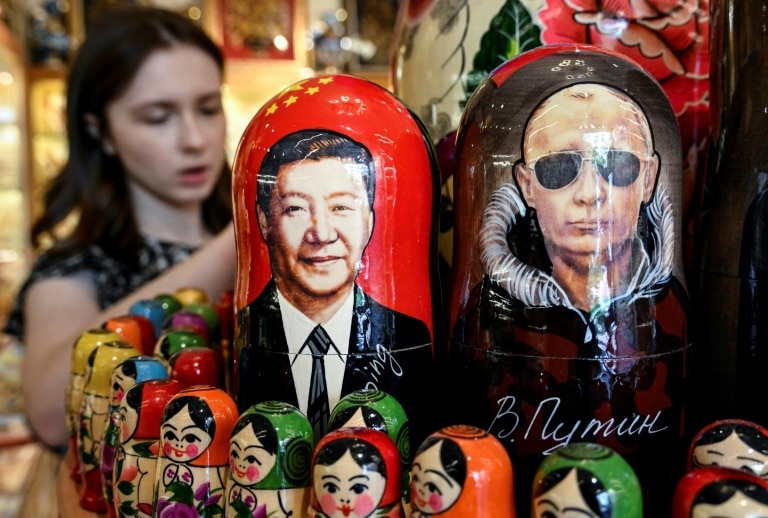
Just days after former U.S. President Donald Trump wrapped up his high-profile visit to Beijing, Russian President Vladimir Putin touched down in the Chinese capital this Wednesday for high-stakes talks with Chinese President Xi Jinping — a meeting framed to showcase the unwavering strength of the bilateral strategic partnership amid shifting global geopolitics.
Trump’s trip last week was marked by elaborate ceremonial pomp, but ended without major breakthroughs on key issues, most notably Chinese assistance to reopen the critical Strait of Hormuz, which has been closed amid ongoing conflict in the Middle East. For Putin, the visit comes at a challenging juncture: years of conflict in Ukraine and sweeping Western sanctions have significantly squeezed Russian energy export revenues, leaving Moscow increasingly economically dependent on Beijing, which has emerged as the primary buyer of sanctioned Russian crude.
The disruption to global energy supplies caused by the Iran conflict has opened a new window of opportunity for Moscow to court energy-hungry China, and observers widely expect Putin to use the summit to push for accelerated progress on the long-planned Power of Siberia 2 natural gas pipeline. The project, which will carry Russian gas to China via Mongolia, would offer Beijing a land-based alternative to seaborne energy imports from the Middle East, aligning with both nations’ goals of diversifying supply chains away from Western-aligned markets. Back in April, Russian Foreign Minister Sergei Lavrov noted after meeting Xi that Moscow stood ready to “compensate” for any Chinese energy shortages triggered by Middle East supply disruptions.
In a pre-visit video address released to the Chinese public on Tuesday, Putin emphasized that bilateral ties have reached “a truly unprecedented level”, highlighting that cross-border trade continues to expand. “The close strategic relationship between Russia and China plays a major, stabilising role globally. Without allying against anyone, we seek peace and universal prosperity,” Putin said, in a thinly veiled reference to shared opposition to U.S. global hegemony.
Under the current era of increasingly unpredictable U.S. foreign policy under the Trump administration, Beijing has moved to shore up strategic alliances with global powers, and Russia has emerged as its closest partner. Ties between Moscow and Beijing have deepened dramatically since Russia launched its full-scale invasion of Ukraine in 2022; with Western nations cutting diplomatic and economic ties with Moscow, Putin has traveled to Beijing annually to strengthen cooperation, and Xi has repeatedly welcomed the Russian leader as an “old friend” — a warm designation he did not extend to Trump during the U.S. president’s visit last week.
According to the Kremlin, Wednesday’s meeting will kick off with formal welcoming ceremonies, followed by closed-door talks before the two sides sign a joint statement outlining expanded cooperation. Unlike Trump’s visit, which was dominated by large-scale public ceremonial displays, Putin’s meeting will be held in a far more intimate setting, reflecting the deep familiarity and trust between the two leaders. “The Xi-Putin relationship does not require that kind of performative reassurance” that marked Trump’s reception, explained Patricia Kim, a foreign policy expert at the Washington-based Brookings Institution. Both leaders view their bilateral bond as “structurally stronger and more stable” than China’s relations with the United States, she added.
Ahead of the talks, analysts note that Xi is expected to brief Putin in detail on the outcomes of his recent summit with Trump. The lack of tangible breakthroughs from that meeting is likely a relief for Moscow, as it eliminates any risk that Beijing struck a deal with Washington that would undermine core Russian interests, Kim noted.
Putin is also traveling to Beijing seeking to lock in deeper Chinese economic commitment, particularly after Trump claimed during his visit that Beijing had agreed to buy more U.S. oil to meet what he called its “insatiable” appetite for energy. With Moscow heavily reliant on Chinese energy purchases to fund its war effort in Ukraine, “Putin does not want to lose that support,” said Lyle Morris, an Asia security expert at the Asia Society. Morris added that Putin will also be eager to learn Beijing’s stance on Middle East policy, after Trump signaled he expects China to take a leading role in resolving the regional standoff.
Still, analysts point out that China and Russia may hold differing priorities when it comes to the ongoing U.S.-backed conflict in Iran. China’s economy is heavily dependent on open navigation through global key shipping lanes, so Beijing strongly prefers an early end to the standoff in the Strait of Hormuz, explained James Char, a security analyst at Singapore’s Nanyang Technological University. For Russia, by contrast, the conflict has delivered economic benefits: higher global energy prices have allowed Moscow to sell more sanctioned oil at premium rates, meaning it may have less incentive to push for a quick de-escalation.
Beijing has maintained its long-stated neutral position on the Ukraine conflict, repeatedly calling for negotiated peace while never publicly condemning Russia’s military operation. While Trump and Xi discussed Ukraine during last week’s summit, those talks also ended without any major progress, mirroring the lack of breakthrough on the Strait of Hormuz.