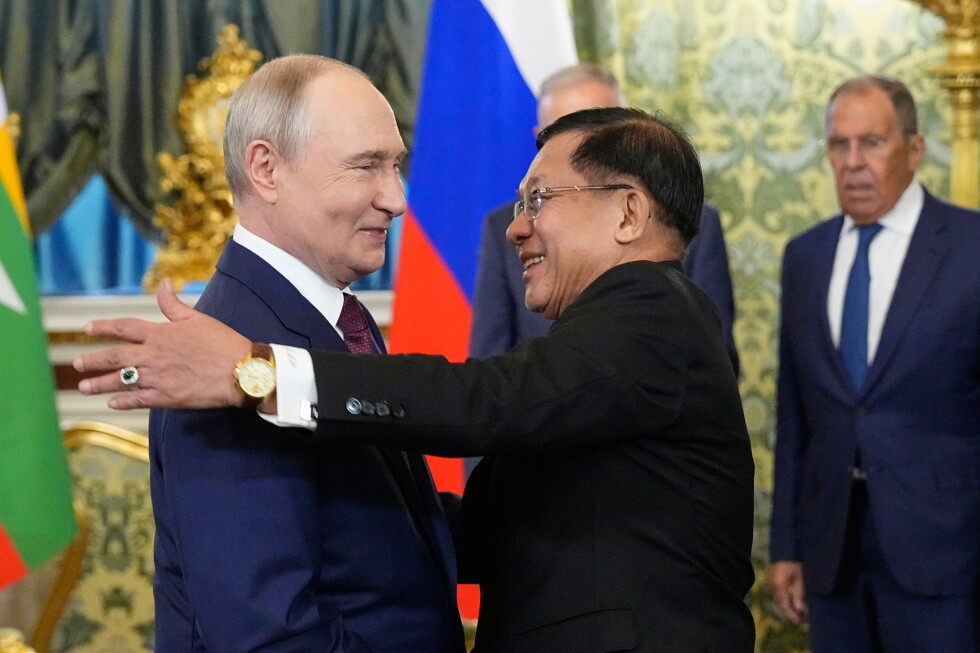
On Tuesday, Russian President Vladimir Putin welcomed Senior General Min Aung Hlaing, the head of Myanmar’s military-backed administration, to the Kremlin for high-level talks focused on expanding bilateral cooperation across multiple key sectors. The meeting marks the seventh visit Min Aung Hlaing has made to Russia since the 2021 military seizure of power, and underscores the deepening strategic alignment between the two nations.
Opening the negotiations, Putin outlined the long-running collaboration between Moscow and Naypyidaw, spanning foreign policy coordination, security partnerships, and joint economic infrastructure projects. The two sides have already conducted multiple combined military exercises, and advanced plans are in place for Russian firms to deliver a suite of major development projects across Myanmar, including a first nuclear power plant, a deep-water seaport, new oil refining facilities, and other critical public infrastructure.
This visit is part of a broader diplomatic push by Min Aung Hlaing, who has traveled to a handful of regional powers including China, India, Laos, and Thailand in recent years. The junta leader’s global outreach aims to shore up international recognition and rebuild diplomatic standing for Myanmar, which has remained largely isolated across the global community since the military ousted the elected civilian government of Aung San Suu Kyi in February 2021.
Western governments have responded to the power grab, which was led by Min Aung Hlaing, and the regime’s violent crackdown on opposition movements with sweeping economic and political sanctions. The repression has killed thousands of civilian non-combatants and sparked an ongoing nationwide civil conflict between junta forces and pro-democracy and ethnic resistance groups.
Moscow has repeatedly shielded Min Aung Hlaing’s government from criticism at major international forums, while Myanmar’s ruling generals have consistently backed Russia’s foreign policy priorities on the global stage. Along with Beijing, Moscow is one of the junta’s most prominent international backers and a leading supplier of military hardware; Russian-built fighter jets are currently used by the junta in offensive operations against territories held by ethnic minority armed groups, many of which are allied to national pro-democracy resistance forces.
During the talks, Min Aung Hlaing expressed gratitude to Putin for Russia’s consistent political support, and reaffirmed that Myanmar would remain a dependable strategic partner to Moscow. Russia’s Economic Development Minister Maxim Reshetnikov confirmed to reporters on the sidelines of the meeting that Moscow is prepared to expand exports of fuel products, agricultural fertilizers, and industrial equipment to Myanmar, while ramping up imports of Myanmar’s agricultural goods and textile products to balance bilateral trade.
Min Aung Hlaing’s most recent prior meeting with Putin took place on the sidelines of Moscow’s World Atomic Week Forum in September 2024, and Putin has not yet conducted an official visit to Myanmar. The junta leader was formally inaugurated as Myanmar’s president in April 2025, following a staged general election that was widely rejected by United Nations experts, global human rights organizations, and the international community as neither free nor fair. Critics have labeled the vote, which was held in staggered phases across late 2024 and early 2025, as a fraudulent attempt to cement the military’s permanent control over Myanmar while creating a veneer of civilian rule.