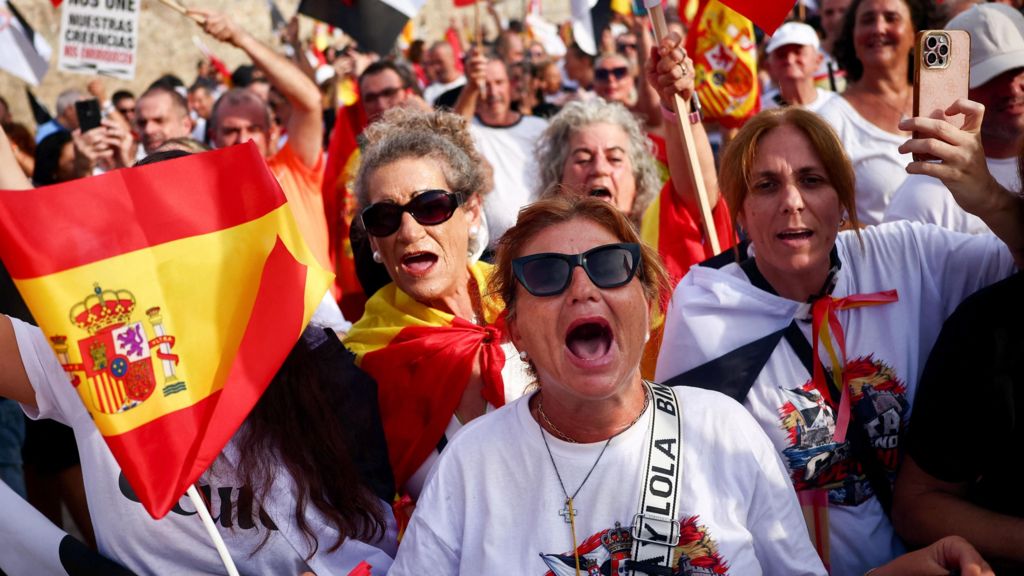
A wave of nationwide protests has swept across Spain this week, with thousands of demonstrators turning out in major cities including Madrid to condemn Prime Minister Pedro Sánchez’s response to the unprecedented mass migrant influx into the North African Spanish exclave of Ceuta. Organized by local councils controlled by or heavily influenced by the conservative opposition Popular Party (PP) and far-right Vox party, the rallies have amplified political pressure on the Sánchez administration, with thousands of protestors gathering in Ceuta itself to demand urgent action on the lingering humanitarian and security situation.
The crisis unfolded in late July, when more than 72,000 migrants crossed the border from Morocco into Ceuta over just two days, on July 30 and 31. While most of the migrants have since returned to Morocco, an estimated 5,000 remain, residing in overcrowded makeshift camps, spreading across city streets and occupying public beaches. This unresolved situation has sparked widespread unrest among local Ceuta residents, who have held near-daily protests calling for the remaining migrants to either be repatriated to their home countries or redistributed to other regions of Spain.
The political fallout deepened this week following the release of a Spanish National Police report obtained by local media, which contradicts earlier claims from Prime Minister Sánchez that Morocco bore no responsibility for the mass crossing. The report, submitted by the National Immigration and Borders Centre (CENIF) to Spain’s National Court, documents that Moroccan security forces maintained a posture of “total permissiveness” during the influx. It notes that Moroccan police deployed far fewer personnel around the Ceuta border than is standard during normal operations, and interviews with crossing migrants described Moroccan authorities taking a passive approach as thousands crossed. While the report stops short of explicitly accusing Morocco of orchestrating the crisis, it directly undermines Sánchez’s prior public stance on the incident. Morocco has repeatedly denied any involvement in facilitating the mass crossing.
Sánchez has pushed back against opposition criticism, framing the crisis as the result of human trafficking gangs that lured migrants across the border with false promises spread through online misinformation. The prime minister has also accused right-wing opposition parties of deliberately exploiting the emergency for political gain. Pre-crisis context compiled by Spanish fact-checking outlet Maldita supports the misinformation claim: the outlet confirmed that in the weeks leading up to the July crossing, encouraging messages circulated widely across Moroccan social media platforms, spreading false claims that the border fence was safe and easy to cross. This social media campaign followed a June ruling by Spain’s Supreme Court, though the exact connection remains unconfirmed. According to Ceuta’s mayor, at least 100 migrants have died attempting to swim around the border fence to enter the exclave, contradicting the false claims of easy access spread online.
On Wednesday, more than 50,000 protestors gathered in the Spanish capital Madrid, according to government counting. PP leader Alberto Núñez Feijóo joined the Madrid rally and delivered a sharp rebuke of the Sánchez government, claiming: “A Spanish city has been invaded, occupied and, unfortunately, this happened with the knowledge of the Government of Spain.” Vox party leader Santiago Abascal went even further, delivering an incendiary speech claiming Sánchez acts “at the service, like a lackey, of the Moroccan regime.” Protesters across all rallies called for Sánchez to step down over his handling of the crisis.
Local Ceuta resident David Hernandez, a 45-year-old teacher who joined the rally in his home city, told reporters that the government’s response had been unacceptable. “The response has been inadequate, late and, to top it all, has involved a complete dereliction of duty on the part of the government,” he said. “We cannot be second-class citizens, and our border must not be sidelined.” Demonstrators in Ceuta chanted slogans including “Ceuta is not for sale, Ceuta must be defended.”
The Ceuta crisis is the latest flashpoint in decades of tense diplomatic relations between Spain and Morocco. Morocco has long maintained a formal territorial claim over both Ceuta and the neighboring Spanish autonomous exclave of Melilla, both of which are located on the North African coast and controlled by Spain. The unresolved dispute has repeatedly created friction between the two neighboring nations, with migration often emerging as a core point of contention in bilateral talks.