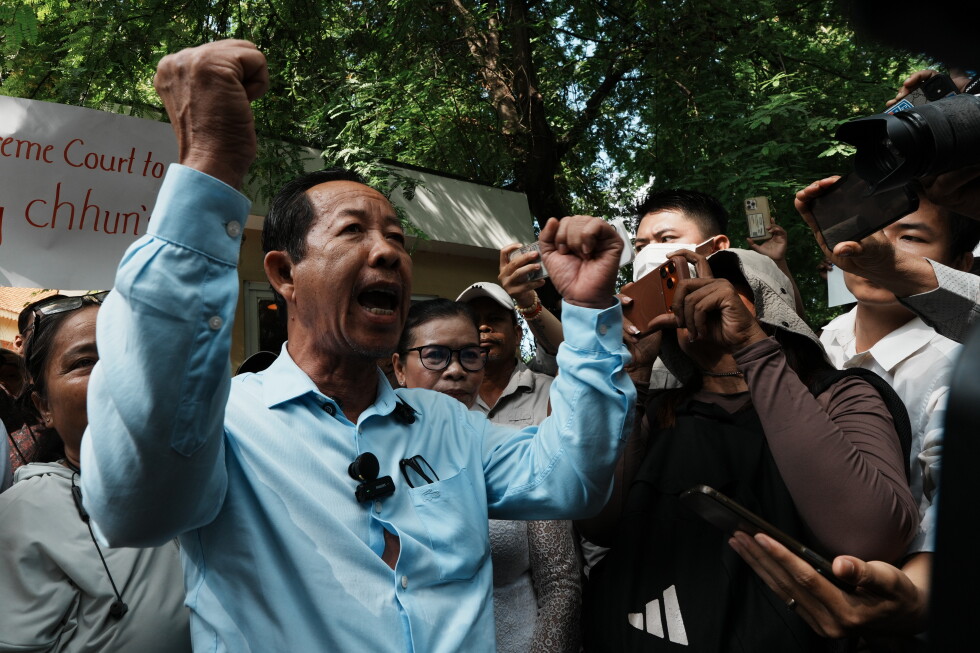
PHNOM PENH, CAMBODIA — As hundreds of chanting supporters gathered outside Cambodia’s Supreme Court on Monday, prominent opposition political figure Rong Chhun emerged from his appeal hearing voicing urgent hope that judges would toss out a controversial incitement conviction that has sidelined him from national politics, clearing the way for his return to public life.
Rong Chhun, 56, a senior policy adviser to the opposition-aligned Nation Power Party, was found guilty of inciting civil disorder last year following his meetings with local villagers displaced by state-backed infrastructure development projects. His conviction is widely categorized as one of a series of coordinated legal actions targeting government critics under the administration of newly installed Prime Minister Hun Manet. The ruling handed down last year sentenced him to four years behind bars and imposed a lifetime ban on his right to run for public office and cast a ballot. Throughout his original trial, Rong Chhun maintained he had done nothing illegal, noting his only public action was sharing photos of his meetings with affected villagers alongside commentary on his Facebook page.
After closing Monday’s morning appeal session, Rong Chhun stepped out of the courthouse to a crowd of roughly 300 supporters, who waved homemade signs calling for his freedom and chanted in unison, “Drop the charges, free Rong Chhun!”
Addressing the gathered crowd, Rong Chhun emphasized that as Cambodia navigates rising border tensions with neighboring Thailand, a sagging national economy, and a host of unresolved domestic challenges, he is committed to advancing a platform of national reconciliation and unity for the country’s 17 million residents. “I hope the court will grant me freedom and justice so that I can continue to practice politics in the future,” he said.
In a sign of the government’s sensitivity to public displays of support for the opposition figure, access roads leading to the Supreme Court compound were blocked by dozens of uniformed police officers manning concrete barricades. Despite the security presence, Rong Chhun walked the final stretch to the courthouse alongside a contingent of supporters that included both local and international human rights defenders.
“We are not worried about going to prison,” he told the crowd. “We are willing to sacrifice everything, and we are determined to use the lives our parents gave us to work toward a Cambodia that achieves true freedom and democracy.”
Incitement charges have become a routine tool for Cambodian authorities to target political opponents, a pattern that predates Hun Manet’s premiership. Rong Chhun was previously handed a two-year prison sentence on identical incitement charges in 2021, after he was accused of spreading misinformation about Cambodia’s shared border with Vietnam during meetings with border-region farmers. That conviction was ultimately overturned by an appeals court later the same year, and he was released from custody.
International observers and rights groups have long documented a pattern of systematic political suppression in Cambodia. The Cambodian government publicly maintains it upholds the rule of law within a functioning electoral democracy, but any independent political party deemed a credible threat to the long-ruling Cambodian People’s Party (CPP) has either been forcibly dissolved by the country’s courts or seen its leaders targeted with imprisonment, legal harassment, or punitive bans from political life.
For nearly four decades, former autocratic Prime Minister Hun Sen oversaw a regime that drew widespread international condemnation for systematic human rights abuses, including widespread crackdowns on freedom of speech and freedom of association. Hun Sen handed power to his American-educated son Hun Manet in August 2023, but to date, analysts and activists have recorded almost no visible progress toward political liberalization or improved respect for civil liberties under the new administration.
Among the supporters who traveled to Phnom Penh to rally for Rong Chhun on Monday was Tim Ratha, a 55-year-old vegetable vendor who made the multi-hour drive from her home in Siem Reap province in northern Cambodia to attend the hearing. “He has devoted everything to us,” she told the Associated Press. “He had no wife, no children — his whole life is dedicated to our cause.”
The Supreme Court has scheduled its final verdict in the appeal for June 19, leaving Rong Chhun and his supporters waiting weeks to learn the outcome of the case.
The Associated Press’s report on the hearing was contributed by correspondents based in Bangkok, Thailand.