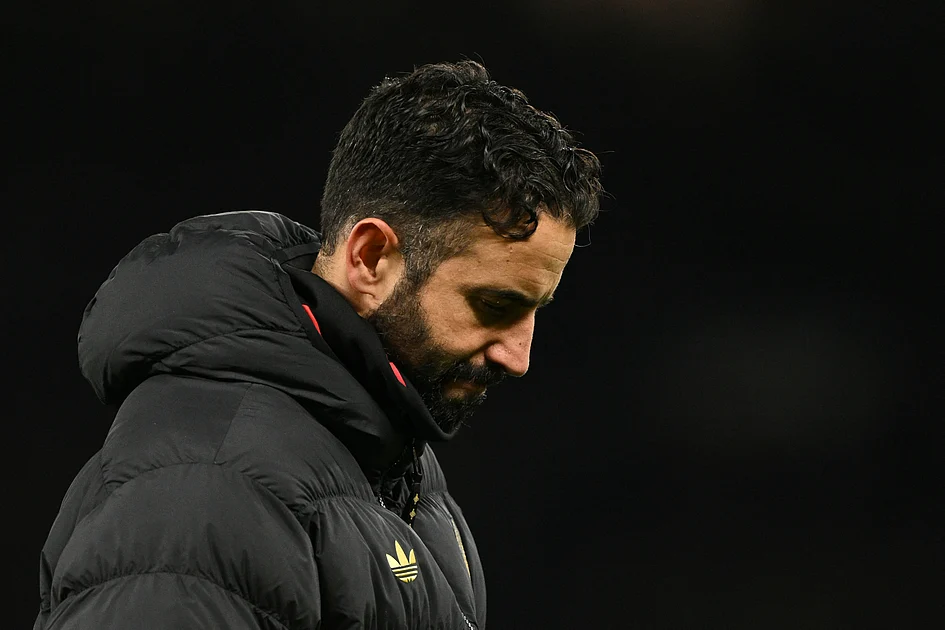
In a decisive move signaling profound institutional discontent, Manchester United has severed ties with manager Ruben Amorim, concluding a tumultuous 14-month tenure marked by underwhelming performance and culminating in a fiery public defense of his position. The club’s leadership announced the termination on Monday, January 5, 2026, just one day following a tense 1-1 draw with Leeds United that precipitated a remarkable press conference outburst from the typically composed Portuguese coach.
The official club statement framed the dismissal as a necessary step to salvage the season, noting, ‘With Manchester United sitting sixth in the Premier League, the club’s leadership has reluctantly made the decision that it is the right time to make a change. This will give the team the best opportunity of the highest possible Premier League finish.’ This decision leaves the storied club languishing 17 points behind league leaders Arsenal, having secured only three victories in their previous eleven matches.
Amorim’s appointment in November 2024, succeeding Erik ten Hag, initially generated optimism but rapidly deteriorated into one of the most challenging periods in the club’s modern history. His inaugural season concluded with a disastrous 15th-place Premier League finish—the club’s worst since their 1974 relegation—coupled with a painful Europa League final defeat to Tottenham Hotspur.
The catalyst for his dismissal emerged during Sunday’s post-match conference where Amorim delivered an impassioned monologue addressing mounting speculation about his future. Defiantly rejecting notions of resignation, he starkly differentiated his perceived role, declaring, ‘I came here to be the manager, not to be the coach. Every department—the scouting department, the sporting director—need to do their job.’ He directly confronted critics including prominent pundit and former player Gary Neville, who had consistently questioned Amorim’s tactical rigidity and adherence to a three/five-at-the-back formation.
Statistical analysis reveals the magnitude of the struggle under Amorim’s leadership. Across 63 matches in all competitions, he managed merely 24 victories against 21 defeats, translating to a win percentage of 38.1%—a figure that plummeted to a historically poor 32% in Premier League competition, the worst record of any permanent manager in the club’s Premier League era.
Despite earning respect from media members for his refreshing candor, Amorim’s management style drew criticism for his harsh public assessments of players, including describing his squad as ‘maybe the worst in the club’s history.’ While summer acquisitions of Benjamin Sesko, Bryan Mbeumo, and Matheus Cunha enhanced attacking options, the team remained visibly unbalanced with a vulnerable defense and inadequate midfield structure.
The immediate future will see former midfielder Darren Fletcher, currently overseeing the under-18 squad, assume temporary managerial duties starting with Wednesday’s fixture against Burnley. Fletcher is expected to implement a traditional 4-4-2 system contrasting sharply with Amorim’s preferred approach.
This termination continues a troubling pattern of managerial instability at Old Trafford since the legendary Sir Alex Ferguson’s retirement in 2013. The club has cycled through seven permanent managers—David Moyes, Louis van Gaal, Jose Mourinho, Ole Gunnar Solskjaer, Ralf Rangnick, Ten Hag, and now Amorim—without securing a single Premier League title in 13 years. Notably, Amorim’s departure follows closely on Chelsea’s dismissal of Enzo Maresca, highlighting the intense pressure and diminishing patience within Premier League leadership structures.