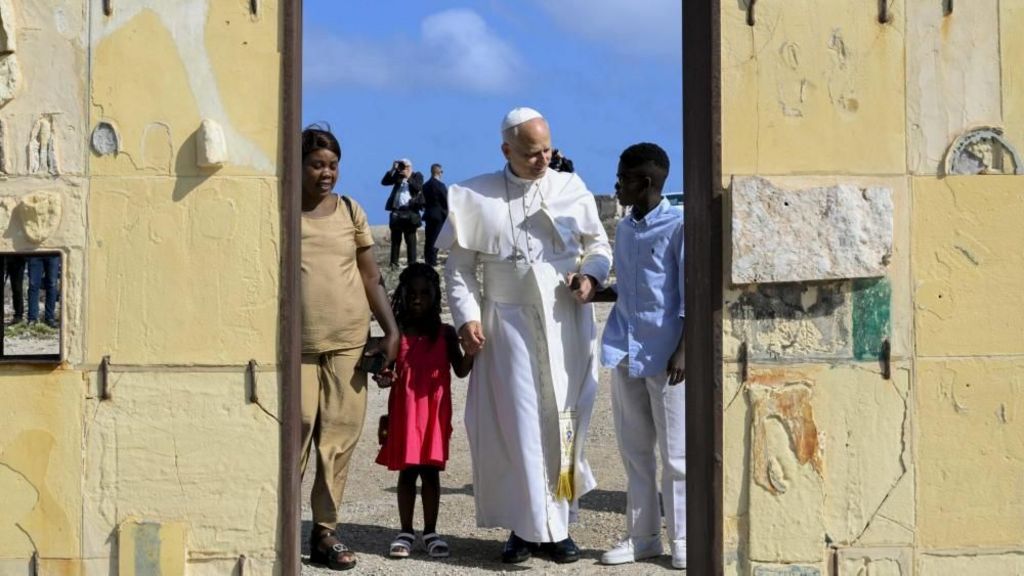
Perched just 145 kilometers off Tunisia’s northern coast, the tiny Italian island of Lampedusa has long been the first European touchstone for hundreds of thousands of people fleeing conflict, poverty and instability across Africa and the Middle East. It is here, on the frontline of the Mediterranean migration crisis, that Pope Leo XIV made a urgent appeal to European leaders to confront what he calls a defining moral and political challenge of the era, just two weeks after the European Union approved sweeping new rules that tighten border restrictions and expand detention powers for undocumented arrivals.
The pontiff’s one-day visit on July 4 began with a quiet act of remembrance: he walked through a local cemetery to pray at the graves of migrants who lost their lives attempting the perilous sea crossing, before stopping at Lampedusa’s iconic Gate of Europe monument, built to honor all those who have perished en route to the continent. After meeting with a migrant family that had recently completed the journey, Pope Leo celebrated open-air mass for a crowd that included new arrivals, Italian coast guard rescuers, aid workers and local residents.
Speaking from what he described as Europe’s farthest Mediterranean outpost, Pope Leo framed migration as a test of the continent’s core values. “Those who have lost their lives in this sea are victims both of decisions that were made and of decisions that were not made,” he told the assembly, pointing to the human cost of both restrictive policies and inaction on the root causes of displacement. He called on European institutions to adopt a holistic approach to the crisis: one that combines immediate, humane support for new arrivals with targeted long-term investment in the developing countries that people are forced to leave. “Europe is capable of addressing the crisis in this region in a comprehensive manner, integrating immediate relief efforts into a long-term strategic plan capable of receiving, protecting, supporting and integrating migrants while assisting developing countries so that no one is forced to emigrate,” he said.
Data from the United Nations’ International Organization for Migration underscores the urgent stakes of Pope Leo’s appeal: more than 1,400 people, including 28 children, have already died or gone missing in Mediterranean crossing attempts this year alone. Migrants typically travel on dangerously overcrowded, poorly maintained vessels, and Lampedusa’s main reception center has long struggled with chronic overcrowding and substandard living conditions for new arrivals.
This visit is consistent with a clear pattern for Pope Leo, who has made expanding support for migrants and refugees a central pillar of his papacy since he was elected head of the Catholic Church in May 2025. He has repeatedly criticized the growing global trend of hardline anti-migration policies, a stance that has put him in direct conflict with political leaders ranging from U.S. President Donald Trump, whose anti-immigration posture he has openly labeled “inhuman.”
Most recently, ahead of the 250th anniversary of United States independence, the pontiff released a public letter to American Catholics that tied the church’s core commitment to protecting life to the moral duty of welcoming immigrants. “The Catholic value of defending life includes welcoming, protecting and assisting immigrants,” he wrote, noting that generations of migrant labor and sacrifice have shaped the United States’ national identity. “To receive them with compassion and generosity is not only an act of charity, but also a recognition of the dignity that belongs to every human person.”
For migrants living and working in Europe, the visit carried deep personal meaning. Kandeh Abdourahman, a migrant who arrived in Lampedusa in 2015 and now works as a cultural mediator for the International Rescue Committee, called the Pope’s trip a powerful validation of migrant experiences. “It was a reminder that our stories are seen, that welcome is not just a word but an act of humanity,” he told reporters. Pope Leo closed his visit by reaffirming his ongoing solidarity with people displaced by crisis, telling the gathered crowd that he will “continue to accompany you, support you and encourage you” amid growing political pressure to restrict migration across the continent.