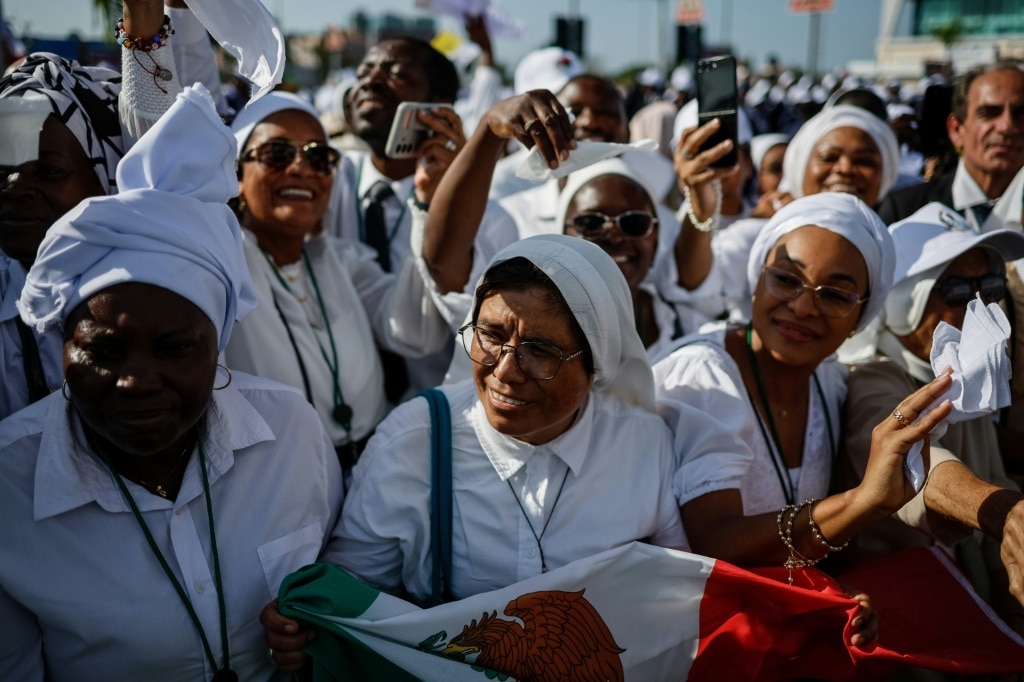
One year after his historic election to the papacy, Pope Leo XIV has arrived in Angola, the third stop on his 11-day four-nation African pilgrimage, and will Sunday lead a massive open-air Mass followed by a visit to one of southern Africa’s most sacred Catholic sites. The Portuguese-speaking nation welcomed the pontiff Saturday, kicking off a leg of the tour that carries both religious significance and sharp social commentary for a resource-rich nation grappling with deep inequality.
In his first formal address to Angolan leaders, including President Joao Lourenco, Pope Leo doubled down on a core theme of his African journey: a rebuke of unregulated natural resource extraction that has, he argues, fueled systemic suffering and created sweeping social and environmental disasters across the continent. The pope has used the tour to issue repeated warnings against corruption and the plunder of Africa’s abundant natural wealth, a throughline he has maintained through every stop of the trip.
The tour, which launched in Algeria Monday, has already been marked by a high-profile public feud with former U.S. President Donald Trump. Last weekend, after Pope Leo called for an immediate end to the ongoing conflict in the Middle East, Trump attacked the first American pope as “weak” in a public statement.
Speaking to reporters Saturday aboard his flight from Cameroon to Angola, the pontiff pushed back against the narrative that his recent comments had been crafted to respond to Trump’s criticism. He noted that a widely discussed reference to “tyrants” during a speech in Cameroon had been written long before Trump’s remarks, adding that entering into a public debate with the U.S. leader holds no benefit for him or the Vatican. “It is not in my interest at all to debate the US leader,” he told the assembled press.
Sunday’s centerpiece events will draw crowds expected to number in the tens of thousands. First, the pope will celebrate Mass in Kilamba, a suburb of Angola’s capital Luanda. After the service, he will travel 110 kilometers by helicopter to Muxima, Angola’s most revered Catholic pilgrimage site, which is home to a 300-year-old church perched on the banks of the Kwanza River—once a major transit route for enslaved people bound for the Americas.
Built by Portuguese colonial settlers to baptize enslaved people before they were shipped across the Atlantic to the Americas, the church houses a beloved statue of the Virgin Mary known locally as “Mama Muxima.” The site draws roughly 2 million pilgrims annually, and organizers expect large crowds to greet the pope during his visit.
In preparation for the papal visit, the Angolan government has launched a massive multi-million-euro infrastructure project to construct a new basilica, residential housing, and expanded public services in Muxima. The development has sparked sharp criticism from observers, who question the government’s spending priorities in a country that, despite massive oil and diamond reserves, remains plagued by widespread poverty and severe wealth inequality.
Local Catholic leader Domingos das Neves, a lawyer active in church affairs, told Agence France-Presse that Pope Leo is fully aware of Angola’s stark social divides. “The pope comes to Angola fully aware of the reality our country is facing, particularly in terms of stark social asymmetries and inequalities, which also stem from the unequal distribution of wealth,” das Neves said. He added that the pontiff would almost certainly address the urgent demand for social justice during his public remarks, noting “Angola is in great need of a guiding light to illuminate our collective efforts — both within ecclesiastical institutions and the state — so that we do not forget the poor and the destitute.”
Widespread poverty has already fueled visible public discontent in Angola in recent years. Last July, a three-day wave of looting across the country left roughly 30 people dead, with critics blaming police for a heavy-handed response to the unrest. Analysts widely frame the unrest as a signal of deep dissatisfaction with the ruling People’s Movement for the Liberation of Angola (MPLA), the socialist party that has held continuous power since the country gained independence from Portugal in 1975.
Following his Sunday events in Luanda and Muxima, Pope Leo will travel 800 kilometers to Saurimo Monday, where he will visit a local retirement home and celebrate a second Mass before departing Angola Tuesday morning. From there, he will travel to Equatorial Guinea, the final stop on a whirlwind 18,000-kilometer journey across the African continent.