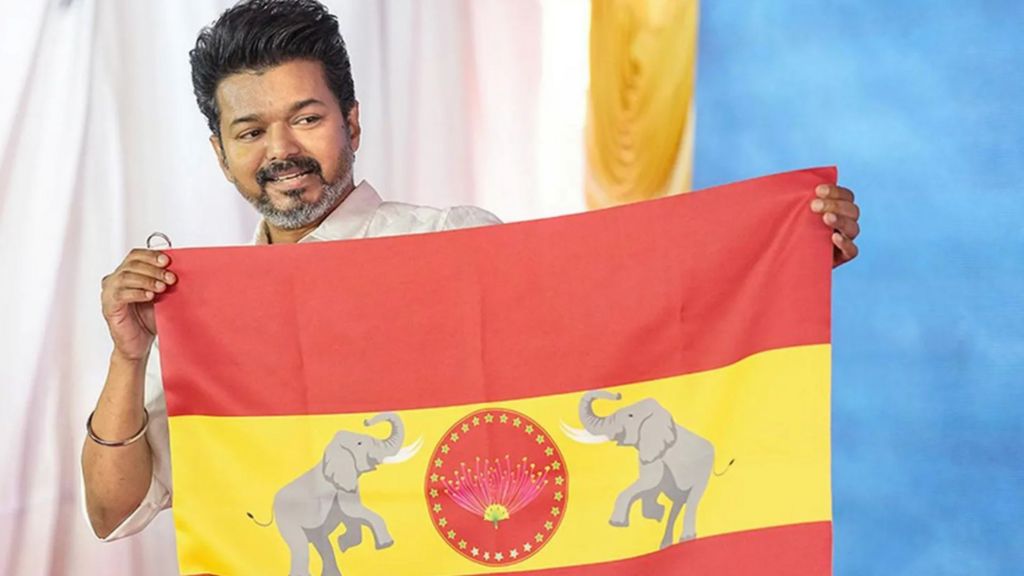
In a political upheaval that has rewritten decades of electoral history in the southern Indian state of Tamil Nadu, film superstar-turned-politician C. Joseph Vijay’s newly launched Tamilaga Vettri Kazhagam (TVK) has emerged as the single largest party in the 234-member state legislative assembly, shattering the long-standing duopoly of the Dravida Munnetra Kazhagam (DMK) and All India Anna Dravida Munnetra Kazhagam (AIADMK). But five days after vote counting concluded, the state remains mired in political uncertainty, with no clear timeline for the formation of a new government and competing constitutional debates over who should get the first chance to take power.
Vijay, a 51-year-old megastar popularly known by his fan nickname ‘Thalapathy’, led his fledgling party to a stunning 108 seats in the election, defeating the incumbent DMK government led by Chief Minister MK Stalin. The result leaves TVK just 10 seats short of the 118-seat majority required to form a government on its own. So far, India’s main national opposition party, the Congress, has pledged its five seats to Vijay’s bloc, leaving the celebrity politician just five legislators short of the required threshold.
Two days after the vote count, Vijay met with Tamil Nadu Governor Rajendra Vishwanath Arlekar twice to formally stake his claim as the leader of the single largest party to form the next administration. Following the second meeting on Thursday, however, the Governor’s office released a statement rejecting the claim, noting that Vijay had not yet demonstrated he holds the requisite majority support to form a stable government. The Governor has insisted that Vijay submit documented proof of the 118 committed legislators before being invited to form government, a move that has drawn sharp criticism from TVK leaders and their backers.
Constitutional experts are divided over the Governor’s decision. Many point to well-established constitutional precedent that grants the leader of the single largest party the first opportunity to form government, with a floor test of majority held after the government takes office. They argue that denying Vijay this opportunity is procedurally unfair. Analysts defending the Governor’s position note that his primary mandate is to ensure the formation of a stable administration that can survive a confidence vote, rather than inviting a minority government that could collapse shortly after taking office.
Vijay’s rapid rise to the top of Tamil Nadu politics has drawn widespread comparisons to MG Ramachandran, another iconic matinee idol who split from the DMK in 1977 to form the AIADMK and went on to become the state’s Chief Minister. For nearly half a century, Tamil Nadu’s politics have been dominated by a two-party system between the DMK and AIADMK, a status quo that TVK has already overturned with its election performance. Unlike Ramachandran and his successor J Jayalalithaa — another film star who led the state for decades — Vijay enters politics with no prior elected experience, though he followed the traditional path of celebrity-turned-politician by retiring from his 69-film acting career full-time after launching TVK in 2024.
As political uncertainty drags on, Indian media outlets have floated a range of hypothetical coalition scenarios, including a shocking power-sharing agreement between the bitter long-time rivals DMK and AIADMK to block TVK from power. Still, many analysts remain optimistic that Vijay can cobble together the required support from smaller regional parties and independent candidates to hit the 118-seat magic number and form the next government, closing out one of the most dramatic political upsets in recent Indian electoral history.