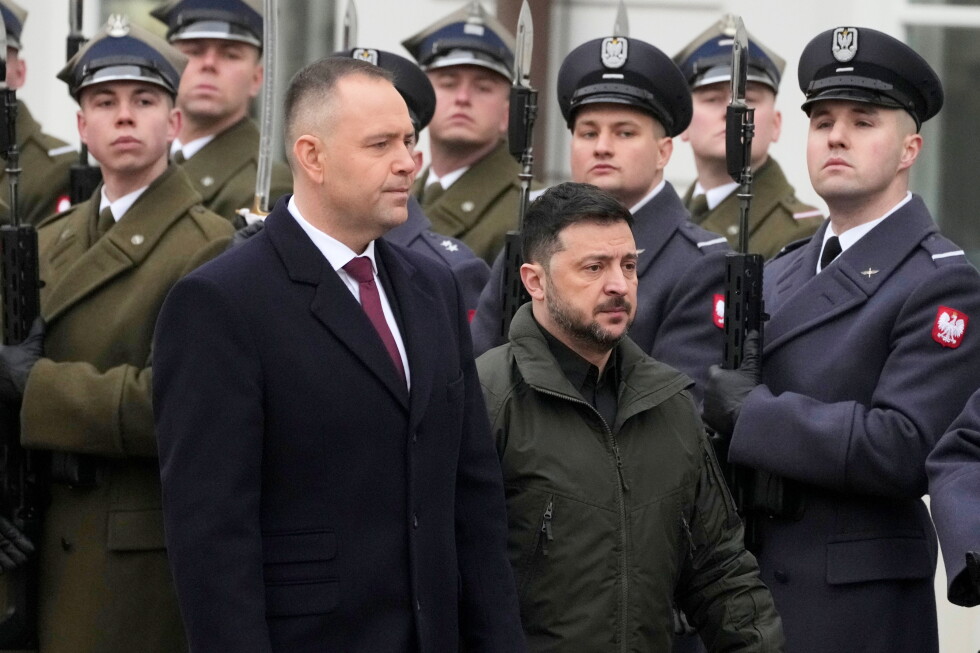
A diplomatic rift has opened between Warsaw and Kyiv after Polish President Karol Nawrocki announced Friday plans to strip Volodymyr Zelenskyy of Poland’s highest civilian decoration, the Order of the White Eagle, over a recent Ukrainian presidential decree tied to a World War II-era paramilitary group blamed for the mass killing of Polish civilians.
Zelenskyy received the prestigious Order of the White Eagle in 2022 from then-Polish President Andrzej Duda, in recognition of the Ukrainian leader’s extraordinary leadership in defending his country’s sovereignty, upholding human rights, and demonstrating extraordinary resilience in the face of Russian invasion. That honor is now set to be formally revoked, triggered by Zelenskyy’s May 26 decree that bestowed the name of the Ukrainian Insurgent Army (UPA) on an active unit of Ukraine’s Special Operations Forces.
In a 13-minute televised address shared on Polish social media platforms, Nawrocki framed the decision as a response to deep public anger across Poland. “For the vast majority of Polish society, the UPA is first and foremost an organization responsible for heinous crimes against citizens of the Polish Republic during World War II,” he stated.
Against a backdrop of longstanding bipartisan Polish support for Ukraine’s war effort against Russia, Nawrocki was quick to emphasize that the revocation would not weaken Warsaw’s backing for Kyiv. The clarification comes as Poland prepares to host a high-profile international conference on Ukraine’s post-war reconstruction next week, an event Zelenskyy is scheduled to attend.
For Kyiv, the renaming was framed as a step to honor historical military heritage and recognize the modern unit’s service in protecting Ukraine’s territorial integrity and independence. The UPA operated across Western Ukraine through the 1940s and 1950s, fighting for Ukrainian independence against both Nazi German occupation and Soviet rule. But in Polish collective memory, the group is synonymous with the mass murder of an estimated tens of thousands of Polish civilians in the Volhynia and Eastern Galicia regions amid wartime chaos. In 2003, the Polish parliament formally adopted a resolution labeling the UPA’s crimes against Poles as an act of genocide.
Ukrainian historical narratives offer a different framing of the period: Ukrainian officials and historians note that both Ukrainian and Polish underground armed groups carried out reprisal attacks, resulting in massive civilian losses on both sides, rather than framing the violence as a one-sided campaign by the UPA.
Poland’s liberal Prime Minister Donald Tusk echoed criticism of Zelenskyy’s decree, but also warned that any open rift between Warsaw and Kyiv would play directly into the hands of Russian President Vladimir Putin, who has long sought to exploit historical divisions to weaken Western support for Ukraine.
On June 3, Ukrainian Foreign Minister Andrii Sybiha released a statement calling for de-escalation, noting that rising tensions between the two neighboring countries serves no interests for either the Ukrainian or Polish people. He urged both sides to pull back from heated rhetoric and leave the complex, sensitive chapters of shared history to analysis by professional historians.
The current controversy marks a sharp reversal of recent progress toward historical reconciliation between the two nations. Just months prior, the two countries had restarted joint work on exhumations of Polish WWII victims, and a December 2024 meeting between the two presidents in Warsaw was widely seen as a breakthrough in bridging longstanding historical divides.