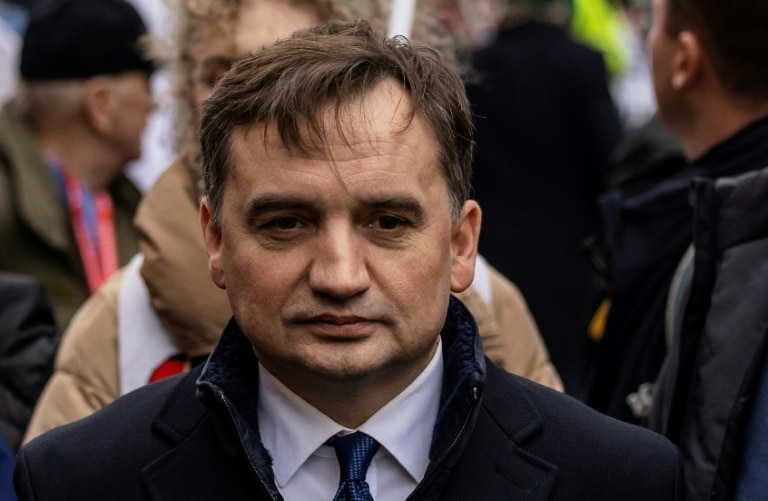
In a confirmation that has sparked immediate diplomatic friction between Poland, Hungary and the United States, Poland’s fugitive former justice minister Zbigniew Ziobro, who is facing multiple serious criminal charges in his home country, has confirmed he has left Hungary for the U.S. following Hungary’s recent change in government.
In an interview Sunday with Polish right-wing media outlet Republika, Ziobro openly acknowledged his new location, saying, “I am in the United States. I arrived yesterday, and this is my third time traveling around the country.” The confirmation came after multiple Polish media outlets first reported his presence in the U.S. over the weekend, with liberal broadcaster TVN24 even publishing a photograph of the former minister taken by a fellow traveler at Newark Liberty International Airport.
Ziobro, a towering figure in Poland’s conservative politics who led the ultra-conservative Sovereign Poland party and served as justice minister and attorney general from 2015 to 2023 as a key coalition partner to the nationalist Law and Justice (PiS) party, has been a wanted man in Poland since the fall of the PiS government. He is best known as the architect of the controversial judicial reforms that triggered years of tense standoffs between Warsaw and the European Union over the rule of law.
Last year, Ziobro fled Poland for neighboring Hungary, where he was granted asylum by the right-wing government of Viktor Orban, a longstanding ideological ally. The charges he faces in Poland include abuse of power, leading an organized criminal enterprise, and diverting public funds earmarked for crime victims to purchase Israeli-made Pegasus spyware, which was allegedly used to illegally surveil political opponents. If convicted on all counts, he could face up to 25 years in prison. He has repeatedly denied all allegations, framing the prosecution as a political witch hunt targeting conservative opposition by Poland’s current centrist government.
Ziobro’s sudden exit from Hungary comes just weeks after Orban’s Fidesz party lost parliamentary elections, ending the former prime minister’s 12-year grip on power. Hungary’s new prime minister, Peter Magyar, who was formally sworn into office on Saturday, has made a clear break from Orban’s policy of shielding Ziobro. Shortly after his election victory in April, Magyar declared that “Hungary will no longer be a dumping ground for internationally wanted criminals,” explicitly naming Ziobro and his former deputy Marcin Romanowski — who is accused of embezzling nearly €40 million ($47 million) — as examples of figures who would no longer receive safe haven.
A key unanswered question remains: how was Ziobro able to travel to the U.S. when Polish authorities had already revoked all of his official travel documents, including his Polish passport and diplomatic passport. Polish local news outlet Onet has reported that Ziobro obtained a U.S. journalist visa tied to his new role at Republika. Shortly after the reports emerged, Republika confirmed it had hired the former minister to serve as its U.S.-based political commentator.
Poland’s current justice minister Waldemar Zurek has already made clear that Warsaw will not drop its pursuit of Ziobro. In a post on social media platform X, Zurek announced that Poland “will reach out to the USA and Hungary with questions regarding the legal basis that enabled Zbigniew Ziobro to… enter the United States despite lacking valid documents.” He added, “We will not cease our efforts to ensure that he and Mr. Marcin Romanowski are held accountable before the Polish justice system.” Speaking to Polsat broadcaster earlier, Zurek confirmed that once Ziobro’s location is officially verified, Poland will submit a formal extradition request to the U.S. government.
For his part, Ziobro has said he is prepared to fight any extradition attempt in U.S. courts. “I am ready to appear before any court, and an American independent court is certainly an independent court,” he told Republika. “If they want to initiate extradition proceedings, by all means,” he added, noting that extradition cases in U.S. courts are “a demanding procedure.”