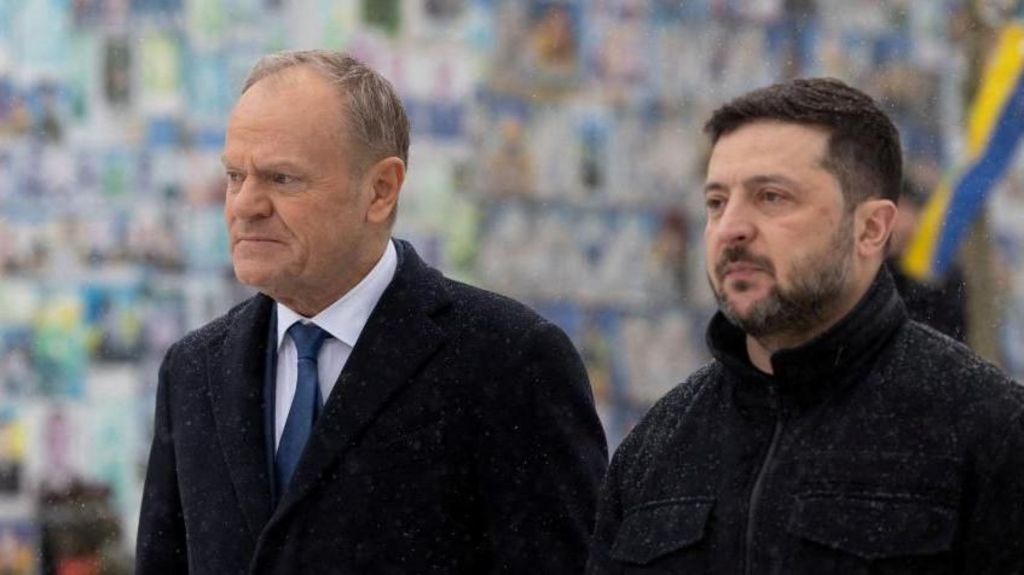
A brewing diplomatic rift between two key Eastern European allies, Poland and Ukraine, has cast a shadow over the 2024 Ukraine Recovery Conference held in the Polish coastal city of Gdansk. Ukrainian President Volodymyr Zelensky skipped the high-profile summit, an absence that came directly after Warsaw stripped him of its highest state honor over a controversial naming decision by Kyiv.
The core of the conflict traces back to a mid-20th century historical disagreement over the Ukrainian Insurgent Army, better known by its acronym UPA. For Ukrainians, the UPA, which operated across Eastern Europe through the 1940s and 1950s, is widely viewed as a band of heroic freedom fighters who battled for Ukrainian independence against multiple occupying powers, including Nazi Germany and the Soviet Red Army, as well as interwar Polish governing forces. But Poland holds a fundamentally different view: it accuses the UPA of perpetrating a mass genocide that killed roughly 100,000 ethnic Polish civilians in the Volhynia region — now part of modern-day northwestern Ukraine — between 1943 and 1945. Tensions flared after Ukraine formally named a military unit in honor of the UPA last month, a move that Polish President Karol Nawrocki lambasted as “outrageous”, “incomprehensible” and “deeply disappointing” that inflicted damage on decades of built trust between the two nations.
In response to the naming decision, Polish authorities revoked the Order of the White Eagle — Poland’s highest state decoration, which had been awarded to Zelensky in 2023. Shortly after the revocation was announced, Zelensky confirmed he would return the honor to Poland. In a public statement this week, Zelensky emphasized that Ukraine remains “open to all meaningful formats of engagement with Poland in order to try to avoid conflicting interpretations of the difficult and painful chapters of our shared past”, and added that Kyiv retains profound gratitude to the Polish people for their unwavering support and longstanding cooperation throughout the war.
Opening the two-day reconstruction summit on Thursday, Polish Prime Minister Donald Tusk stressed that durable progress for Ukraine’s future can only be founded on “truth, on mutual respect, on an understanding of history”. Unlike past iterations of the annual conference, where Zelensky personally led Ukraine’s delegation, this year’s Ukrainian contingent is headed by Prime Minister Yulia Svyrydenko.
Tusk has previously moved to de-escalate the public dispute, noting that the rift between the two allies is a outcome that “delights” Russian President Vladimir Putin, and calling on both Zelensky and Nawrocki to “calm emotions, not to stoke tensions”.
The timing of this diplomatic clash could not be more sensitive for Ukraine. Kyiv is currently locked in a brutal defensive war against Russia’s full-scale invasion, and is actively lobbying the international community for billions of dollars in additional military aid and post-conflict reconstruction investment. It is also working to demonstrate its readiness to advance European Union accession talks, which launched their first formal negotiating phase last week in Luxembourg. Both reconstruction investment and EU accession are scheduled to be top of the agenda at the Gdansk summit. Even amid the dispute, Nawrocki has stressed that the historical disagreement will not alter Poland’s longstanding commitment to supporting Ukraine in its war against Russian aggression.
Poland has been one of Ukraine’s most stalwart allies since Russia launched its full-scale invasion in February 2022. It has absorbed hundreds of thousands of Ukrainian refugees fleeing the war, and serves as a critical logistics and transit hub for Western military and humanitarian aid bound for Kyiv’s front lines. This year’s conference draws senior representatives from across the European Union, including European Commission President Ursula von der Leyen and European Council head Antonio Costa, alongside senior officials from Bulgaria, Estonia, Finland, Latvia, Lithuania, Romania and Sweden.