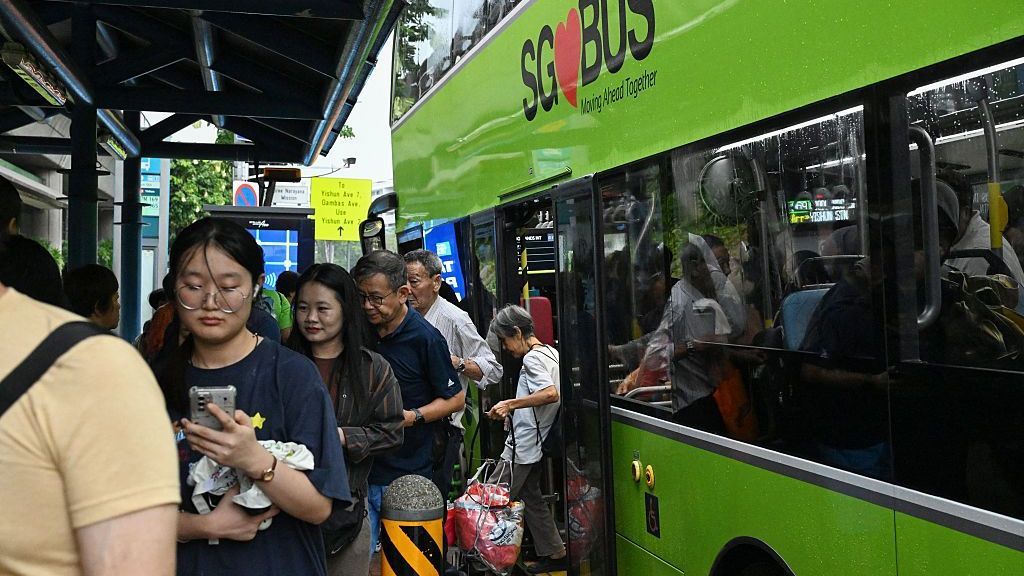
Singapore has rolled out a new set of legal penalties for disruptive and unhygienic behavior among public bus passengers, bringing bus network rules in line with long-standing regulations governing the city-state’s Mass Rapid Transit (MRT) rail system. The updated framework, officially announced by the Land Transport Authority (LTA) on Monday, establishes two tiers of fines to address different levels of offending.
Minor nuisance behaviors that make journeys uncomfortable for fellow commuters will now carry a maximum fine of 500 Singapore dollars (equivalent to roughly $391 USD or £293 GBP). This category of offenses includes placing feet on passenger seats, playing loud audio that disturbs others, eating and drinking onboard, and improper littering.
For more severe infractions that put others at risk or cause significant damage to shared transport infrastructure, penalties are far steeper, with maximum fines reaching 5,000 Singapore dollars. Serious offenses cover acts that create obstruction or safety hazards for other commuters within bus terminals and interchanges, as well as the deliberate or negligent soiling of any part of public buses, interchanges or terminals.
In a public statement outlining the reform, the LTA emphasized that the updated rules are designed to cultivate a safer, more considerate and enjoyable commuting environment for all passengers using Singapore’s extensive public transport network.
Previously, standards of behavior on Singapore’s buses were enforced as internal company policies rather than formal legal offenses. Bus drivers were responsible for addressing misbehavior, and could only ask uncooperative passengers to exit the vehicle. With the new regulations in place, these common nuisance behaviors are now classified as official legal violations that carry immediate, formal fines.
Under the new enforcement structure, only authorized personnel — including ticket inspectors and full-time bus interchange staff — are permitted to issue official offense notices to passengers caught violating the rules. Bus drivers, referred to as “bus captains” in Singapore, will not be granted this fining authority, a change intended to allow drivers to keep their full focus on the core responsibility of operating vehicles safely. Drivers still retain the right to request passengers stop disruptive behavior; those who refuse to comply can still be asked to exit the bus, and severe cases of continued noncompliance may result in police intervention.
Singapore’s regulatory update is not an isolated effort to improve public transport experiences. As urban transit networks expand globally, cities across the world have increasingly moved to crack down on unruly passenger behavior to guarantee comfortable, peaceful commutes for all users.
Earlier in 2025, the Polish city of Kraków implemented analogous regulations, imposing maximum fines of 200 Polish złoty (around $52 USD or £39 GBP) on commuters who disturb public peace on transit via loud audio from mobile phones or other electronic devices. In the United Kingdom, national laws already ban anti-social behavior on trains and stations, including the unauthorised use of sound-producing devices that causes annoyance to other passengers. Some UK politicians have recently pushed to expand these rules, introducing specific fines of up to £1,000 for so-called “headphone dodgers” — people who play loud music and videos without using headphones across all forms of public transport, including buses.
The coordinated shift toward formal penalties for disruptive behavior in Singapore, Kraków and the UK reflects a growing global trend of transport regulators taking proactive steps to protect the comfort and safety of the commuting public. Echoing this shared priority, Singapore’s LTA reaffirmed that public transport is a shared community space, and every passenger has a role to play in maintaining a gracious, pleasant journey for everyone.