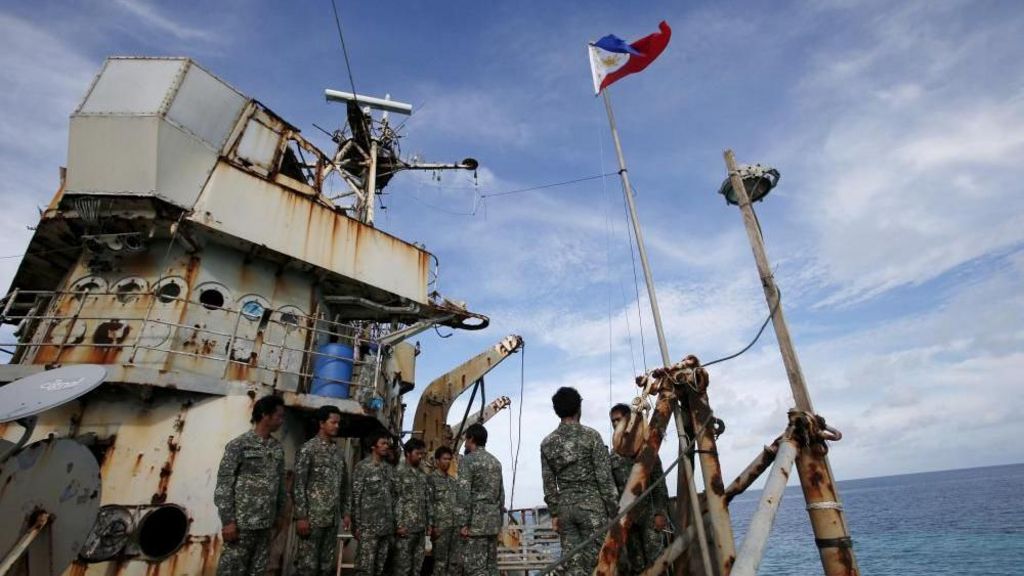
Long-running territorial friction in the South China Sea has entered a new phase of escalation after Manila formally accused Chinese fishermen of deliberately dumping cyanide in waters around the Spratly Islands, a contested archipelago at the heart of competing regional sovereignty claims.
In an official press briefing Monday, Philippine National Security Council (NSC) Assistant Director-General Cornelio Valencia framed the alleged activity as a deliberate act of sabotage targeting Filipino military personnel stationed at Second Thomas Shoal. According to Valencia, the cyanide poisoning first began last year, with the explicit goal of wiping out local fish populations to cut off a critical food supply for troops based in the area. Beyond threatening food access, he added, the toxic contamination poses direct health risks to military personnel and could damage the coral reef ecosystems that provide structural support to the BRP Sierra Madre, the World War II-era vessel intentionally grounded at the shoal in 1999 to assert the Philippines’ territorial claim.
Philippine Navy Spokesperson Rear Admiral Roy Vincent Trinidad laid out what Manila says is evidence backing the accusation: Filipino forces seized 10 bottles of cyanide from small sampan boats linked to larger Chinese fishing vessels in three separate incidents across February, July, and October 2024. He also confirmed that last month, troops observed another sampan crew dumping substances near the shoal, and follow-up laboratory testing of water samples confirmed the presence of cyanide.
Cyanide fishing is a banned practice across most of Southeast Asia, including under Philippine law. The technique, historically used to stun fish for the lucrative live reef trade, causes irreversible harm to coral reefs and marine ecosystems, making it illegal in most international and regional fishing frameworks.
China has immediately and forcefully rejected the accusation, dismissing it as a baseless fabrication. Chinese Foreign Ministry spokesperson Guo Jiakin called the claim “completely unbelievable and not even worth refuting”, countering that the Philippines has a long record of illegal harassment against Chinese vessels engaged in legitimate, routine fishing activity in the area.
Valencia confirmed that Philippine officials raised the allegation during a recent diplomatic meeting with Beijing but have yet to receive a formal response. The NSC is preparing a full report for the Philippine Department of Foreign Affairs, which could serve as the foundation for an official diplomatic protest. In the meantime, the Philippine Navy and Coast Guard have been ordered to ramp up patrols across the disputed Second Thomas Shoal region.
The latest exchange of accusations comes amid years of steadily escalating tensions between the two countries in the South China Sea, a strategically critical waterway that holds some of the world’s richest fishing grounds and untapped offshore energy reserves. More than half of the world’s global fishing fleet operates in the South China Sea, and the waterway carries an estimated $3 trillion in annual international trade. Sovereignty over the sea is disputed by six parties: China, the Philippines, Vietnam, Malaysia, Brunei, and Taiwan. China claims nearly the entirety of the South China Sea as its sovereign territory, a claim that was ruled to have no legal basis under international law by a 2016 tribunal ruling under the United Nations Convention on the Law of the Sea (UNCLOS) — a decision Beijing has repeatedly refused to recognize.
Tensions around Second Thomas Shoal, in particular, have spiked repeatedly in recent years. China’s coast guard has made repeated attempts to block Philippine resupply missions to the small outpost on the BRP Sierra Madre, and a violent confrontation in June 2024 saw Chinese coast guard personnel armed with melee weapons board Philippine navy vessels near the shoal, leaving multiple Filipino sailors injured.
In recent months, the Philippines has deepened military cooperation with extra-regional powers in response to growing tensions with Beijing. Last week, Manila held joint maritime exercises with the United States and Australia in the disputed South China Sea, leading into the annual Balikatan military exercises, which will include Japan as a full participating member for the first time this year. Beijing has repeatedly condemned these multinational drills, arguing they unnecessarily raise geopolitical tensions in the region. In a further sign of expanding defense ties, the Philippines signed a military agreement with France in March that will see a 15 to 20-person French contingent deploy to participate in the upcoming April 20 Balikatan exercises.