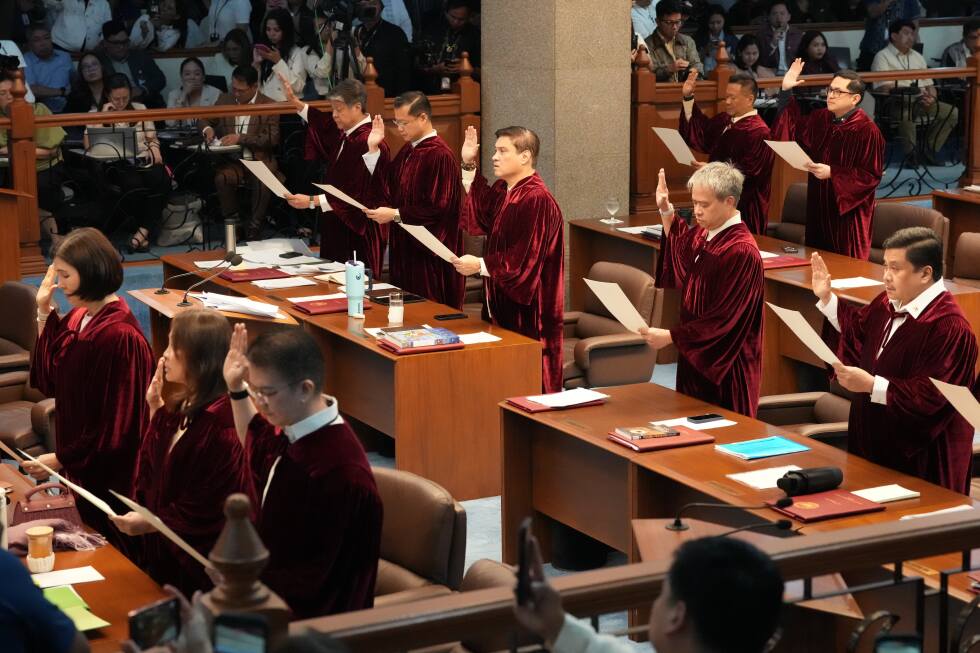
MANILA, Philippines — A high-stakes political crisis has engulfed the Philippines, as the country’s Senate convened an impeachment court Monday to try Vice President Sara Duterte on a slate of criminal allegations, just days after a violent gunfight erupted inside the chamber amid escalating power struggles between the nation’s top two leaders. The proceedings mark the climax of weeks of growing tension between Duterte and her former political ally, President Ferdinand Marcos Jr., that has laid bare the deep ideological and partisan divides that have long troubled the Southeast Asian democracy.
The impeachment proceedings got their start one week prior, when the Philippine House of Representatives voted by a wide majority to advance three core charges against Duterte: unexplained unexplained wealth, misuse of public state funds, and a public threat to assassinate President Marcos Jr. if she were killed amid their ongoing political feud. A rising political figure who has already publicly announced her intent to run for the presidency in the 2028 national election, Duterte has issued a blanket denial of all charges but has declined to respond to the specific allegations in any detail.
The crisis is deeply tied to the legal troubles of Duterte’s father, former Philippine President Rodrigo Duterte, who was taken into custody by the International Criminal Court (ICC) earlier this year on charges of crimes against humanity. Those charges stem from the former president’s deadly nationwide anti-drug crackdown, launched during his six years in office, that left thousands of mostly low-level, petty drug suspects dead. Sara Duterte has publicly blamed Marcos Jr. for orchestrating what she calls the “kidnapping” of her ailing father, referring to his March arrest and transfer to ICC custody in The Hague.
The path to this week’s impeachment trial has already been marked by dramatic, unprecedented chaos in the Senate. Last Monday, 13 of the chamber’s 24 senators — led by a bloc of close Duterte allies — launched a surprise power grab to oust the sitting Senate president and install their own candidate, Alan Peter Cayetano, leaving the final outcome of the impeachment trial deeply uncertain. The power play relied entirely on the unexpected appearance of Senator Ronald dela Rosa, a long-time Duterte confidant who had spent months in hiding to avoid an ICC arrest warrant.
Dela Rosa, who served as national police chief during Rodrigo Duterte’s anti-drug crackdown, was named by the ICC as a co-conspirator in the alleged crimes against humanity, and the court unsealed an arrest warrant for him just last Monday. After months in self-imposed hiding, Dela Rosa emerged last week, traveling to the Senate in a van arranged by Cayetano. When National Bureau of Investigation agents moved to arrest him upon his arrival, Dela Rosa fled into the Senate complex, darting up a stairwell to the plenary hall, where Cayetano and his bloc placed him under the chamber’s official “protective custody.”
What followed was a days-long tense standoff between Senate security personnel and NBI agents, who had positioned themselves in an adjacent government building. The standoff boiled over into open gunfire Wednesday night, when Senate security fired what their chief Mao Aplasca described as warning shots toward the agents. In the aftermath of the shooting, President Marcos addressed the nation in a late-night national television broadcast, urging the public to remain calm amid the escalating unrest.
In a new twist that deepened suspicions of political sabotage, Cayetano later confirmed that Dela Rosa had disappeared from the protected Senate chamber. Government investigators are now probing whether the gunfight was deliberately instigated by Duterte allies to create enough chaos to allow Dela Rosa to slip away from custody entirely. With the impeachment trial now underway and control of the Senate still contested, the Philippines faces one of its most severe political crises in recent decades, as the rivalry between the Marcos and Duterte political clans spills out into open institutional conflict.