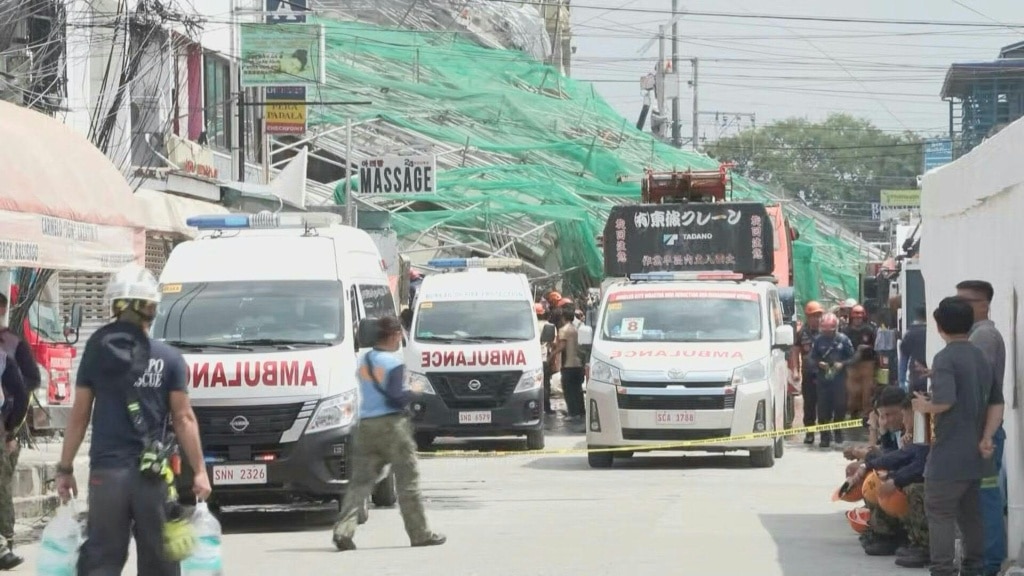
Eight minutes ago, AFP updated the death toll from a catastrophic building collapse at a construction site north of the Philippine capital, confirming four fatalities with approximately 17 people still unaccounted for nearly 36 hours after the disaster struck.
The nine-story under-construction structure gave way in pre-dawn hours Sunday in Angeles City, roughly 80 kilometers north of Manila. As the building collapsed, it crashed into an adjacent adjacent hotel, killing one Malaysian guest staying at the property. Immediately after the disaster, two construction workers were pulled alive from the tangled wreckage, but both succumbed to their injuries overnight despite desperate efforts by medical teams to save them.
Regional fire bureau spokesperson Maria Leah Sajili explained to AFP the grim circumstances of the two workers’ deaths: “The first of the two was pulled out alive, but unfortunately, his body gave out and he did not survive. Doctors could not resuscitate him. The other one suffered a cardiac arrest around 3:00 am (1900 GMT Sunday). Doctors could not attend to him as he was still pinned down.”
On Monday morning, rescue crews recovered a fourth unidentified body from the rubble, though officials have not yet confirmed whether this victim was already counted among the missing. As of Monday afternoon, 17 people remain listed as missing, the vast majority of whom are construction workers who were sleeping on the construction site when the collapse occurred.
Families of the missing have flocked to the area, waiting anxiously for any update on their loved ones amid agonizing uncertainty. Lea Casilao, 47, whose boyfriend is among the unaccounted for, traveled from her home in northern Manila to Angeles City on Sunday, bringing rice and canned goods for her partner unaware the accident had already happened. She spent Sunday night sleeping in a local government building near the site, sharing her heartbreak with reporters: “It’s very difficult, it is breaking my heart to wait for something uncertain.”
In Bulacan province, not far from Angeles City, Stephanie Batar and her mother only learned of the disaster Monday morning via social media, and have been unable to reach Batar’s 64-year-old father, who had just started a six-month contract at the site weeks earlier. “I couldn’t breathe. I couldn’t stand. It’s very painful and we did not know what to do,” Batar told AFP.
Alfredo Albis, a 55-year-old worker who survived the collapse because he was sleeping in a worker barracks just five meters from the fallen building, lost two cousins who are still trapped in the rubble. “They were working here to earn for their families and (they) are missing,” he said, adding he fears the worst for his relatives.
Investigations into the exact cause of the collapse are still ongoing, but regulatory records reveal the construction project was already flagged for serious safety violations just months earlier. Geraldine Panlilio, regional director of the Philippine labor department, told Manila radio station DZMM her office ordered a temporary shutdown of the project in September 2024 after inspectors documented multiple violations of national occupational safety standards.
“Our labor inspectors had monitored poor working conditions, a violation that would put our workers at risk,” Panlilio said. She added that the construction crew lacked basic required safety equipment including hard hats, work boots, safety belts and lifelines, and also worked in poorly lit sites with no mandatory safety warning signage. Construction resumed one month after the shutdown after the project’s contractor reportedly corrected the cited violations and met minimum regulatory requirements.
Officials confirmed that while up to 70 workers were employed at the site, most had left for the weekend to return to their homes, which likely reduced the final death toll. Rescue operations continue at the site, but Sajili noted that search efforts for trapped survivors face extraordinary logistical challenges: “rescue in (a) building collapse is very challenging since any sudden shift triggered by the movements of our rescuers can cause areas to move and people under can get crushed.”
She added that if thermal scanners fail to detect any more signs of life in the rubble, heavy mechanical equipment including excavators will be brought in to clear debris and recover remaining victims. No official timeline has been announced for the transition to recovery operations.