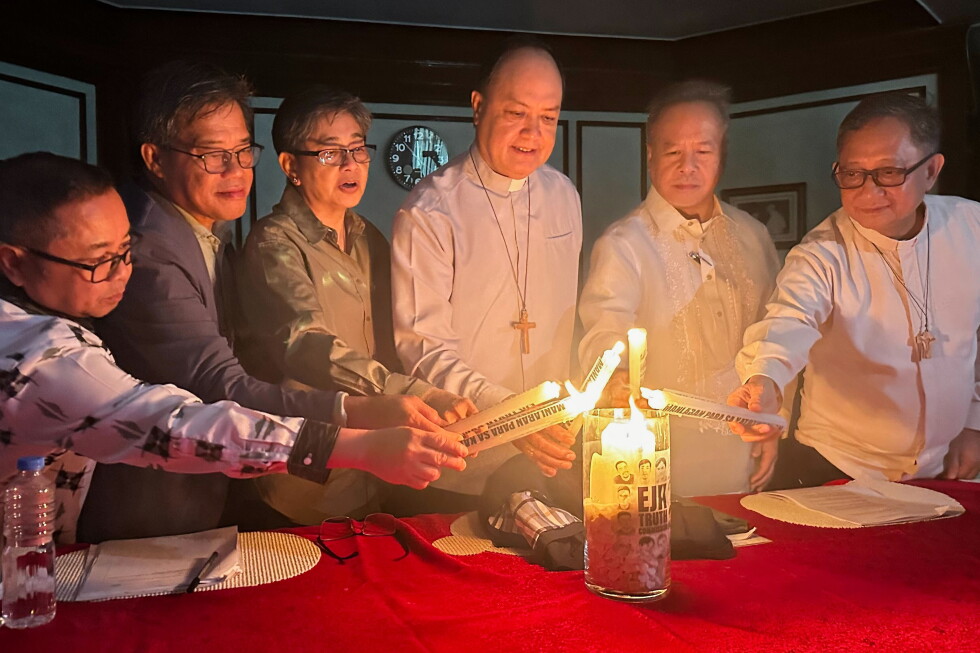
MANILA, Philippines — Nearly three years after Rodrigo Duterte stepped down from his six-year presidential term, a new independent fact-finding initiative led by one of the country’s top Roman Catholic leaders is breaking the long-standing silence surrounding the former president’s controversial and deadly anti-narcotics crackdown. On Wednesday, the coalition launched the non-governmental EJK Truth Commission, an independent body tasked with documenting witness testimonies, compiling physical evidence, and formalizing a public record of the thousands of extrajudicial killings tied to the drug war — work that will be made available to domestic and international prosecutors pursuing accountability.
The crackdown, which Duterte oversaw from 2016 to 2022, left an estimated thousands of mostly low-income suspected drug users and dealers dead, according to human rights monitoring groups. The campaign drew global condemnation from Western governments and human rights organizations over the scale of unlawful killings. Last year, Duterte was taken into custody to face charges of crimes against humanity before the International Criminal Court (ICC) based in The Hague, Netherlands. Ronald dela Rosa, Duterte’s staunch political ally and the former national police chief who first implemented the anti-drug crackdown, is named as a co-perpetrator in the ICC case and has an active arrest warrant against him. Philippine authorities have pledged to execute the warrant and transfer dela Rosa to the global court, but the senator has evaded capture and remains in hiding. Both Duterte and dela Rosa have repeatedly denied authorizing extrajudicial killings, though Duterte openly issued public death threats against drug suspects throughout his presidency.
To date, human rights groups note that the vast majority of police officers directly implicated in the killings have never faced formal investigation, with only a tiny number ever convicted on charges related to the crackdown. For many victim families, systemic delays and institutional cover-ups have prevented them from accessing justice for years. “This is long overdue,” Cardinal Pablo Virgilio David, the commission’s founder, told reporters during a Manila news conference. David emphasized that the new body is not focused solely on prosecution: it aims to provide closure for victims’ families, offer a pathway to accountability for repentant law enforcement officers, and support national healing. “This is an opportunity for a catharsis … so we can recover our dignity as a country,” David said. “Ultimately, what we aspire for is healing not only for the victims but also our institutions.”
Heading the commission’s fact-finding work is Raul Pangalangan, a highly respected Philippine legal scholar and former ICC judge. Pangalangan explained that the body’s core mission is to ensure the experiences of victims, survivors and bereaved families are not erased: “It was created to ensure that the stories of victims, survivors and families are heard, verified and preserved.” The commission plans to hold public hearings across the country to collect testimonies, breaking what Pangalangan called a years-long “conspiracy of silence” that allowed the killings to continue without accountability. “These things happened because everybody looked the other way,” he added.
The commission will share its verified findings with domestic and international justice and human rights bodies, enabling prosecuting authorities to use the evidence to advance cases against implicated officials and law enforcers. David has called on civil society organizations, academic institutions, religious groups and other stakeholders to support the initiative, noting that a large German charitable foundation has already committed funding to support the commission’s work.
Still, commission members acknowledge the work will face significant barriers, years after most of the killings took place. Raquel Fortun, a forensic pathologist at the state-run University of the Philippines and a commission member, told the Associated Press that many implicated law enforcement officials have actively taken steps to cover up evidence of unlawful killings. She gave the example of 13 exhumed remains of drug suspects, whose original death certificates issued during Duterte’s term listed natural causes such as heart attack and pneumonia as their cause of death. “When I examined the remains, I found that they were hit by gunfire,” Fortun confirmed. That pattern of falsified records, she added, underscores how difficult it will be to reconstruct an accurate account of the drug war’s death toll and responsibility for the killings.