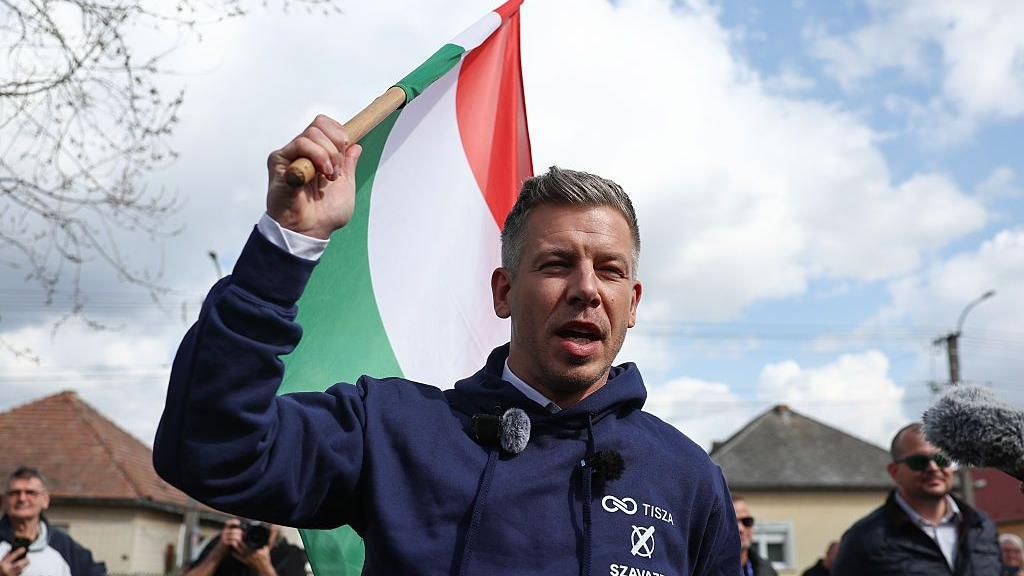
As Hungary gears up for its 12 April parliamentary elections, the political landscape of the Central European nation has been upended by a surprising challenger whose rapid rise has sent shockwaves through Viktor Orban’s long-dominant ruling party. Forty-five-year-old Peter Magyar, a one-time insider within Orban’s Fidesz party who only entered full opposition politics two years ago, now stands as the most serious threat to Orban’s 16 consecutive years in power since the prime minister first won office in 2010. Opinion polls currently place Magyar within striking distance of an election victory.\n\nMagyar’s campaign has been defined by relentless energy and a urgent, nationally rooted message. Borrowing his original slogan “Now or Never” from a 19th-century Hungarian revolutionary poet’s rallying cry for national independence, he has condensed the message to just “Now” on campaign materials, crossing out the “or Never” to amplify the sense that this is Hungary’s critical moment for change. Over the course of the campaign, he has crisscrossed every corner of the country, with plans to visit all 106 of Hungary’s parliamentary constituencies, delivering up to six public speeches a day. Over more than two years of grassroots organizing, he has built a robust support base even in the small towns and rural villages that have long been Fidesz’s strongest electoral strongholds. In 2024, he completed a 300-kilometer walk from Budapest to the Romanian border, framing the journey as an effort to “reunite” a divided nation and win over disillusioned traditional Fidesz voters.\n\nMagyar’s break from the party he once belonged to did not come out of nowhere, but it was accelerated by a high-profile 2024 political scandal that brought down two of Fidesz’s top female leaders. Before February 2024, Magyar was deeply embedded in the Fidesz political machine: he joined the party as a university student in 2002, married rising Fidesz star Judit Varga (who would later become Hungary’s justice minister), and held a series of key positions, including a diplomatic posting to Hungary’s permanent mission in Brussels, leadership of Fidesz’s European Parliament negotiating team, and board seats on multiple state-owned enterprises.\n\nThe scandal that shattered Fidesz’s ranks erupted when Hungarian President Katalin Novak granted a pardon to an official who helped cover up systemic sexual abuse at a state-run children’s home. Public outrage forced Novak to resign, and Varga – who had co-signed the pardon as justice minister and was slated to lead Fidesz’s 2024 European election campaign – was also forced to step down, ending her rising political career within the party. With his ex-wife pushed out of Fidesz and their marriage having already ended in 2023, Magyar made a bombshell move: he appeared live on a leading pro-opposition YouTube channel Partizán to publicly renounce the Fidesz leadership. The interview, watched by more than a million viewers in a country of just 9.6 million people, instantly went viral.\n\n”Everyone warned me against it – friends, family, people I’ve known for years,” Magyar told the host during the interview. “I’ve been inside this system, inside this circle, for a very long time.” In a subsequent Facebook post, he declared he would no longer remain part of a system where top leaders hid behind female subordinates to take the blame for their mistakes. Speaking to the BBC after the interview, Magyar noted that his disillusionment with Fidesz had grown gradually over years: “The Fidesz we see today is very, very different from the one I joined in 2002. For a long time, I accepted the argument that holding power required the compromises they made. But 2024 became the turning point.” He also acknowledged he feared for the future of his three children after making the leap into opposition, but said the need for change outweighed those personal risks.\n\nA month after his viral interview, on Hungary’s 15 March national holiday marking the 1848 revolution against Habsburg rule, Magyar cemented his status as the leading opposition voice. While Orban delivered a fiery speech from Budapest’s National Museum attacking the European Union and calling for Hungary to “occupy Brussels,” Magyar addressed a crowd of an estimated 10,000 supporters, accusing Fidesz of widespread systemic corruption and economic mismanagement. He used the event to announce the formation of his new political movement, later taking over a small dormant party called Tisza to qualify for elections. He further escalated his attacks by releasing a secretly recorded 2023 conversation with his ex-wife that referenced a high-profile corruption trial, a move that drew condemnation from Varga, who accused him of abuse – a charge Magyar has repeatedly denied. Orban’s inner circle has attacked Magyar as a traitor who betrayed his family first, then his country, framing him as a proxy for Brussels. Orban himself has downplayed the challenge, dismissing Magyar simply as “someone who left Fidesz.”\n\nDespite the attacks, Magyar’s political momentum proved unstoppable. In the 2024 European Parliament elections, Tisza won 29.6% of the national vote and seven seats, finishing behind Fidesz’s 44.8% but demonstrating that Magyar could draw significant support away from the ruling party. By autumn 2024, Tisza had pulled ahead of Fidesz in national opinion polls. During commemorations of the 1956 anti-Soviet uprising last year, Magyar led a rival march to Orban’s, directly challenging the prime minister’s long-standing close ties to the Kremlin. He pointedly asked Orban, who rose to political prominence calling for Soviet troops to withdraw from Hungary in 1989: “Mr. Prime Minister, why won’t you say ‘Russians go home’ any more?” He accused Orban of betraying the legacy of 1956 to remain what he called “the Kremlin’s most loyal ally,” pushing back against Orban’s framing of Tisza as a “warmonger” movement carrying out a “Brussels war agenda.”\n\nA key factor in Magyar’s rise is his positioning as a non-liberal alternative to Orban, unlike the fragmented liberal opposition that repeatedly failed to unseat the prime minister in previous elections. Magyar has openly criticized the old liberal opposition, dismissing former Socialist leader Ferenc Gyurcsany as no better than Orban, and has systematically consolidated anti-Orban support under his own banner. He has also directly confronted the pro-Orban media outlets that dominate Hungary’s media landscape, going public early this year to reveal an alleged Russian-style smear and honey-trap campaign targeting him.\n\nMagyar announced that intelligence operatives had leaked surveillance footage implying he had used drugs during a private meeting with an ex-girlfriend. He pre-empted the leak by acknowledging he had consensual sex with the woman but denied any drug use, calling the incident a set-up by state security services. He subsequently passed multiple drug tests to prove his innocence, and none of the corruption or personal scandals that Orban’s camp has leveled against him have damaged his public support to date.\n\nAs a former insider, Magyar argues he has a unique advantage over Orban: he knows the ruling party’s tactics and vulnerabilities intimately. “I know them, I know their tricks, and I know they are terrified,” he told reporters. For Hungarians, he says, this election is a once-in-a-generation opportunity to change the course of the country after 16 years of Orban’s rule. \n\nOn policy, Magyar has centered his campaign on promises to root out systemic corruption, revitalize Hungary’s stagnant economy, reach out to the country’s marginalized Roma community, and unlock billions of euros in frozen EU development funds that have been withheld due to Brussels’ concerns over rule of law erosion under Orban. For his part, Orban has campaigned on framing Magyar as a puppet of the EU and Kyiv, positioning himself as the champion of national sovereignty and a “real party of peace” amid the ongoing war in Ukraine.