Earlier in 2025, during a closed-door meeting with senior military leadership, then-President-elect Donald Trump posed a sharp question to his inner circle: what would be the outcome of a full-scale military conflict with Iran? While then-Chairman of the Joint Chiefs of Staff General Dan Caine pushed for urgent caution, correctly forecasting that an escalated campaign would push Iran to block the critical Strait of Hormuz—through which 20% of the world’s oil supplies pass—one voice leaped to endorse immediate war: Pete Hegseth, Trump’s self-described informal “Secretary of War.”
Trump would later recount the exchange at a public press event, noting: “Pete, I think you were the first one to speak up. And you said, ‘Let’s do it, because you can’t let them have a nuclear weapon.’”
For millions of Americans, military service is rooted in a desire to serve country, secure economic stability, or join a shared community of purpose. But for Hegseth, a long-running Fox News host turned top Pentagon advisor, a hunger for martial glory and a quest to forge a more aggressive masculine identity have always overshadowed all other motivations.
What many observers overlook is the throughline connecting Hegseth’s early life, his military career, and the current war he championed. After graduating from Princeton University in 2003, he deployed to both Afghanistan and Iraq—two conflicts that ultimately ended in humiliating U.S. defeat. For years after returning home, he used his media platform to defend the Pentagon’s long occupations of both nations, parroting mainstream Republican talking points that brushed aside widespread chaos and civilian death with promises that stable democratic governance was just over the horizon.
Military analysts and veteran observers say this unyielding zeal stems not from patriotic conviction, but from a desperate search for personal validation after decades of failed foreign policy. Adam Weinstein, a Marine Corps veteran and deputy director for Middle East policy at the Quincy Institute, a nonpartisan Washington-based think tank focused on peace and diplomacy, explains that rank-and-file service members and many junior officers have long accepted the catastrophic failure of the post-9/11 wars. “There’s a deep sense of sacrifice and loss for nothing,” Weinstein says. “And that can lead to fatalistic beliefs, it can lead to Islamophobia. In its healthier form, it can lead to questioning the principles of interventionism and the US foreign policy establishment.”
Hegseth chose a different path: he has refused any reckoning, either personal or geopolitical, with the failures of the Global War on Terror. Once open defense of the invasions became politically untenable, he shifted to a narrative that avoided any examination of his own military career and instead leaned into extreme rhetoric, increasingly laced with anti-Muslim bigotry, misogyny, and a toxic vision of hyper-masculine militarism.
As his public profile grew, Hegseth began arguing that the Pentagon itself was weak-willed, insufficiently aggressive, and overrun by incompetent, cowardly leaders—disproportionately targeting women and racial minorities, whom he claims have been unfairly promoted over more qualified white men. His solution was blunt: the U.S. simply needed to fight harder in the Middle East until the mission was complete and what he labels “Islamic extremism” was eliminated entirely. One former colleague noted, “I never got the feeling that he wanted to abandon the Middle East.”
### A Childhood Quest for Masculine Validation
Born and raised in Minnesota, Hegseth was raised in a conservative, religious household and fit the mold of an ideal all-American boy: athletic, devout, well-spoken, and conventionally attractive. But in his 2016 memoir *In the Arena: Good Citizens, a Great Republic, and How One Speech Can Reinvigorate America*, he admitted he carried a core shame: he saw himself as soft, unwilling to pick fights or confront conflict because of deep-seated fear. He hailed his father for his integrity and strong work ethic, but resented that he had not been taught the art of aggressive confrontation—something he saw as the core of true manhood.
For Hegseth, military service was the obvious path to remedy what he saw as a fatal flaw: he believed it would instill the toughness and masculinity he craved, while also opening doors to social mobility and national prestige. He applied to both West Point, the nation’s most prestigious service academy, and Princeton University, where he competed for an ROTC scholarship, ultimately accepting Princeton’s offer and matriculating in 1999.
Scholars have drawn a striking parallel between Hegseth’s path and that of another famous Minnesotan Princeton alumnus: novelist F. Scott Fitzgerald. Both were working-class young men who gained entry to the elite Ivy League institution, chafed at its upper-crust elitism while craving its validation, honed their writing voices on campus, and went on to serve in the U.S. Army. Both also struggled with alcohol and turbulent personal relationships, though Fitzgerald was far more reflective about his own flaws than Hegseth has ever been.
Hegseth has long echoed that unapologetic ambition, stating in a 2015 interview: “If you want something, you go after it – you’re willing to sleep a little less, put up with more, put up with a little insanity and do things you don’t want to do.”
Even during his time at Princeton, former professors and classmates noted Hegseth had “many faces”: in public, he loudly championed the impending Iraq War and attacked campus feminist groups, but in private settings, he could show nuance and kindness. Today, his former professors say his current public persona does not align with the young man they knew. That disconnect is no accident: his over-the-top, war-mongering posturing during the Trump era bears little relation to either his Ivy League education or his actual military service record.
Hegseth left Iraq with a Bronze Star, but the decoration was issued “without valor”—a lower-tier award that the *Washington Post* found was “issued somewhat liberally” during the War on Terror, with many enlisted troops joking that it amounted to little more than a “participation trophy” for ambitious officers. His award citation relied on the same empty platitudes the Bush White House used to sell the disastrous invasion to the American public, claiming he had “contributed immeasurably to the success of building a free and democratic nation for the citizens of Iraq”—a claim that is widely acknowledged as fiction decades later.
### Building a Political Brand Around War Crime Advocacy
After returning home, Hegseth built his political profile through work with a network of astroturf veterans’ groups backed by powerful conservative donors, most notably Concerned Veterans of America, which is funded by the billionaire Koch Brothers and advocates for full privatization of the U.S. Department of Veterans Affairs. In 2014, he headlined a 10-city “Defend Freedom” national tour, featuring patriotic rock band Madison Rising and speeches from decorated service members and military families.
It was on that tour that he connected with Karen Vaughn, a Gold Star mother whose son, a SEAL Team Six member, was killed in action in Afghanistan. Vaughn remains a close ally, saying she supports Hegseth because he prioritizes the voices of people who have experienced combat firsthand: “His friends are the people who fought these wars. They are not the people who sat around white linen tablecloths with glasses of wine discussing them.”
Vaughn later introduced Hegseth to Eddie Gallagher, a Navy SEAL who sparked national controversy when he was accused of killing unarmed civilians and stabbing a wounded, captive teenage fighter to death. Hegseth seized on Gallagher’s case, along with two other high-profile cases of troops accused of war crimes, to shift the national conversation around acceptable rules of engagement during war. He brashly argued: “These are men who went into the most dangerous places on earth with a job to defend us and made tough calls on a moment’s notice. They’re not war criminals, they’re warriors.”
Ultimately, Trump sided with Hegseth: he reversed Gallagher’s demotion after he was acquitted of the most serious charges, and issued full pardons to other troops convicted of war crimes. That victory cemented Hegseth’s credibility among a subset of hardline active-duty service members, and established him as the face of the modern Trumpian soldier archetype: white, male, devoutly Christian, and unapologetically aggressive.
### The Ideological Roots of Hegseth’s Bellicosity
Hegseth’s worldview has been deeply shaped by his repeated trips to Israel, which he first visited in 2013. Writing for *National Review* after that trip, he praised what he called “Israel’s sense of purpose,” noting that unlike the U.S., which often hides its wars behind technocratic policy justifications, Israel frames its conflicts in religious and existential terms. “I find myself envious of the gravity and substance of the Israelis’ task,” he wrote.
For Hegseth, Israel represented exactly the kind of unapologetic military dominance he had long sought for the U.S. in the Arab world. Repeated visits over the following decade reinvigorated both his Christian faith and his belief that aggressive, total war is morally justified. He met with far-right Israeli political leaders, toured military outposts along the northern border, and visited occupied Hebron in the West Bank, and produced a series of pro-Israel documentaries for Fox News’ streaming platform.
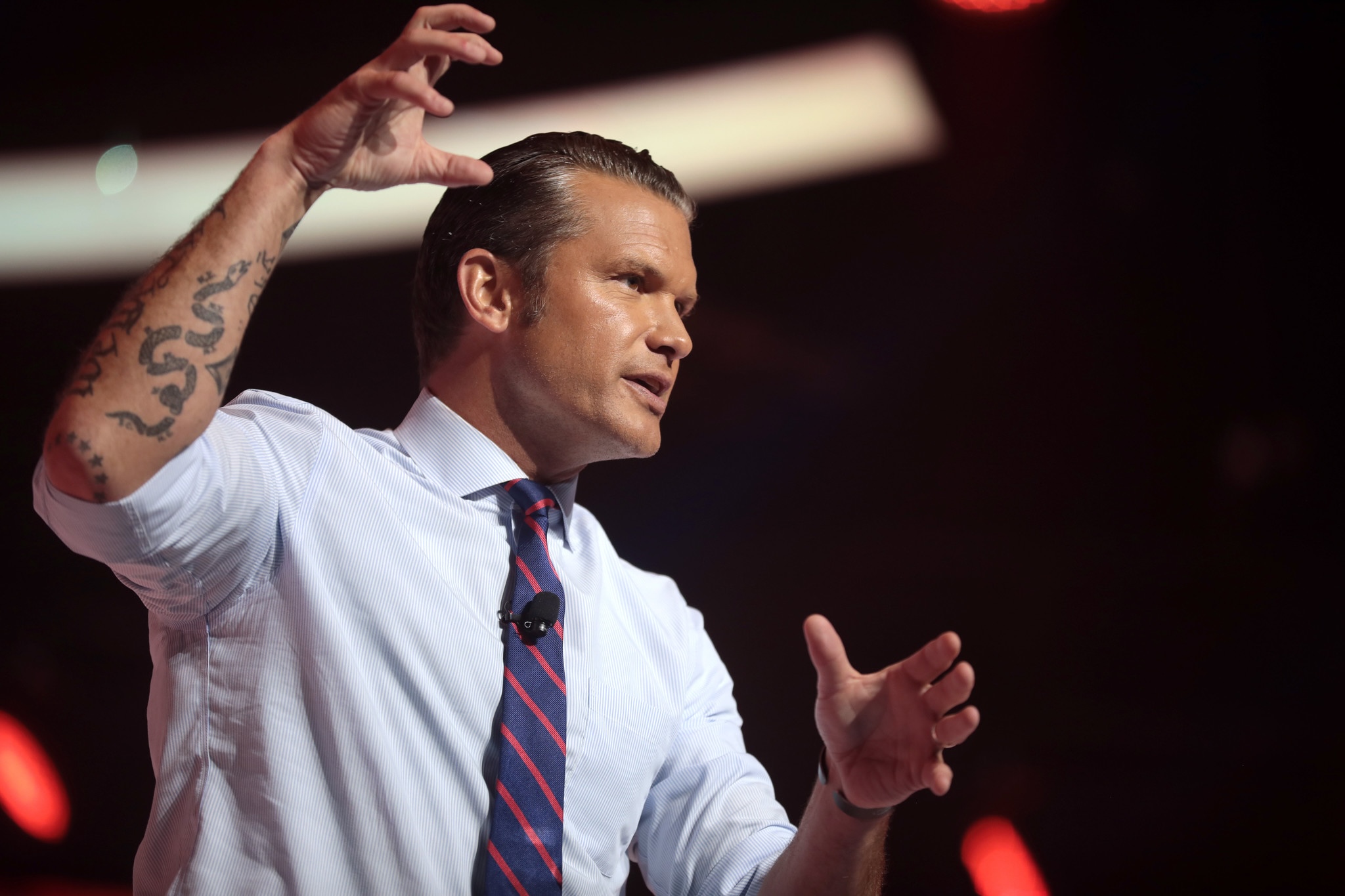
It was during one of these filming trips that he first encountered the Jerusalem cross, a symbol historically associated with the medieval Crusades. He had the cross tattooed on his chest, saying he wanted “to show that my religion is front and center in my life.” Today, his body art is a public manifesto for his worldview: it also includes an American flag, an assault rifle, the phrase “Deus Vult” (Latin for “God wills it”), a Crusader motto that has been widely adopted by white supremacists and was prominently displayed at the violent 2017 white nationalist rally in Charlottesville, Virginia. He also has the word “kafir” — Arabic for “infidel” — tattooed on his right bicep.
By 2016, Hegseth had framed U.S. national security as inextricably linked to Israel’s security, calling the Obama administration’s historic Iran Nuclear Deal a cowardly betrayal that would allow Iran to destroy both nations. During a 2016 speech in Jerusalem, he pledged that the U.S. would forever “lock arms and shields with all of you in defense of freedom and western civilization.”
### Driving the Current Iran Conflict
It is this long personal and ideological history that goes a long way toward explaining the current U.S. war with Iran. As the effective top leader of the Pentagon under the second Trump administration, Hegseth is a man driven by a deep personal need to erase the humiliation of the failed post-9/11 wars he served in, which he has framed as a personal emasculation.
Experts and former administration officials say this makes his push for war a deeply personal, ideological project, not a response to any actual imminent threat to U.S. national security. Multiple former Trump administration officials have publicly rejected the push for war, most notably Joe Kent, a former counterterrorism official who resigned his post, explicitly citing that “no imminent threat to our nation” comes from Iran. Even former Director of National Intelligence Tulsi Gabbard and former CIA Director John Ratcliffe have tacitly acknowledged that the war was not launched in response to a concrete, verifiable threat from Iran.
Today, Hegseth has abandoned any pretense of caution or compassion. As he recently told reporters: “We are punching them while they’re down, which is exactly how it should be.”
In practice, that has translated to a brutal joint bombing campaign with Israel that has hit civilian targets including a girls’ primary school, killing multiple children, and attacked commercial oil tankers in the Strait of Hormuz, causing massive oil spills that have poisoned regional marine ecosystems. Hegseth has also publicly pledged not to offer quarter to enemy combatants, a direct violation of the Geneva Conventions and international humanitarian law.
Hegseth has explicitly injected religious ideology into the U.S. military’s ranks, echoing Israel’s framing of conflict in religious terms. He recently told CBS News: “the providence of our almighty God is there protecting those troops, and we’re committed to this mission.” When asked if he sees the conflict as a religious war, he responded: “Obviously, we’re fighting religious fanatics who seek a nuclear capability in order for some religious Armageddon.”
He has hosted public prayer services at the Pentagon featuring hardline Christian nationalist pastors and prominent Christian contemporary musicians, and official Defense Department promotional videos have featured Bible verses superimposed over combat footage. Military watchdogs have also claimed that senior U.S. commanders have told troops that the war fulfills biblical prophecies about the end times. In recent weeks, a poster featuring Jesus Christ firing a mortar round has been spotted displayed at a U.S. military base in the Middle East, encapsulating Hegseth’s fusion of Christianity, violence, and masculine power.
In his 2024 book *The War on Warriors*, Hegseth laid out his full vision for remaking the U.S. military in his image, arguing that the force has been “warped and woke” by efforts to expand gender integration, diluting standards to allow women into combat roles while punishing “good soldiers” for misogynistic or offensive tattoos. In Hegseth’s own words, women belong on the front lines only as ink on a man’s bicep.
This article is republished with permission from TomDispatch, written by investigative journalist Jasper Craven, author of *God Forgives, Brothers Don’t: The Long March of Military Education and the Making of American Manhood*, and a fellow at the Veterans Healthcare Policy Institute.