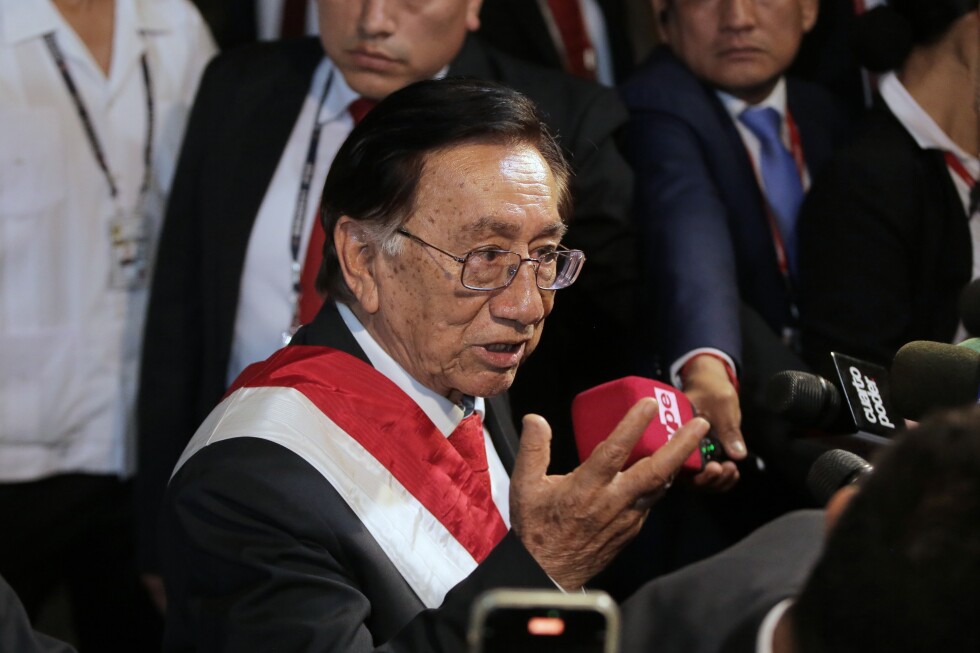
Political turbulence has erupted in Peru this week, as the nation’s defense and foreign ministers stepped down from their posts Wednesday following interim President José María Balcázar’s decision to push a $3.5 billion U.S.-built F-16 fighter jet purchase decision to the next elected administration. The abrupt resignations have thrown a fresh spotlight on Peru’s ongoing political instability and its delicate diplomatic and defense ties with Washington.
Balcázar, who was sworn in as Peru’s eighth president in just 10 years after his predecessor was ousted over corruption allegations just four months into office, announced last week that he would forgo finalizing the purchase of 24 Lockheed Martin F-16 jets. He argued that as a temporary transitional leader, he lacked the democratic mandate to commit the country to such a massive long-term financial obligation. “For us to commit such a large sum of money to the incoming government would be a poor practice for a transitional government,” Balcázer stated at the time.
The U.S. ambassador to Peru, Bernie Navarro, quickly issued a sharp public warning on social media platform X after the announcement. Navarro threatened unspecified measures against Peru if the country was found to be “negotiating in bad faith” or acted to undermine U.S. interests, though he offered no additional details on what actions he might pursue.
Just days after the interim president’s announcement, Defense Minister Carlos Díaz and Foreign Minister Hugo de Zela resigned. Speaking at a joint press conference Wednesday, the pair confirmed they had made multiple unsuccessful attempts to convince Balcázar to move forward with the deal as planned. Díaz’s resignation letter, obtained by the Associated Press, warned that postponing the procurement could cause serious harm to Peru’s long-term national defense interests.
In a revealing twist, Díaz disclosed that senior Defense Ministry officials had already formally signed the purchase contract on Monday, in line with the agreed timeline of the procurement process, even without Balcázar’s formal approval. De Zela, speaking to a local Peruvian radio outlet, accused Balcázar of misleading the Peruvian public about the status of the contract. Both officials have confirmed that core details of the deal remain classified and cannot be released publicly, a standard procedure for major defense procurement agreements.
The $3.5 billion procurement plan was first launched under the administration of former President Dina Boluarte in 2024. The procurement program outlines that Peru will cover the cost through $2 billion in domestic borrowing in 2025, followed by an additional $1.5 billion in 2026. Three major global defense firms submitted bids for the contract: U.S. defense giant Lockheed Martin with its F-16 platform, Sweden’s Saab, and France’s Dassault Aviation.
Peru is currently in a period of political transition ahead of a presidential runoff election scheduled for June 7. The first round of voting was held on April 12, and election officials are still processing ballots from remote Andean regions and overseas Peruvian consulates. The political upheaval over the fighter jet deal is the latest in a decade-long streak of leadership instability that has shaken the South American nation, with Balcázar becoming the eighth person to hold the presidency since 2014.
This development comes as unrelated political friction has already roiled Peru’s election process: the nation’s top election official resigned earlier this year over widespread logistical failures in the hotly contested presidential race, and a Peruvian court has set a May 15 deadline for officials to complete the full counting of first-round ballots.