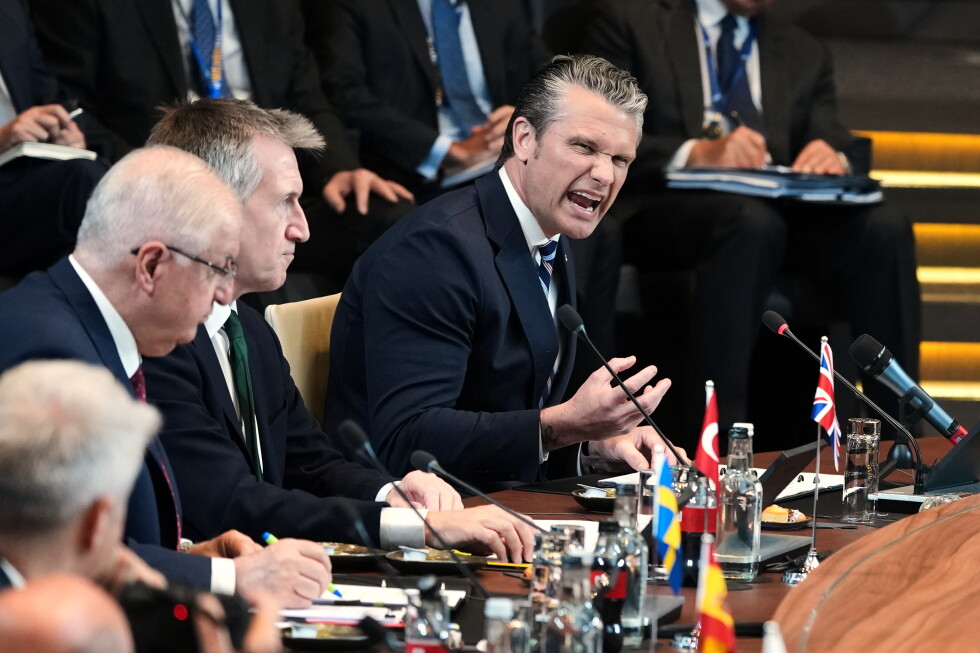
BRUSSELS – Just hours after U.S. Defense Secretary Pete Hegseth delivered a scathing rebuke of NATO’s European members and unveiled a Pentagon-led performance review of the alliance, regional leaders were deep in discussions mapping out ongoing advances toward their core security goals at a recent Brussels summit.
Analysts and alliance insiders note that Hegseth’s criticism centered on long-acknowledged priorities that European leaders have been advancing since Russia’s full-scale 2022 invasion of Ukraine. The agreed-upon agenda items already guiding European defense planning include sustained increases in defense spending, industrial investments to ramp up military hardware production, integration of battlefield lessons from the Ukraine war, and accelerated acquisition or domestic development of drones, air defense systems and long-range strike weapons.
During the two-day summit concluding Friday, leaders also debated strategies to maximize joint European Union funding for defense, streamline bureaucratic red tape to speed up military procurement, enhance cross-border “military mobility” for faster troop and equipment deployment, and upgrade critical port and airport infrastructure across the continent. Participants reaffirmed their binding target of decisively strengthening European defense readiness by 2030, a goal that predates Hegseth’s latest intervention.
Intelligence assessments across Western capitals have long warned that Russian President Vladimir Putin could launch offensive military action against other European states before 2030, particularly if his forces achieve a decisive victory in Ukraine. European governments have already documented multiple instances of Russian sabotage and disinformation campaigns targeting the continent, adding urgency to defense modernization efforts.
With roughly two-thirds of EU member states also holding NATO membership, the growing unpredictability of U.S. policy under the second Trump administration has pushed European leaders to accelerate independent defense integration efforts. Hegseth’s surprise announcement of the Pentagon review is just the latest in a series of shifts that have altered transatlantic defense dynamics.
Hegseth, who rarely participates in regular NATO defense ministerial gatherings, departed Thursday’s ministerial meeting early, but his public comments have already left a lasting mark on alliance discussions. In his high-profile address to allies this week, following a major February 2025 speech, he labeled NATO a “paper tiger”, accused European members of “shameful” underperformance, and claimed too many allies failed a Trump administration test by refusing access to their European bases for U.S. strikes targeting Iran. He also criticized alliance focus on gender equity and climate action, and slammed European migration policies.
Following his broadside, Hegseth gave allies a six-month deadline to implement reforms ahead of the performance review, which will tie the continued forward deployment of U.S. troops in Europe and American defense investment in NATO to whether the U.S. deems allies are contributing their fair share. He also announced that U.S. contributions to NATO’s joint operating budget, which funds alliance headquarters and core facilities, will be reduced for members that do not accelerate defense spending.
“It is a protection racket framing that undermines NATO solidarity, erodes trust in U.S. commitment to the alliance, and ultimately harms U.S. own security interests,” explained Rachel Ellehuus, Director-General of the Royal United Services Institute and a former senior U.S. advisor to NATO. Ellehuus added that decisions on U.S. force positioning “should be driven by detailed threat assessments, operational requirements, and military planning – not used as a form of reward, punishment or revenge.” Such an approach, she noted, undermines allies already working to address defense gaps and signals to adversaries that U.S. security commitments come with conditional, negotiable terms.
Notably, the full scope and specific terms of Hegseth’s review remain undisclosed. Hegseth framed the review as a mechanism to push NATO toward an irreversible shift to European-led primary responsibility for the continent’s defense, saying “Some countries will fail and others will pass with flying colors.” The review is expected to take up to six months, with participation from U.S. military commanders, members of Congress and allied representatives. Speaking to reporters at Brussels Airport before departing, Hegseth added that the review will also evaluate U.S. basing arrangements across Europe to ensure Washington has guaranteed access and overflight rights when needed for its military operations.
NATO Secretary-General Mark Rutte acknowledged that alliance leadership has no clear insight into the review’s expected outcomes, telling reporters “There’s still no clarity on exactly what the outcome will be, because that will depend on the review. So, we’ll see what happens. Wherever we can be helpful, we will be helpful.” Rutte is scheduled to travel to Washington next week for further discussions, where he expects to gain more clarity on the U.S. plan.
Rutte pushed back on the harshest of Hegseth’s criticism, noting that European allies and Canada have already made substantial progress on defense spending. “What we are seeing is staggering amounts of money coming in,” he said, adding that “Europe and Canada are spending in 2025 more than $90 billion extra compared to 2024, which is almost a 20% increase in defense spending.” Rutte acknowledged that allies still need to convert this increased spending into operational military equipment, weapons and ammunition, but emphasized that progress is already well underway.
At the 2024 NATO summit, allies agreed to raise their defense budget targets to align with U.S. spending as a share of GDP, an outcome that left then-President Trump satisfied after the meeting. Even so, Hegseth’s new performance review has cast uncertainty over the upcoming NATO summit scheduled for July 7-8 in Turkey.
In recent months, senior European military officers have taken on more command roles within NATO’s command structure, and U.S. allies have taken lead responsibility for coordinating arms and funding transfers to Ukraine after the Trump administration drew back from its leading role in the campaign. Many European countries and Canada have also spent billions of dollars to purchase U.S.-made air defense systems that they have subsequently donated to Ukraine, which European leaders view as fighting an existential war for European security.
Many alliance analysts argue that European allies have already moved as quickly as possible to address defense gaps, with the only unmet demand from the Trump administration being full, unrestricted access to European airspace and bases for U.S. military operations in other regions such as the Middle East.