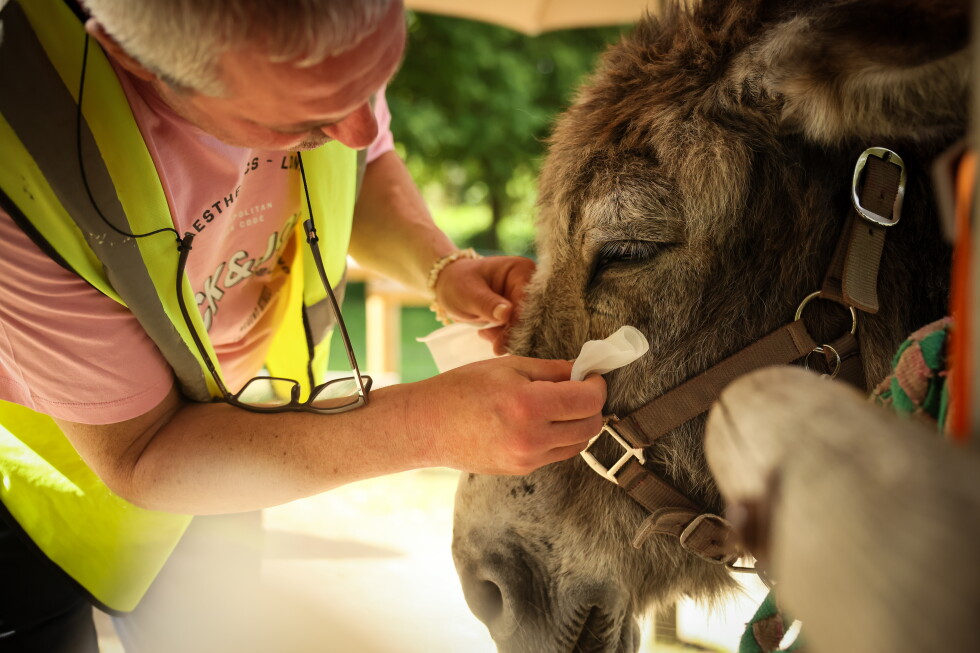
In the quiet, tree-lined grounds of Ville-Evrard hospital, just outside Paris in Neuilly-sur-Marne, a one-of-a-kind mental health treatment program is changing patients’ lives through an unlikely partner: calm, gentle therapy donkeys. Housed in restored 19th-century farm buildings, this specialized unit blends the restorative power of nature with the intuitive emotional intelligence of animals to offer a complementary form of care that stands alone in France today.
On a recent Friday session, patients walked the site’s wooded paths alongside the program’s five donkeys — Nono, Pitou, Oscar, Manolo and Malraux — learning to groom the animals, clean their hooves, and build quiet, trusting bonds. Many participants left the session with soft hugs for their donkeys, visibly relaxed after hours of interaction away from traditional hospital treatment routines. For 60-year-old patient Nathalie, the impact of the sessions matches that of her anxiety-relieving medication. “I’d call it animal medicine,” she explained, speaking under a first-name-only agreement to protect her privacy. “It brings relief. You stop thinking about everything else.”
The program, which is fully covered by France’s public health system, is offered to patients at no extra cost as part of their personalized treatment plans. Nurse Audrey Seffar, who works on the unit, highlighted Nathalie’s remarkable progress over just a handful of sessions. When she first joined, Nathalie, who experiences physical difficulties, would not leave the mobility cart provided for her. But with gentle encouragement from staff and the quiet presence of her paired donkey, she gradually gained the confidence to stand and walk alongside the animal. “The animal serves as a mediator,” Seffar explained. “It’s such an extraordinary one that today she was able to leave the cart and stand beside her donkey.”
For 52-year-old patient Jérôme, the program has cut through the deep loneliness that often accompanies chronic mental illness. “Talking with people, taking part in activities I wouldn’t normally do, it helps me in my daily life,” he said. “It helps you break away from the routine of treatment and medication. Staying at home isn’t good for me.”
The groundbreaking initiative first launched in 2016, spearheaded by psychiatric nurse Ermelinda Hadey and her husband François Hadey. Ermelinda had long advocated for the value of animal-assisted therapy, and identified donkeys — known for their naturally calm, social demeanor — as ideal candidates for the work. François trained the animals specifically for therapy interactions, and many of the donkeys themselves were adopted from animal shelters after surviving neglect or mistreatment, creating an unspoken shared understanding with patients navigating trauma.
François Hadey notes that donkeys’ unique temperament makes them perfect for this work: “A donkey is very intelligent. It understands things very quickly, but you have to explain slowly. Donkeys are calm, serene animals that are generally close to people. Once they’re involved in these interactions, they connect very well with patients. They’re emotional sponges.”
In 2022, the program earned official status as a dedicated health care unit within the hospital, enabling it to hire three full-time nursing staff, with additional support from volunteers with a local nonprofit that helps care for the animals. It has since expanded beyond donkeys to add a range of other small animals, including guinea pigs, chickens, doves, goats, turtles and rabbits. Sessions are tailored to each patient’s ability and needs, with smaller animals able to be brought directly to the rooms of patients who cannot leave their beds.
Eighteen-year-old nursing student Alicia Fabi, who regularly participates in the sessions, says the program offers patients a much-needed break from the structured hospital environment. “Every time we come back from the activity, they say they feel good, calm and relaxed, and that they enjoyed the outing. That’s really positive,” she explained. Walking and working alongside the animals also allows care teams to build deeper, more trusting relationships with patients outside of clinical conversations. “We talk about many different things, their illness, their lives and just about everything else. We don’t focus only on the illness because we don’t want them dwelling on it all the time,” Fabi added.
The program is designed to treat a wide range of mental health conditions, including anxiety, depression, autism spectrum disorder, schizophrenia, and other mood and personality disorders. Care teams report consistent improvements in patients’ emotional regulation, communication skills, social interaction, and self-esteem. Even small daily tasks with the animals double as therapeutic work: when patients help feed and groom the donkeys, those habits translate to improvements in their own self-care, Ermelinda Hadey explained. “Everything we do with the animals allows us to work with the patient,” she said. “We work on feeding the animal, which helps us address the patient’s own eating habits. We work on the animal’s hygiene, and by mirror effect, we work on the patient’s hygiene as well.”
Many participants take intensive prescription medications, including antipsychotics and sedatives, that can leave them feeling unmotivated to engage in activities. Hadey says the connection with the animals cuts through that fog, giving patients a reason to show up and participate. Crucially, the program does not replace traditional psychiatric care or medication, but acts as a complementary support to help patients regain confidence and a sense of self-worth.
Now, the team behind the program is pushing for formal recognition from the global psychiatric community, and is calling for targeted scientific research to document the long-term benefits of donkey-assisted therapy. While hundreds of patient anecdotes and daily observations from care staff confirm the program’s positive impact, formal clinical research is needed to cement its status as a evidence-based complementary treatment. “To do that, we need research. We have plenty of accounts from patients … Caregivers who accompany them see the benefits every day as well. But doctors have so many other responsibilities that they don’t necessarily witness it firsthand,” Hadey explained. For the staff that works on the unit every day, though, the proof is already clear: as one nurse put it at the end of Friday’s session, “Donkeys are my best colleagues.”