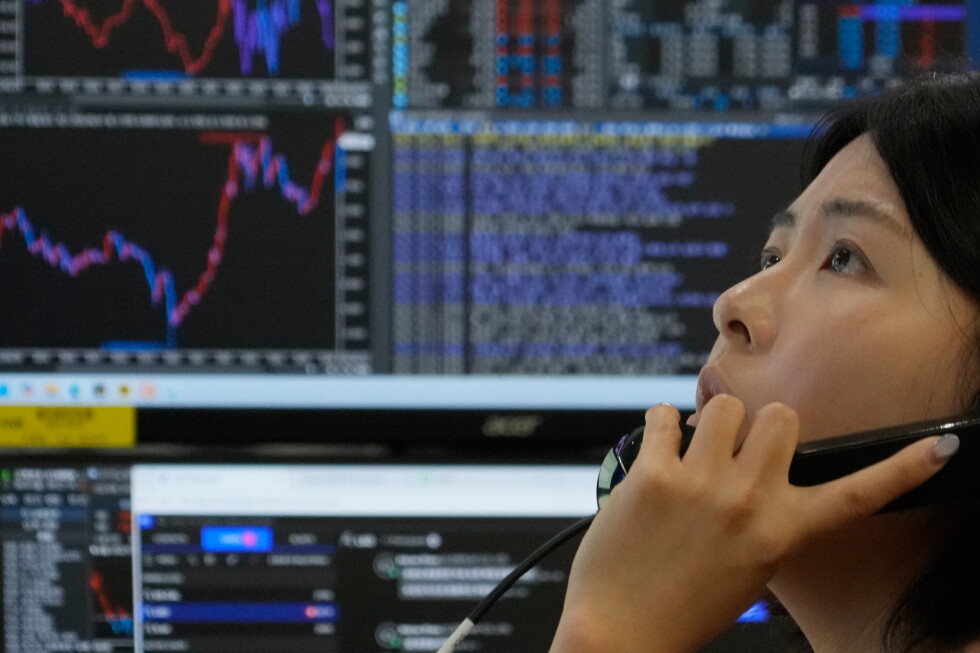
Global financial markets kicked off the trading week on a mixed note Monday, as a relentless surge in artificial intelligence demand drove benchmark indices in Japan and South Korea to unprecedented all-time highs, while volatility persisted in energy markets amid ongoing negotiations over an extended Iran war ceasefire.
The wave of investor optimism surrounding AI’s long-term growth trajectory lifted technology and semiconductor stocks across Asia, pushing two of the region’s most closely watched benchmarks into uncharted territory during intraday trading. Japan’s Nikkei 225 climbed more than 1.3% to close at 67,231.28, marking the first time the index has crossed the 67,000 threshold in its history. Leading the rally was SoftBank Group, the Japanese investment conglomerate that has built a massive portfolio of AI-focused assets, whose shares jumped more than 9% after notching a record high in the prior week. Over the past 30 days, the Nikkei 225 has rallied more than 12% as investor appetite for technology exposure continues to grow.
South Korea’s Kospi index matched its regional peer’s historic run, soaring nearly 5% to hit an all-time peak of 8,874.16. Market gains were anchored by Samsung Electronics, the country’s largest corporation and a leading global producer of advanced semiconductors, whose shares rose more than 9%. The stellar performance came as newly released official data showed South Korean exports surged 53% year-over-year in May, powered entirely by booming global demand for memory chips critical to powering AI systems. Over the past month alone, the Kospi has jumped more than 27%, cementing its status as one of the world’s best-performing major indices this year.
Most other Asian markets also posted modest gains on Monday. Hong Kong’s Hang Seng Index climbed 0.9% to 25,408.96, while Taiwan’s Taiex gained 1.4% and India’s Sensex added 0.6%. China’s Shanghai Composite edged down 0.1% to 4,063.72, and Australia’s S&P/ASX 200 slipped 0.1% to 8,720.30, after China released weekend data showing factory activity softened in May due to cooling demand for exports from key global markets.
Beyond the AI-driven stock rally, market movements remained tightly tied to geopolitical uncertainty stemming from the three-month-old Iran war, with investors closely awaiting a decision on a proposed 60-day extension of the current ceasefire. Negotiations between U.S. and Iranian officials remained ongoing Monday, with key sticking points including the reopening of the Strait of Hormuz — the strategic global waterway that carries roughly a fifth of the world’s daily oil and natural gas trade. The strait has remained largely closed since the war began, after the U.S. imposed a sea blockade on Iranian ports, and a final agreement remains unsettled: U.S. President Donald Trump held high-level talks with advisors last Friday but had not issued a final decision on the ceasefire extension, and Iranian officials have confirmed no deal has been finalized.
Geopolitical tensions pushed energy prices sharply higher on Monday. International benchmark Brent crude climbed 2.4% to $93.33 per barrel, up from roughly $70 per barrel in late February just before the war began. U.S. benchmark crude rose 2.8% to $89.76 per barrel. U.S. stock futures edged higher in pre-market trading, extending a record-breaking rally that lifted all three major Wall Street indices to new highs last Friday. The S&P 500 notched its seventh consecutive daily gain, climbing 0.2% to close at 7,580.06, while the Dow Jones Industrial Average rose 0.7% to 51,032.46 and the technology-heavy Nasdaq composite gained 0.2% to 26,972.62.
The U.S. rally was also powered by AI-linked technology names: Dell Technologies surged 32.8% after posting stronger-than-expected quarterly results and raising its full-year outlook on the back of booming AI demand, while Microsoft added more than 5.4% and chipmaker Broadcom gained 4.7%.
In currency markets, the U.S. dollar appreciated slightly against the Japanese yen, rising to 159.48 yen from 159.25 yen in prior trading. The euro edged lower to $1.1645, down from $1.1667.
Market analysts note that while the AI boom has created a powerful, broad-based rally across global equity markets, ongoing geopolitical uncertainty around the Iran conflict continues to act as a headwind, keeping energy prices volatile and pushing investors toward safe-haven assets at intervals. Even so, sustained strong demand for AI-related semiconductors and services has offset much of that uncertainty, keeping stock indices on an upward trajectory through the first half of the year.