In an unprecedented decision that has sent shockwaves through Britain’s legal and activist communities, a British High Court judge has branded four Palestine Action protesters as terrorists and sentenced them to seven years in prison — an extraordinary move that comes even after a jury refused to convict the group on any terrorism-related charges.
The case stems from a August 2024 direct action protest at an Elbit Systems UK facility near Bristol, where the four activists — Leona Kamio, Samuel Corner, Fatema Rajwani, and Charlotte Head — were found guilty by jurors only of criminal damage linked to the raid. Two additional co-defendants, Jordan Devlin and Zoe Rogers, were cleared of all charges entirely. Elbit Systems UK is a local subsidiary of the Israeli arms manufacturing giant that produces drones and military weapons deployed by the Israeli military in its ongoing military campaign in Gaza.
Presiding Justice Jeremy Johnson formally added the controversial “terrorism connection” designation to the activists’ offenses during Friday’s sentencing hearing. The judge first flagged a potential terrorism link in a March 2025 preliminary ruling, arguing the protesters aimed to influence the Israeli government by disrupting arms supply chains. Crucially, this preliminary finding was never shared with the jury that ultimately convicted the group on non-terrorism charges.
This ruling marks the first time in United Kingdom legal history that the terrorism designation has been applied to non-violent direct action protesters who were never convicted of terrorism offenses or intentional harm to people. Johnson justified his decision in court, stating the designation was grounded in findings that the group caused “serious property damage”, intended to pressure both the UK and Israeli governments, and intimidated members of the public, while acting to advance a clear political and ideological cause.
A central point of contention in the sentencing phase has been the late submission of prosecution evidence used to quantify the damage from the raid. Prosecutors turned over a report from an independent forensic consultant just days before the hearing, which estimated total damage just over £1.2 million, covering harm to building infrastructure, IT systems, operational equipment and 40 separate military assets.
Chief defense counsel Rajiv Menon KC lambasted the timing of the submission, calling it a last-minute move that came 20 months after the protest, long after Elbit finalized its insurance claim in March 2025. Menon argued that the delayed filing gave the defense no meaningful opportunity to review or challenge the report, which he dismissed as full of hearsay and unsubstantiated opinion. He further noted that the report included damage claims for sections of the factory the four defendants never even entered during the protest.
Menon argued that relying on this unvetted evidence to increase the sentence and apply the terrorism designation would be a fundamental violation of the activists’ right to a fair trial. He criticized prosecutors for their inconsistent approach to evidence: “The Crown cannot have their cake and eat it. It can’t exclude evidence on the one hand and somehow bring it through the back door for sentencing.”
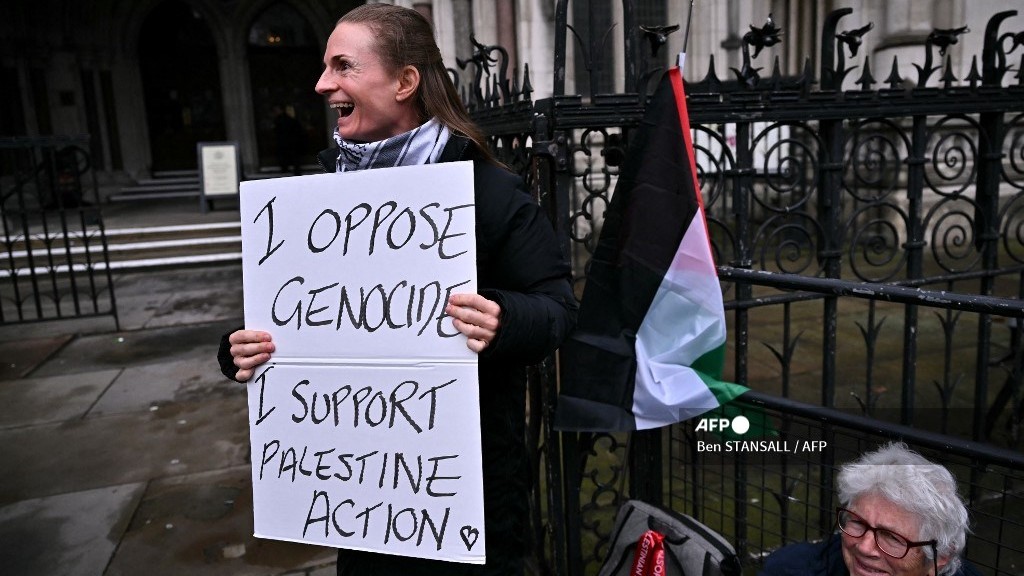
Outside the courtroom, the ruling sparked immediate mass protest: hundreds of demonstrators gathered to demonstrate support for the activists, and police reported that more than 100 people were arrested simply for displaying signs in solidarity with Palestine Action, which has been proscribed as a terrorist organization in the UK.