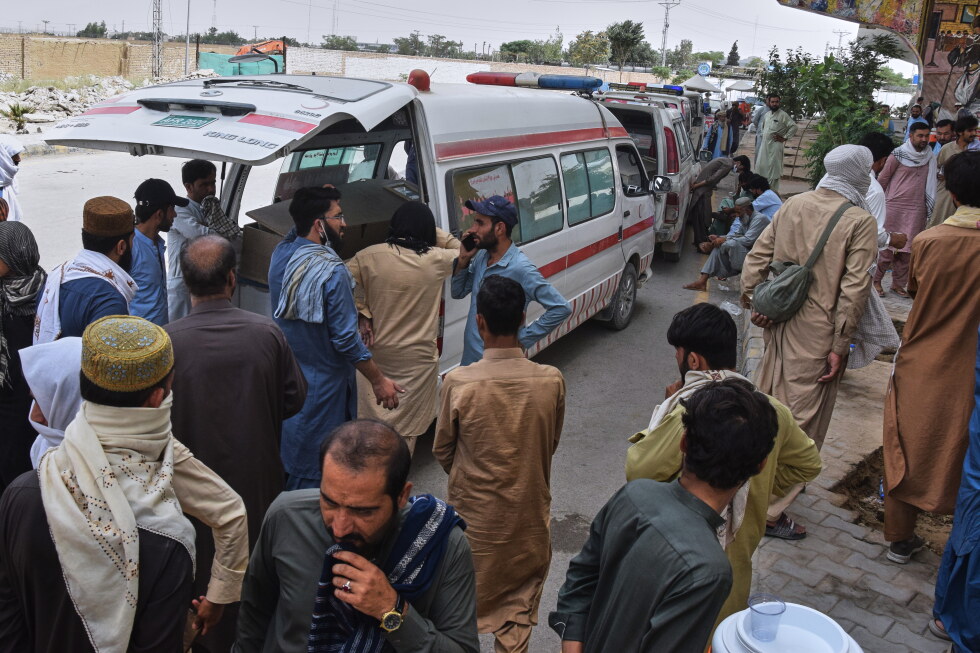
A wave of coordinated insurgent attacks that killed 42 people, most of them Pakistani security personnel, in southwestern Pakistan’s restive Balochistan province this week has sparked a fierce military response and a firm pledge from Prime Minister Shehbaz Sharif to crush militant activity across the country. During a high-stakes visit to Quetta, Balochistan’s provincial capital, on Thursday, Sharif met with grieving families of the victims, and convened an emergency security meeting alongside Pakistan’s army chief Field Marshal Asim Munir and Balochistan Chief Minister Sarfraz Bugti.
Since Monday, when the string of attacks began, the outlawed Baloch Liberation Army has claimed responsibility for the violence that has sent shockwaves across Pakistan. The deadliest incident unfolded in Balochistan’s Ziarat district, where insurgents stormed a police outpost. Nine officers were killed in the initial assault, and 18 more officers who were abducted during the attack were later executed by their captors. In response to the killings, dozens of relatives of slain police officers organized a public sit-in protest in Quetta, positioning the victims’ bodies in a public space to demand that authorities hold attackers accountable and deliver tangible justice.
Following the attacks, Pakistani security forces launched large-scale counter-insurgency operations, which have killed at least 54 suspected insurgents, according to official statements from the military and local Balochistan officials. This surge in violence has amplified growing concerns that small, once-marginalized separatist groups are expanding their operational capacity and reach across the resource-rich province.
In televised remarks from the security meeting, Sharif emphasized the government’s unwavering commitment to eradicating terrorism: “The war against terrorism will continue until the last terrorist in Pakistan is eliminated.” He also made pointed allegations against neighboring powers without naming them directly, claiming that Pakistan’s eastern neighbor India is supplying weapons, funding and other support to fuel the insurgency. He added that militants are using Afghan territory as a staging ground for attacks in both Balochistan and the northwestern province of Khyber Pakhtunkhwa, vowing that Pakistani forces would foil what he called the militants’ “nefarious designs.”
Neither the Indian government in New Delhi nor the Taliban-led government in Kabul issued an immediate response to Sharif’s allegations. Both countries have repeatedly rejected similar accusations in the past.
Balochistan, Pakistan’s largest province by geographic area but its least densely populated, has faced decades of separatist unrest and militant activity. In addition to separatist groups like the Baloch Liberation Army, the province also sees regular attacks from Tehrik-e-Taliban Pakistan (TTP), a Pakistani Taliban faction that is allied with but separate from the Afghan Taliban. Analysts have noted that the TTP has grown significantly in strength and operational scope since the Afghan Taliban retook control of Afghanistan in 2021.