博客

  • UK’s Burnham to welcome Zelensky in first foreign leader visit

    UK’s Burnham to welcome Zelensky in first foreign leader visit

    Fresh off taking office as the United Kingdom’s prime minister, Andy Burnham will welcome Ukrainian President Volodymyr Zelensky to London on Monday — marking Burnham’s first in-person meeting with a foreign head of state since assuming the role, and a powerful opportunity to reaffirm London’s longstanding commitment to Kyiv amid its ongoing four-year war with Russia.

    The visit comes just 24 hours before Zelensky travels to Washington D.C. for high-stakes talks with U.S. President Donald Trump, as the Ukrainian leader ramps up international appeals for increased military support to counter intensified Russian drone and missile strikes. Currently, U.S.-led peace negotiations remain at an impasse, with Washington’s foreign policy focus partially diverted to the ongoing conflict in Iran.

    In a statement released late Sunday, Downing Street outlined the day’s itinerary: Burnham and Zelensky will tour a British naval base, where they will meet military personnel from both countries who have been involved in the UK’s program training Ukrainian service members for frontline combat. During the meeting, Burnham is set to reiterate the unbreakable alliance between the two nations, a promise he first made to Zelensky in a phone call just hours after he succeeded Keir Starmer as prime minister last month.

    “Britain stands with Ukraine, shoulder to shoulder, and our support remains unwavering,” Burnham said in the official statement, confirming his tenure began July 20. “Russia should be in no doubt of our resolve, and we will not back down until we achieve long-lasting and just peace for Ukraine.”

    Beyond diplomatic statements, London announced a tangible new contribution to Ukraine’s defense: it will share full intellectual property rights for a battle-tested electronic jamming system codenamed “Stone Cloak.” Roughly the size of a standard tablet computer and designed to be mounted on drones, the military-grade device disrupts Russian air defense systems’ ability to track and intercept Ukrainian drones mid-flight. Downing Street explained the technology emerged from the “rapid innovation” collaboration established under the 100-year bilateral partnership pact signed by the two countries in January last year. Thousands of the jammers have already been supplied to Kyiv, and after successful frontline testing, the system will be integrated into the next generation of the UK’s own deep-strike military capabilities, with potential for mass production in Ukraine to scale up distribution.

    “Stone Cloak is the best of homegrown British innovation and proven on the frontline, and it will be vital to protecting our security in both our countries,” Burnham added.

    The visit also paves the way for deeper defense industrial cooperation between the two nations. In an interview with UK broadcaster Sky News released Sunday, Zelensky outlined his goal to sign a landmark “drone deal” with Britain and establish a dedicated drone manufacturing facility on UK soil, opening a new chapter in bilateral defense ties.

    “We’re ready to share all our experience with the UK, and I hope that the UK will do the same, so we need to make this drone deal very strong,” Zelensky said. He openly acknowledged the critical gaps in Ukraine’s current defenses, admitting “we don’t have enough missiles to defend” against Russia’s latest wave of attacks using hypersonic ballistic missiles, which have stretched Ukraine’s air defense networks to breaking point. “(Moscow) can increase the production of ballistic missiles and that’s why we need air defence as quick as possible,” he added.

    During Monday’s meeting, the two leaders will also meet roughly 200 Ukrainian military personnel and sailors who have spent the past three weeks in the UK participating in maritime security and counter-mine training, designed to prepare Ukrainian forces for future operations in the Black Sea. To date, the UK has committed a total of £25 billion ($33 billion) in support to Ukraine since Russia launched its full-scale invasion more than four years ago, £16 billion of which is direct military assistance, according to Downing Street.

    Following his stop in London, Zelensky will travel to Washington on Tuesday for talks with President Trump, a White House official confirmed last week. He will also attend the funeral of longtime U.S. Senator Lindsey Graham, a prominent Ukraine supporter who died earlier this month. The relationship between Trump and Zelensky has been turbulent: it shifted from a public shouting match in the Oval Office in February 2025 to a gradual warming in recent months. At this month’s NATO summit, Trump told Zelensky the U.S. would allow Ukraine to produce U.S.-designed Patriot air defense systems, which are capable of intercepting ballistic missiles. Washington has also passed bipartisan legislation targeting nations that purchase Russian energy, opening the door for increased economic pressure on Moscow.

    Even with this recent progress, Zelensky recognized the challenge of competing for U.S. attention amid the ongoing Middle East conflict, which has already cost the U.S. $37.5 billion and raised concerns about depleting American weapons stockpiles. “I understand the United States is focusing on the Middle East,” Zelensky told Sky News. “I try to manage it now with some Europeans and with Americans and with some other countries. This, for me, it’s a big challenge, a big challenge for Ukraine.”


  • New AI tools let readers talk to books

    New AI tools let readers talk to books

    The landscape of reading is undergoing a dramatic transformation, as a new wave of artificial intelligence tools launches to turn passive reading into an interactive, conversational experience. The groundbreaking technology allows readers to ask detailed questions about the text they are engaging with, unlocking a new level of depth and accessibility that traditional reading formats have never offered.

    Ahmed Kamel, CEO of beta-stage AI platform Sinai.ai, describes the paradigm shift: readers now interact with a book as if it were a living, responsive object, a radical change from the static reading experience most people know. Under the model rolled out by most developers, users access an e-book or audiobook paired with a custom AI chatbot trained exclusively on the text of that specific work. If a reader becomes confused by a character’s hidden motives, struggles to contextualize a historical event referenced in the narrative, or wants to unpack a complex philosophical argument woven into the plot, they can get an immediate answer without pausing their reading to conduct separate outside research.

    The movement has gained traction across both startups and industry giants. French startup My Smart Book rolled out its own similar interactive tool in mid-April, joining early players like Sinai.ai in building chatbots that draw only on the content of the original book, excluding external information to keep responses grounded in the author’s work. Major publishing and tech players are not far behind: Amazon, the world’s largest book retailer, has already rolled out AI interactive features across its two core reading platforms. Audible, Amazon’s leading audiobook subsidiary, launched its “Ask a Question” feature in late 2023, allowing listeners to ask questions mid-narration, get an immediate answer, and jump right back to their place in the story.

    An Audible spokesperson shared with Agence France-Presse that the company sees the technology as a major opportunity to elevate the reader experience, noting that the tool is purpose-built to address only questions about the specific audiobook a user is currently engaging with. Beyond improving experience for existing readers, Amazon believes the feature can expand the audience for books by making the medium more approachable and engaging for casual readers who may have previously struggled with complex works. Amazon’s Kindle e-reader platform has followed suit with “Ask this Book,” marketed as an “expert reading assistant” that answers questions about plot, characters, and context without interrupting a reader’s flow.

    Rising AI voice technology firm ElevenLabs has also entered the space with ElevenReader Voice Chat, a tool that positions itself as able to turn any book into a two-way conversational experience, breaking down the traditional barrier between author and reader.

    Despite the widespread excitement around this innovation, the emerging industry faces a major, unresolved thorn: copyright and compensation for authors and publishers. Different platforms have taken vastly different approaches to licensing and payment, creating a divide between compliant operators and those that operate in a legal gray area.

    Sinai.ai, for example, only hosts works that are either in the public domain or cleared for use through formal agreements with authors, their estates, or publishing houses. The company has even built a compensation framework it calls “AI rights”, which automatically pays rights holders when their work is accessed through the platform’s AI chatbot. Kamel told AFP that the startup is in active negotiations with four of the five major U.S. publishing houses – commonly called the “Big Five”: Hachette, Penguin Random House, Simon & Schuster, HarperCollins, and Macmillan – and has already signed deals with multiple major U.S. publishers and prominent publishing houses in the Middle East. Kamel added that the technology could even drive renewed interest in classic works, giving readers a reason to re-engage with old favorites by exploring layers of the text they previously missed.

    Other operators have taken alternative approaches to avoid copyright conflict. Founder Brian Yang of iChatbook explained that his platform does not host full texts of copyrighted books. Instead, the AI extracts core concepts, ideas, and facts from works, explaining them in simplified language that makes the tool particularly useful for students. By never directly quoting full text, iChatbook sidesteps many of the most pressing legal concerns around copyright infringement.

    However, not all platforms implement strict copyright screening. A number of popular tools, including Myreader, allow users to upload any book – copyrighted or not – to connect to their AI chat interface. Google’s widely used Gemini Notebook (formerly NotebookLM) does not screen for copyright status, nor does BookWorm AI, a ChatGPT-based tool marketed as a “book companion” for readers.

    None of the Big Five U.S. publishing houses responded to AFP’s requests for comment on their ongoing plans for AI interactive reading tools. The technology has already faced pushback from author advocacy groups. In December 2023, the Authors Guild issued a sharp rebuke of Amazon’s “Ask this Book” feature, arguing that the tool uses copyrighted content without permission, generates no additional revenue for rights holders, and does not offer authors or publishers the option to opt their works out of the feature. The group argued that the unlicensed use sets a dangerous precedent for the future of author compensation in the AI age.

  • Shein swings to $99m loss as Trump tariffs hit sales

    Shein swings to $99m loss as Trump tariffs hit sales

    Global fast-fashion giant Shein, which maintains its headquarters in Singapore after its founding in China, has reported an unexpected first-quarter net loss, citing new US trade policies, ongoing geopolitical uncertainty, and accounting adjustments as the primary headwinds dragging down its performance ahead of a planned Hong Kong stock market listing.

    In its regulatory filing ahead of the initial public offering (IPO), Shein confirmed it posted a net loss of $99 million in the first three months of 2026. This marks a sharp reversal from the $395 million net profit the company recorded in the same period one year earlier, as growth in global sales slowed significantly following a key change to US trade policy.

    The downturn traces directly to an executive order signed by former US President Donald Trump that took effect on August 29, 2025, eliminating the longstanding de minimis import exemption. For decades, this rule had allowed packages valued at $800 or less to enter the United States duty-free, a benefit that heavily benefited low-cost online retailers like Shein and rival platform Temu that cater to price-sensitive American consumers. The updated order expanded a prior restriction that only applied to low-cost goods from China and Hong Kong, eliminating the exemption for all countries globally. The Trump administration justified the move by claiming the exemption was being exploited to evade existing tariffs and smuggle deadly synthetic opioids into the country.

    “The removal of the US de minimis exemption has had an adverse impact on our sales in the US and the overall growth of our net revenues,” Shein stated in the filing. In response to rising import costs driven by the policy change, the company confirmed it is evaluating multiple mitigation strategies, including rolling out moderate price increases for its US market offerings to offset a portion of the additional expenses.

    Shein added that broader geopolitical uncertainty has also weighed on performance, noting that the ongoing Iran conflict has disrupted global supply chains, pushed up operational costs, dampened consumer demand, and caused delivery delays across several key regional markets. Uncertainty around the paused but unresolved tit-for-tat US-China trade war has also created additional planning challenges for the cross-border retailer, the company added.

    Roughly one-third of the reported quarterly loss stems from a non-cash paper adjustment tied to an accounting change for special investor shares, which can be converted into ordinary common stock ahead of or following the IPO. The $328 million accounting charge reflects a revaluation of these shares, whose value will remain flexible until the listing is completed.

    Despite the quarterly setback, the filing revealed bright spots in Shein’s long-term growth trajectory. In the 12-month period ending March 2026, the company counted 281 million active customers globally, representing a 16% year-over-year increase. These customers placed more than 1 billion orders over the period, underscoring sustained mass consumer demand for the brand’s affordable fast-fashion offerings.

    The earnings announcement comes as Shein finalizes preparations for its Hong Kong IPO, a path the company pursued after earlier attempts to launch public listings in New York and London fell through. On July 10, the China Securities Regulatory Commission (CSRC) granted formal approval for the Hong Kong share sale, with the listing expected to launch sometime in the coming months. The latest filing did not disclose key details including the expected IPO size, pricing range, or exact launch timetable.

    The policy pressure on Shein is not limited to the United States. Earlier in July, the European Union introduced a €3 levy on all low-value e-commerce imports entering the bloc, a measure explicitly designed to counter what EU regulators call unfair competition from Chinese low-cost online retailers. The new rule mirrors the US shift toward ending duty exemptions for small, low-value packages, creating a dual headwind for Shein in two of its largest developed markets.

  • British rapper Yung Filly to testify in Perth District Court rape trial

    British rapper Yung Filly to testify in Perth District Court rape trial

    A high-profile sexual assault trial of British rapper Yung Filly, real name Andres Felipe Valencia Barrientos, has entered its second week in Western Australia, with the 30-year-old influencer and performer set to take the witness stand after prosecutors wrapped up their case last week. The 30-year-old artist, who counts millions of followers across his social media platforms, has repeatedly pleaded not guilty to 10 criminal charges, including counts of sexual assault, common assault and choking. The allegations stem from an alleged incident involving a 20-year-old female fan during Yung Filly’s tour of Australia nearly two years ago.

    Opening arguments and witness testimony from the complainant during the first week of the trial at Perth District Court have painted a detailed picture of the encounter the woman says led to the violent, non-consensual assault. According to court records, the Perth local had traveled to Bar1 Nightclub, located in Perth’s northern suburbs, wearing what she called her lucky outfit, hoping to meet the rapper, whom she identified as her celebrity crush. Videos the woman recorded inside the venue, which were played for the court during testimony, captured her saying, “I am going to get married and have his baby,” “I got touched by Yung Filly in a good way,” and “I love Filly” before their interaction turned to what she says was abuse.

    The complainant told the court she encountered Yung Filly in the club’s VIP section, where he allegedly put his hands down her pants and told her, “You’re coming home with me tonight.” After she pushed his hand away and told him she was not interested in that kind of interaction, the rapper is accused of touching her breast. When she told him “You can’t do that,” he responded, “Really shows your age,” according to the woman’s testimony.

    Later that night, the woman told the court she agreed to join the rapper and his entourage in a van, believing they were heading to a scheduled after-party. It was only when the group arrived at Perth’s luxury InterContinental Hotel that she realized no event was planned, she said. Inside Yung Filly’s hotel room, the woman told the court the pair began consensual sexual activity, but the encounter quickly escalated into non-consensual violence. She alleged the rapper bit her, slapped her, and ultimately raped her. The bite injury was severe enough that the woman required a tetanus shot after the alleged incident, the court has heard, and she has testified that she feared Yung Filly would harm her again before she was able to escape the room.

    Yung Filly has denied all allegations against him, and his legal team has not yet presented their full defense, as the trial is still ongoing. Now that prosecution has closed its case, all eyes are on the upcoming week of proceedings, when the rapper is expected to give his own testimony under oath. The trial is scheduled to continue through the coming days as the court hears the full scope of evidence from both sides.

  • Macron calls crisis meeting as wildfires threaten Bordeaux and heatwave looms

    Macron calls crisis meeting as wildfires threaten Bordeaux and heatwave looms

    A fast-expanding wildfire that has already scorched tens of thousands of hectares of land is pushing toward the southwestern French city of Bordeaux, prompting President Emmanuel Macron to convene an emergency cabinet meeting on Monday to coordinate the national response to the growing crisis.

    As of Sunday, the active fire line sat just 15 kilometers (9 miles) from Bordeaux’s city limits, where more than 850,000 residents currently remain under no evacuation orders, according to mayor Thomas Cazenave. However, officials warn an incoming second heatwave threatens to derail containment efforts, with forecasts predicting temperatures will surge to 40°C across parts of the country starting Tuesday. France’s Interior Minister Laurent Nuñez described the ongoing situation as “very unfavourable”, noting the blaze is moving “erratically” in the direction of the city. Tens of thousands of residents in outlying areas surrounding Bordeaux have already been forced to evacuate their homes over the past week.

    The massive Gironde region fire has spawned an extremely rare and dangerous atmospheric phenomenon known as a pyrocumulonimbus – a fire-generated thunderstorm fueled by the blaze’s own intense winds and lightning, spokespeople for the National Firefighters Federation of France (FNSPF) confirmed. “We don’t know how the blaze will spread, the fire front is constantly shifting. We cannot fight it directly,” said FNSPF spokesman Eric Brocardi, framing the battle as a lopsided “David-versus-Goliath” scenario. Brocardi added that only two outcomes will bring the fire under control: three consecutive days of heavy rainfall, or deliberately steering the blaze toward a natural barrier like the ocean where it will burn itself out.

    To date, the Gironde fire has destroyed roughly 42,000 hectares of land, marking one of the largest wildfire events in France since the end of World War II. Across the entire country, more than 98,000 hectares have burned since the start of 2026, and over 220,000 people have been displaced from fire-risk zones in southwestern regions alone. Speaking on Saturday, President Macron reaffirmed the national government’s commitment to supporting affected communities, stating France would “rebuild” and that his administration would “be there for as long as is needed”.

    This crisis is not isolated to France. Over the past week, uncontrolled wildfires have swept across large swathes of Southern Europe, with neighboring Spain facing some of the most devastating conditions on record. Combined, more than 330,000 people have been evacuated across both countries.

    In eastern Spain, firefighters worked through Sunday to contain a newly ignited blaze near the coastal city of Valencia that has already forced roughly 15,000 residents to flee. Pilar Bernabe, the central government’s delegate to Valencia, called the fire “very intense” and warned that worsening weather conditions would amplify challenges in the coming days. Spanish Interior Minister Fernando Grande-Marlaska, who is scheduled to tour the affected Valencia region on Monday, reported the fire is advancing slowly, while Prime Minister Pedro Sanchez warned “difficult hours lie ahead” during a visit to a fire zone in Ávila province, west of Madrid. Sanchez has also called for a sweeping national agreement to address the underlying climate emergency driving extreme wildfire events. During a tour of an emergency shelter in Villamanta, southwest of the capital, King Felipe VI stated the blazes have caused “incalculable” damage to Spain’s unique natural heritage.

    The fire burning in the Ávila region is the largest wildfire in Spain’s recent history, according to Ecological Transition Minister Sara Aagesen. As of Sunday, Aagesen confirmed roughly 77,000 hectares of land across Spain have been burned by the ongoing outbreak, and more than 90,000 people have been evacuated from high-risk areas surrounding Madrid and Ávila.

    For many displaced residents, the crisis has brought sudden, devastating upheaval. Olga Congacha, a 50-year-old resident who fled her village of Robledo de Chavela west of Madrid on short notice, described overwhelming panic when evacuation orders came. “I didn’t know whether to cry or what. It was a moment when you feel awful,” she said. When Congacha returned to her home briefly on Sunday to retrieve critical medication, she found the village streets empty and her home covered in a thick layer of ash. While authorities confirmed that winds are currently pushing the blaze near Madrid southward, away from the capital, the fire has already forced additional evacuations of small villages in its path.

  • Bus billboards, blimp launched by Australian activists in Korea in Great Barrier Reef plea

    Bus billboards, blimp launched by Australian activists in Korea in Great Barrier Reef plea

    As the UNESCO World Heritage Committee convenes this week in Busan, South Korea, to deliberate on the long-term future of Australia’s Great Barrier Reef, environmental campaigners have launched a high-profile public campaign across the coastal city to pressure global and local fast-food chains over their links to deforestation that threatens the natural World Heritage site.

    Last week, UNESCO’s cultural branch upheld a draft ruling that opted against adding the 2,300-kilometer reef to the organization’s “in danger” list, a decision that Australian federal authorities framed as a validation of years of investment and policy reform to protect the ecosystem. Last year, the Australian government passed sweeping legislative changes that introduced federal oversight of land clearing in the reef’s river catchment areas and established the country’s first-ever National Environmental Protection Agency, capping off years of back-and-forth negotiations between Canberra and UNESCO.

    But environmental organizations have pushed back against claims of sufficient progress, arguing that the Australian government must speed up and expand conservation reforms, while also holding major food corporations accountable for their role in accelerating ecosystem decline. Campaigners argue that beef suppliers for major fast-food brands are directly tied to large-scale land clearing in the reef’s catchment zones, where deforestation for cattle grazing drives sediment pollution that damages fragile coral habitats.

    To amplify their message during the week-long committee meeting, campaigners from Australian and global environmental groups have blanketed Busan – a city of more than 3 million residents – with attention-grabbing advertisements, including subway signs, bus shelter billboards, and even a flying blimp. The most viral of these ads parodies McDonald’s iconic golden “M” logo and famous slogan “I’m lovin’ it”, reworking it to read “I’m killin’ it with Aussie Beef” alongside a graphic of bleached coral. The modified slogan, printed in both English and Korean, appears across all campaign materials deployed across the city.

    Kristin Urquiza, senior adviser for global environmental organization Mighty Earth, explained that the campaign targets McDonald’s alongside other major chains including Burger King and South Korea’s homegrown leading burger brand Lotteria, noting that 70% of McDonald’s locations worldwide – including those in South Korea – source Australian beef. South Korea is the third-largest market for Australian beef by value, trailing only the United States and China, with roughly one-third of all beef consumed in the country coming from Australian farms.

    “Land clearing for grazing is the single biggest driver of sediment pollution that harms the Great Barrier Reef, and companies buying beef from cleared reef catchments are part of that harmful supply chain,” Urquiza said. “Australia has never met its own domestic targets for cutting sediment pollution flowing onto the reef, so corporate action is critical to driving change.”

    Environmental experts confirm that deforestation in catchment areas that drain into the Great Barrier Reef releases large volumes of sediment into the marine ecosystem, which smothers coral and degrades critical inshore reef habitats. Data collected by the Australian Conservation Foundation shows that between 2018 and 2023, more than 856,700 hectares of forest and woodland were cleared in the reef’s catchment zones, 84% of which was cleared to make space for cattle grazing. The Burdekin and Fitzroy catchments alone – with the Fitzroy ranking as Australia’s second-largest sea-draining basin – dump more than 4.9 million tonnes of sediment into the reef’s waters every year.

    Nathaniel Pelle, deforestation expert at the Australian Conservation Foundation, added that while a majority of Australian cattle producers prioritize responsible land stewardship to protect threatened ecosystems, a small minority continue clearing native forests that undermines the collective effort to protect the reef. “Every burger, sausage and steak sold by major retailers and chains should come from Australian producers that have committed to zero deforestation,” Pelle said.

    McDonald’s has previously framed Australia as a high-priority market for its deforestation-free beef procurement policy, alongside other major beef producing nations including Brazil, Argentina, and Uruguay. In its official policy, the company states that it has collaborated with producer groups for years to “better understand and address the links and drivers between beef production, deforestation and conversion”.

    For its part, the Australian government has welcomed UNESCO’s recent decision not to list the reef as in danger, with Environment Minister Murray Watt saying the ruling recognizes “Australia’s strong collaboration and ongoing efforts to protect the reef”. “While challenges like climate change remain significant, today’s recognition demonstrates that Australia’s long-term investments, strong management and governance frameworks and collaborative approach are delivering tangible results,” Watt said. “We will continue to build on our comprehensive suite of actions, leverage strong partnerships, and utilise our world‑leading reef management to support the Great Barrier Reef’s resilience into the future.”

    Since 2014, the Australian federal government and the Queensland state government – which jointly manage the reef – have invested more than $5.3 billion in conservation initiatives. The Great Barrier Reef is one of Australia’s most important economic assets, supporting hundreds of thousands of jobs and contributing roughly $9 billion annually to the national economy. Alongside the Great Barrier Reef assessment, the World Heritage Committee is also set to discuss this week the Statement of Outstanding Universal Value for Australia’s recently inscribed Murujuga Cultural Landscape, a sacred Indigenous site in Western Australia home to tens of thousands of ancient rock engravings.

  • ‘Picking up their crap’: How horses helped Lachlan Galvin avoid outside noise as Bulldogs plot own sprint home

    ‘Picking up their crap’: How horses helped Lachlan Galvin avoid outside noise as Bulldogs plot own sprint home

    For rising NRL halfback Lachlan Galvin, the public criticism that followed his high-profile 2025 mid-season switch from Wests Tigers to Canterbury-Bankstown Bulldogs has been constant and often overwhelming. But the 21-year-old playmaker has opened up about an unexpected off-field passion that helps him block out the noise and stay focused on pushing his new side into the 2025 finals series.

    Controversy has followed Galvin since his departure from the Tigers, and internal chaos at the club has kept the conversation around his exit alive long after he left. Recent off-field turmoil at Wests Tigers, including five-eighth Jarome Luai’s 2026 move to Parramatta Eels and fullback Adam Doueihi’s refusal to take the field for a recent match, has kept the spotlight trained on Galvin. Many Tigers fans have refused to forgive the young halfback’s switch, and he was met with loud boos from the crowd when the two clubs faced off in Round 13.

    In his first extensive interview of the 2025 season, Galvin spoke about how he has learned to navigate the constant scrutiny. “There’s always going to be a bit of noise around this game, but I’ve learned to just block it out,” he said. “I love playing footy and I love being around my teammates, so nothing really changes how I approach the game. This is just part of rugby league, and I’ve accepted that.”

    What many fans do not see is the routine Galvin has built away from Belmore Oval to decompress: a love of horse racing that has him mucking out stables and caring for thoroughbreds at Warwick Farm, a world away from social media criticism and match-day pressure. Galvin is a part-owner of a racehorse fittingly named Exit Clause, and he regularly helps out at trainer Jason Coyle’s stable with hands-on tasks from feeding horses to mucking stalls and saddling up for track work.

    “That’s my escape,” Galvin explained. “It gets me completely away from footy, away from all the noise. It’s my own little bubble with Jason and a few of my family members, and that’s exactly what I need. When I get back to training after a few hours at the stables, I’m refreshed and ready to work hard.”

    While the young athlete has been able to compartmentalize the backlash, Galvin acknowledged that the constant criticism has been harder on his family. “Any parent is going to hate seeing people say negative things about their kid, but we have our getaway, and we step away from footy whenever we can,” he said. “They’re all incredibly supportive, they know who matters, and they don’t pay attention to all the outside noise.”

    Galvin’s escape to the stables has paid off on the field, as he has emerged as a key playmaker for the Bulldogs, who are now on the cusp of breaking into the top eight to qualify for the finals. The 21-year-old has formed a devastating right-edge combination with back-rower Jacob Preston, which produced another try in the Bulldogs’ recent clash against the New Zealand Warriors.

    “He’s a freak, honestly. He makes me look so good out there,” Galvin said of Preston. “I just run at the line, and he always spots the right gap to hit. He’s one of the best back-rowers I’ve ever played with. It’s such a confidence boost having him inside me on defense and outside me on attack — I couldn’t ask for a better partner.”

    Galvin also praised five-eighth Stephen Crichton, who turned out an exceptional performance just one day after welcoming his newborn child, as well as head coach Cameron Ciraldo for creating a supportive team environment that has helped him thrive through a turbulent 12 months. With the Bulldogs climbing the ladder and on track for a finals spot, Galvin said the team’s on-field success has made navigating off-field pressure far easier.

    “Winning fixes everything, right? I already have such an amazing support network around me, but when you’re winning and everyone’s smiling, it makes everything so much better,” he said. While Galvin’s horses did not claim a win on the racecourse last Saturday, he is already looking forward to the upcoming Spring Carnival, where he hopes to celebrate a win both on the turf and on the football field.

  • Watch: Scaffolding ripped from Hong Kong building as Typhoon Noul makes landfall

    Watch: Scaffolding ripped from Hong Kong building as Typhoon Noul makes landfall

    Dramatic footage has captured the moment massive scaffolding was torn violently from the side of a Hong Kong building as Typhoon Noul, the most powerful tropical cyclone to hit Chinese territory so far this year, makes landfall. According to Chinese state media reports, the storm has already brought destructive winds and severe weather conditions to southern coastal regions, with Hong Kong among the areas hardest hit by its advance. The video of the collapsing scaffolding, which has circulated widely across local and international media, underscores the raw destructive power of the typhoon as it moves across southern China. Local authorities have issued multiple weather warnings, urging residents to avoid unnecessary travel and secure loose outdoor structures that could become dangerous projectiles in high winds. As of the latest updates, emergency response teams have been deployed across the region to conduct rapid damage assessments and respond to any weather-related emergencies. Meteorological agencies are continuing to track the storm’s path, providing regular updates to help communities prepare for ongoing impacts from Noul’s landfall.

  • Whales at risk, hungry pelicans: Marine heat wave hits California

    Whales at risk, hungry pelicans: Marine heat wave hits California

    Along California’s sunbaked Pacific coastline, a quiet ecological crisis is unfolding beneath the waves, driven by an extended marine heat wave that has already begun reshape marine life patterns and threaten vulnerable species. As climate change amplifies extreme ocean warming and overlaps with a projected record-breaking El Niño event, scientists and conservationists are sounding the alarm over cascading harm to coastal ecosystems.

    Sara Lesser, a 39-year-old naturalist at Long Beach’s Aquarium of the Pacific, has witnessed the shift firsthand during daily whale-watching excursions. This summer, she told AFP, the playful pods of dolphins and pods of whales that once drew tourists to the waters are increasingly hard to find. Rising surface ocean temperatures have pushed the small schooling fish that cetaceans depend on — anchovies and sardines — to retreat to deeper, cooler waters or migrate much farther north than their typical ranges. With their food source gone, whales and dolphins have followed, leaving fewer sightings for onlookers and signaling a far larger disruption to the coastal food web. For Lesser, the drop in encounters is not just a disappointment for tourists; it is an early warning sign of more systemic damage underway.

    Data from the U.S. National Oceanic and Atmospheric Administration (NOAA) confirms the severity of the current warming event: surface water temperatures along California’s coast are currently 3 to 4 degrees Celsius above the long-term average, and the heat wave has persisted for roughly six months, according to NOAA research oceanographer Andrew Leasing. What makes this event particularly worrying is its overlap with a developing El Niño, the climate pattern that warms equatorial Pacific surface waters and alters global weather systems. Scientists project this El Niño could rank among the strongest ever recorded, potentially outpacing the destructive 2015–2016 event that devastated California’s marine ecosystems.

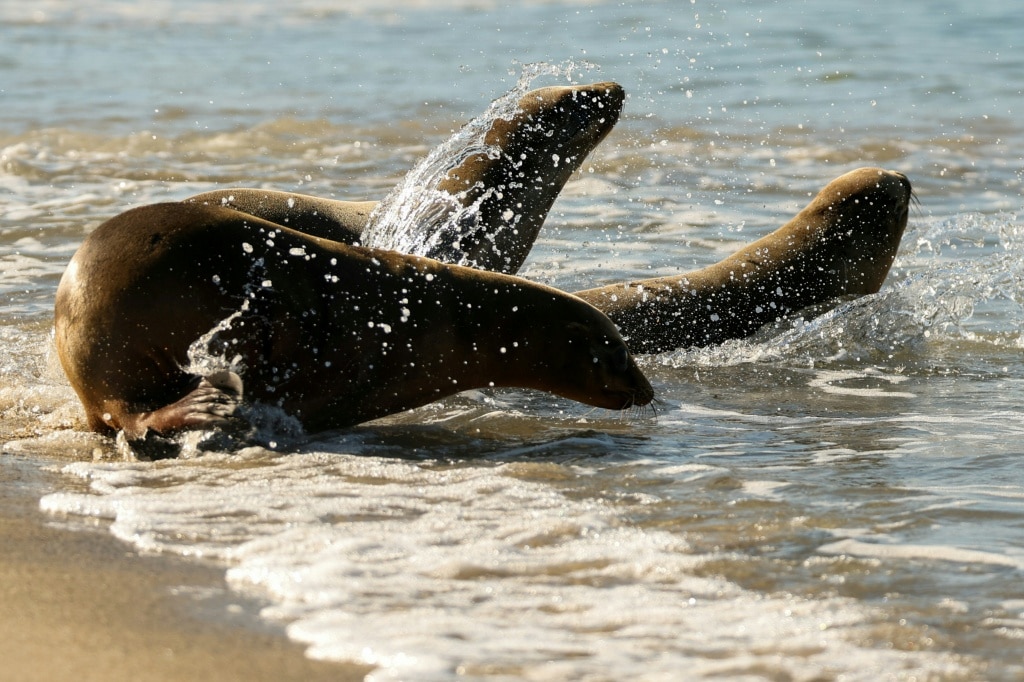
    That 2015 event, which followed an earlier marine heat wave that started in 2014, offers a grim preview of what may come. Thousands of seabirds starved when fish moved out of accessible surface waters, and the bodies of emaciated sea lions and whales washed up on public beaches. Today, early signs of the same collapse are already appearing. In recent months, dozens of dead pelicans and cormorants have been recovered near San Diego. One of California’s most iconic native species, sea lions, face growing risk: Leasing explained that warming waters force female sea lions to abandon their pups to travel farther for food, leaving young pups to starve. Additionally, higher ocean temperatures fuel the growth of toxic algal blooms that produce domoic acid, a neurotoxin that accumulates in anchovies and sardines, which then poison marine mammals that eat them. In early June, two juvenile humpback whales washed up dead on the shores of Monterey Bay from domoic acid poisoning — a mass poisoning event so large it has not been seen in a decade, according to Elliott Hazen, an adjunct professor of ecology and evolutionary biology at the University of California, Santa Cruz. “These are such large predators, it just highlights how much domoic acid there has to be in the ecosystem for it to affect them,” Hazen told AFP.

    The ecological shift is also bringing unexpected changes to human activity along the coast: warming near-shore waters have pushed juvenile great white sharks much closer to shore than is typical, as younger sharks prefer warmer temperatures. Recent months have brought multiple high-profile encounters: a Malibu resident filmed a great white swimming just meters from unsuspecting children playing in the surf, and Huntington Beach was forced to close swimming areas three times this spring after aggressive sharks were spotted close to shore, putting beachgoers on edge.

    Marine heat waves along California have become an annual event since 2019, and experts warn that these anomalous conditions will become the new norm if current warming trends continue. “We know that climate change is adding more fuel to the fire,” Hazen said. The long-term risk extends far beyond iconic marine mammals: repeated heat waves erode the ability of coastal ecosystems to sustain the fish populations that both wildlife and human communities rely on for food. “If we have these marine heat waves over and over again, and we lose the ability to sustain the ecosystem the way we have in the past, we’re going to lose some of the fish species that we rely on for food. So that’s the big concern,” he added.

  • Argentinian leader calls Brazilian president a ‘thief’ and a ‘convict’

    Argentinian leader calls Brazilian president a ‘thief’ and a ‘convict’

    A sharp diplomatic rift has erupted between Latin America’s two largest nations after Argentine President Javier Milei launched vitriolic personal attacks against Brazil’s sitting head of state during a right-wing political campaign event in São Paulo, prompting Brasilia to immediately pull its top envoy from Buenos Aires.

    Milei traveled to Brazil on Sunday to publicly support Flávio Bolsonaro, the right-wing presidential candidate vying for October’s national election and son of former Brazilian President Jair Bolsonaro. During the rally, Milei launched into a scathing verbal assault on Brazilian President Luiz Inácio Lula da Silva, labeling him a “thief” and a “convict” without explicitly naming the incumbent. He went on to frame Flávio Bolsonaro as the only candidate capable of blocking Lula from retaining power.

    The offensive remarks did not stop at Lula. Milei also targeted Brazilian Supreme Court Justice Alexandre de Moraes — the jurist who oversaw the 2024 conviction of former President Jair Bolsonaro for his role in plotting a coup to overturn his 2022 election loss to Lula, a plot that resulted in a more than 27-year prison sentence for the ex-leader. Milei called Moraes “bald trash”, a reference to a long-running personal dispute: Moraes previously blocked Milei from visiting the former president during his current house arrest in Brasilia.

    In response to Milei’s comments, Brazilian officials condemned the Argentine President’s words as a direct insult not just to the national government, but to the Brazilian people and the country’s democratic system. Lula pushed back against the intervention in a public address later that same day, emphasizing he would continue governing free from outside interference. “In Brazil, we do not accept anyone sticking their nose where it doesn’t belong,” Lula stated. Per reports from Agence France-Presse, Brazil’s Ambassador to Argentina Julio Bitelli was scheduled to depart Buenos Aires for Brasilia between Sunday and Monday as part of the diplomatic recall.

    The current confrontation is rooted in years of contested political history in Brazil. Lula was originally sentenced to 12 years in prison in 2018 amid a large-scale corruption and bribery investigation, but he was released after just over 18 months in custody. In 2021, Brazil’s Supreme Court overturned all of Lula’s convictions on procedural and judicial misconduct grounds. The following year, Lula mounted a political comeback, narrowly defeating the far-right incumbent Jair Bolsonaro in the 2022 presidential election with 50.9% of the national vote.