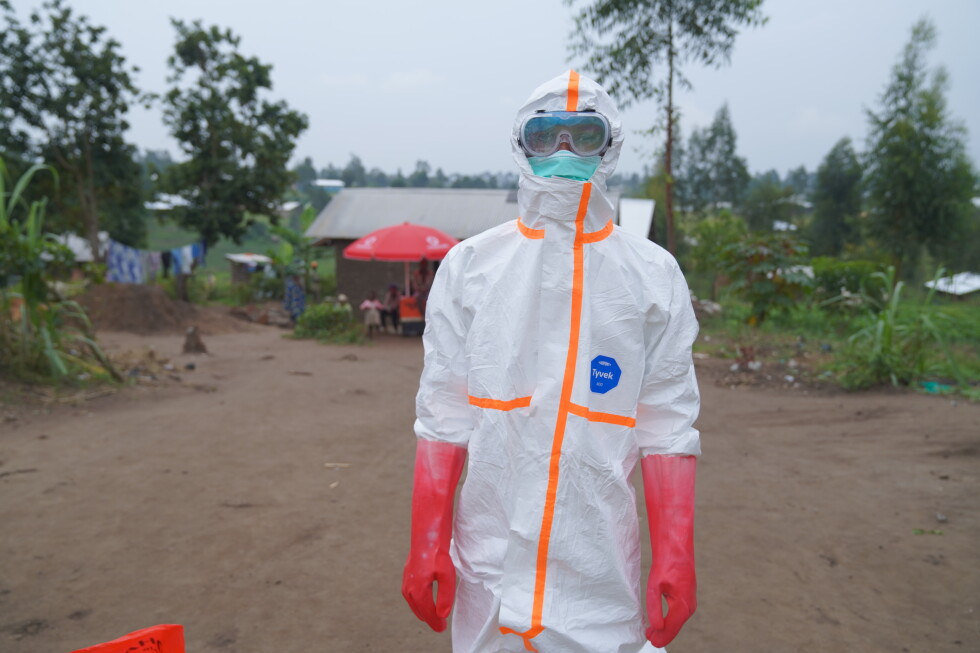
In the conflict-scarred, remote heart of eastern Democratic Republic of the Congo’s Ituri province, the epicenter of the country’s surging Ebola outbreak, 29-year-old infection control specialist Wiza Bondele reports for duty every day. His mission is unwavering: slow the spread of the fastest-growing Ebola outbreak ever recorded. But since the outbreak was declared in mid-May, he has worked without pay, joining hundreds of other frontline responders from burial teams to ambulance drivers who put their lives on the line every day with no financial compensation.
Bondele, a veteran of the 2018-2020 Congo Ebola response, volunteered to return to duty when the Bundibugyo strain of Ebola reemerged earlier this year. Ituri province accounts for nearly 90% of all confirmed cases in this current outbreak, and his years of experience on the frontlines made him a critical asset to the response. Today, his daily routine includes decontaminating high-risk treatment areas, screening visitors for fever, and enforcing mandatory handwashing protocols—work that brings him into regular contact with patients who are bleeding or vomiting, the bodily fluids that transmit the deadly virus. Even with this constant exposure, he and hundreds of fellow workers have yet to receive the $510 monthly salary they were promised when they signed on.
While authorities have promised to resolve backlogged payments via mobile money transfers, only a small fraction of workers have received any compensation, and even those who were paid have not received their full wages. For Bondele, who supports his wife, child, and extended family, the financial strain has reached a breaking point. On one recent morning, he ran out of fuel for his motorcycle while commuting to work. With no cash to refill the tank, he left the bike with neighbors and walked the remaining 8 miles to the hospital, arriving with his shoes completely worn through.
Latest government data puts this outbreak at more than 4,000 confirmed cases, with over 1,800 deaths recorded. This makes it the second-largest Ebola outbreak in recorded history, outpaced only by the 2014-2016 West Africa outbreak that killed more than 11,000 people, and deadlier than the 2018-2020 Congo outbreak that claimed at least 2,200 lives. Complicating the response further, the outbreak is caused by the Bundibugyo virus, for which no approved vaccines or targeted treatments currently exist.
In recent weeks, hundreds of unpaid workers including Bondele have joined strikes and protests to demand back pay, at times abandoning treatment facilities and leaving critical response gaps as the virus continues to spread faster than responders can track it. Workers warn that months of unpaid wages have crushed morale and directly undermined patient care, with one treatment center’s staff announcing they would remain on strike until concrete solutions to the pay crisis were implemented. Government Ebola response officials have acknowledged the issue, blaming logistical delays for the backlog and stating they expect to clear all outstanding payments soon after switching from cash to mobile money disbursements. But for Bondele, these promises have done little to ease his anxiety over his and his family’s future.
The pay crisis comes at a time when the Ebola response is already battling multiple overlapping challenges. Ituri province is gripped by ongoing armed conflict, and widespread misinformation has fueled deep public mistrust of health workers. Bondele says he has been threatened and even beaten while conducting community awareness outreach, as many residents reject basic prevention measures like regular handwashing. Restrictions on traditional burials, which require avoiding contact with highly contagious deceased patients, have stoked resentment, while persistent false rumors claim the outbreak is a hoax, that health workers are profiting from the crisis, or that hospitals withhold treatment from infected patients.
This misinformation has repeatedly turned violent: crowds have burned down treatment centers, stormed hospitals to retrieve the bodies of deceased relatives, and attacked teams conducting safe burials. Public mistrust has also made contact tracing—one of the most critical tools for stopping Ebola spread—far more difficult, especially in remote communities already destabilized by rebel violence.
Even with all these hardships, Bondele and hundreds of his colleagues continue to show up for work seven days a week, convinced their work is too important to abandon. “Working this job takes a lot of courage,” he said. “But today, I am discouraged.” He still holds out hope that authorities will follow through on their promises to pay workers what they are owed: “I hope their conscience tells them that I deserve to be paid.”
This reporting was supported by the Gates Foundation, with The Associated Press retaining full editorial control over all content. Banchereau contributed reporting from Dakar, Senegal.